The Cash-Out Refinance: Too Good to be True?
A strong monetization strategy that pushes risk into the future
A couple of weeks ago I introduced the concept of “monetizing” your investment once you have added value. As a reminder, “monetize” is a fancy way to say that you turn created value into actual cash.
Last week I described the process of selling your property.
Today I am going to walk you through another option: the cash-out refinance.
A cash-out refinance can be an effective and tax-free way to get a significant amount of cash out of your property, sometimes as much as if you were to sell your property.
Sound too good to be true?
Your instincts are correct…it is not that simple.
That’s why your friendly Professor Bateman is here to guide you through it. Today we will cover:
What a cash-out refinance is.
How lenders size the refinance amount.
Finding the right lender.
When you should consider a cash-out refinance.
Why you need to be careful.
Refinances are a critical tool you should consider.
Let’s dig in.
What a Cash-Out Refinance Is
Let’s start with defining a refinance. A refinance is: replacing your current loan with a new loan. That simple. The new loan could be more, less, or equal in amount (and interest rate) to the current loan.
A cash-out refinance is when the new loan amount is more than the current loan amount. Example: $160,000 new loan vs a $110,000 current loan = $50,000 more in debt.
You pay off the loan with the current lender and keep the difference ($50,000) as cash for yourself.
It is more complicated than that due to closing costs and lender fees, but that is the basic process you need to get started.
Here’s a personal example from one of my limited partner investments. I invested $50,000 in a value-add deal. The property did so well that we had a cash-out refinance of 90% of my investment in year three. Three years later, we had another cash-out refinance of 160% of my original equity for a total of 250%.
$125,000 cash-out refinances in six years without cash. No taxes. Pretty cool!
I will come back to this example later, but first we need some foundational knowledge.
How Lenders Size the Refinance Amount
A refinance follows the same basic process as I described in Debt: An Amazing Tool with Strings Attached. The key difference with a refinance is how the lender determines the loan amount.
Lenders have three main tools they use to determine how much debt they will give you in a refinance, including a cash-out refinance.
Loan to Value
Debt Service Coverage Ratio
Debt Yield
Let’s describe each one.
Loan to Value (LTV)
Calculation: new loan amount divided by the appraised value of the property.
Example: $160,000 new loan amount divided by $245,000 appraised value = 65%.
A licensed appraiser will be hired by the lender (and paid for by you) to come up with a market value of the property using a combination of approaches: sales comparisons, capitalization rate, and replacement costs.
The lender will have a maximum LTV they will go to. As long as the LTV is less than their maximum, they will be OK funding the new loan.
Debt Service Coverage Ratio (DSCR)
Calculation: net operating income (NOI) divided by interest costs for the new loan.
Example: $15,000 annual NOI divided by $8,800 annual interest costs = 1.70.
Many lenders use the DSCR as the main metric to size the loan amount. Lender DSCR requirements can vary significantly with different lenders. Some go as low as 1.00.
Pro Tip: make sure you understand how the lender will calculate the NOI, as it is often different from the actual NOI. For example, they may include an artificial vacancy factor that reduces the revenue. This will be detailed in the loan agreement. Make sure you understand this before you sign the loan agreement.
Debt Yield
Calculation: NOI divided by new loan amount.
Example: $15,000 divided by $160,000 new loan amount = 9.4%.
I like to think of this as the lender’s cap rate. If you default on the loan and the lender gets the property back, this is what their cap rate is (at least at the moment in time they made the loan).
LTV vs. DSCR vs Debt Yield
Some lenders favor one more than the other and most will use a couple in conjunction with each other. Just remember that the lender will use the one that gives the lowest loan amount. Said another way, the most conservative constraint wins.
Get to know your potential lenders and which tools they favor. Understanding this could help you get to the best lender for your property.
Finding the Right Lender
Not every lender will do a cash-out refinance. Some only focus on loans for acquisitions.
Some will look closely at the amount of original equity you would still have invested in the property after the cash-out refinance. If they see that you are pulling out 100%+ of your original equity, they may see you as more likely to walk away if things get tough — you’re playing with house money (zero equity in the deal).
Here’s how to find the best lender for you:
Get quotes from multiple lenders. You want to talk with at least 2-3 lenders to understand your options. It may be worthwhile to hire and pay a debt broker to help you with this. Their 1% of loan amount fee may pay for itself in the better loan terms you get.
Understand the lender’s process. What tools do they use: LTV, DSCR, debt yield? What internal approvals do they need? Have they done similar loans recently?
Think about what you want. Don’t just go with the highest loan amount. It may be better to get a bit less debt in exchange for a lower interest rate and/or more flexibility in how you operate the property.
Don’t rush it. Take the time to carefully evaluate your options.
Here’s an example of why focusing on a single piece of the loan does not tell the whole picture.
I was working on a cash-out refinance and we ended up with two lender options to replace our $3,000,000 loan for our property with $250,000 of NOI:
$4,000,000 new loan - 4.0% interest cost = $160,000 and 1.56 DSCR
$5,000,000 new loan - 4.5% interest cost = $225,000 and 1.11 DSCR
Option 2 would have resulted in an additional $1,000,000 of cash-out refinance proceeds, but $65,000 per year more in interest costs and a much lower DSCR.
There was no correct answer. We decided to take the more conservative route of option 1. We still had a win of a $1,000,000 cash-out refinance, but retained more future flexibility with a higher DSCR.
When You Should Consider a Cash-Out Refinance
Now that you understand the fundamentals and have seen some examples, let’s talk about when it makes sense to consider a cash-out refinance instead of selling your property. Here are key characteristics of each strategy:
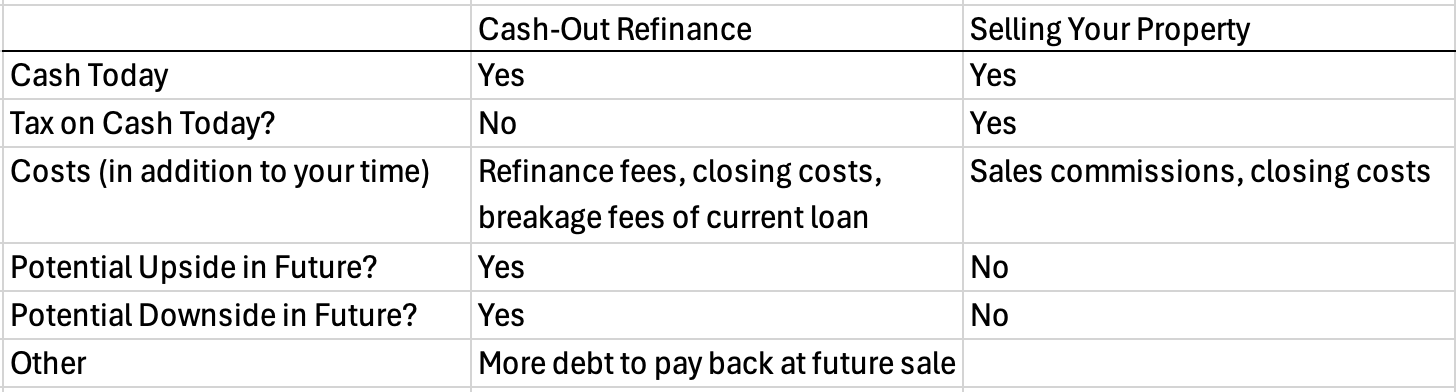
Table 1: Cash-Out Refinance vs. Selling Your Property
So how do you decide whether to do a cash-out refinance or sell?
As I have said in the past, it is all about understanding your investment goals.
A cash-out refinance is a great strategy if you want to continue owning the property longer term. You continue to believe in the long-term upside of your investment and want to benefit from its success.
Remember my cash-out example from the beginning? Had we sold the property we would have missed the strong performance that led to the second cash-out refinance.
Why You Need to Be Careful
I am a fan of cash-out refinances, but recognize they are not without risks and costs.
Here is what I recommend you keep in mind:
Refinance Costs: in addition to using your time, a cash-out refinance will include lender fees (example 1% of the new loan amount) and closing costs.
Current Loan Costs: be careful to review the terms of your current loan and talk with your current lender. Sometimes there are penalties for paying off your loan early, particularly if it is a fixed rate loan and interest costs have gone up. These can be huge.
More Debt = Less Cash Flow: if cash flow is your highest priority, you may be better off keeping your debt low.
A Sale is Final — A Refinance Keeps You in the Deal: Selling a property is your final move for that property. It doesn’t matter what the future holds. A cash-out refinance keeps you in the deal with an uncertain future that could be good or bad, all the while with more debt.
More Debt = More Risk: to state the obvious, a cash-out refinance means that you are adding more debt to your property. At some point, you are going to have to pay it back. Additionally, if things go wrong in the future you may have less cash flow cushion as your interest costs will be higher. Here’s an example of a cash-out refinance gone bad.
We bought a collection of office buildings in the mid-2000s and did a large cash-out refinance in 2007. Then the great financial crisis of 2008 hit. By 2009 we were struggling to make interest payments. The drastic slowdown of the economy almost forced us to default on the debt and give the property back to the lender. Had we had a smaller debt amount (and interest costs), we would have had much more flexibility.
Over my 20+ years of personally investing in real estate, I have benefited from 20+ cash-out refinances in the 60+ personal investments I have made. This compares to 30+ sales.
Cash-out refinances are a great tool. Just remember they are not without risk.
Knowledge is power.
Use it to make the right decisions for you.