Case Study 1: Where Discipline Meets a Little Luck
Investing $30,000 in an out-of-state duplex
Today we kick off a new series that will bring us from theory closer to reality.
Although I layer in many personal stories of investing into each newsletter, there is nothing like working through a single property example to bring it all together.
Let’s start by summarizing the main topics we have covered over the past 36 weeks.
Introduction to Real Estate
Investment Fundamentals
The Acquisition Process
Owning & Managing Real Estate
Executing Your Business Plan
Sales & Refinances
Today we move into our first case study.
In order to best convey the learnings, I have combined aspects of deals I have been a part of and information I have heard from other investors into individual case studies.
What this means is that the case study is “real” in that all the things I describe have happened on various investments, but they haven’t ALL happened on each of the case studies I write here.
This “fictionalization” is a trade-off worth having because many investments don’t have much going on for long periods of time. There wouldn’t be much to learn if the case study was effectively: You bought the property, painted the interior, and then sold it two years later.
Instead, I am going to concentrate the challenges, solutions, and key decisions into each case study, writing them as if you were the investor.
I will follow a consistent format for each case study over the next weeks:
The Target Niche
The Acquisition
The Operating Years
The Sale or Refinance
This is going to be fun.
Let’s dig in.
The Target Niche
You are an aspiring real estate investor living in Denver, CO. You have a good job with a medical device company. You have saved some money and can put $30,000 towards a real estate investment.
With 20% down, you can buy a $150,000 property ($30,000 equity + $120,000 loan = $150,000). Unfortunately, you can’t find any investment properties in this price range near Denver. Your friend has invested in Milwaukee, WI and says you can find a duplex in this price range. He also has a broker and property manager you can work with.
With this information, you define your niche:
Asset Class: duplex (1-4 unit residential)
Geography: Milwaukee, WI
Strategy: Light Rehab
Key Takeaways:
Don’t Reinvent the Wheel: learn from those who have “been there, done that”. Knowing (and trusting) someone who is already doing what you want to do is a huge plus.
Pick a Niche: without a niche, you will be looking at anything and everything.
The Acquisition
Now it is time to get to work. You have a call with the local broker and describe your niche. She starts sending you properties for sale. You also regularly check Zillow and other property listing sites. You take a long weekend to visit and tour Milwaukee with the broker.
Over the course of 60 days, you look at 20 properties for sale. You are starting to learn the market by following the key steps to finding your first deal.
In month three you see a property for sale that is a little better than the rest.
This is the one to pursue.
You have the broker write up an offer for you and, after a few rounds of negotiation, you come to an agreement on price and other deal terms with the seller. The property is 40 years old and 100% leased to two tenants. Here are the financial details:
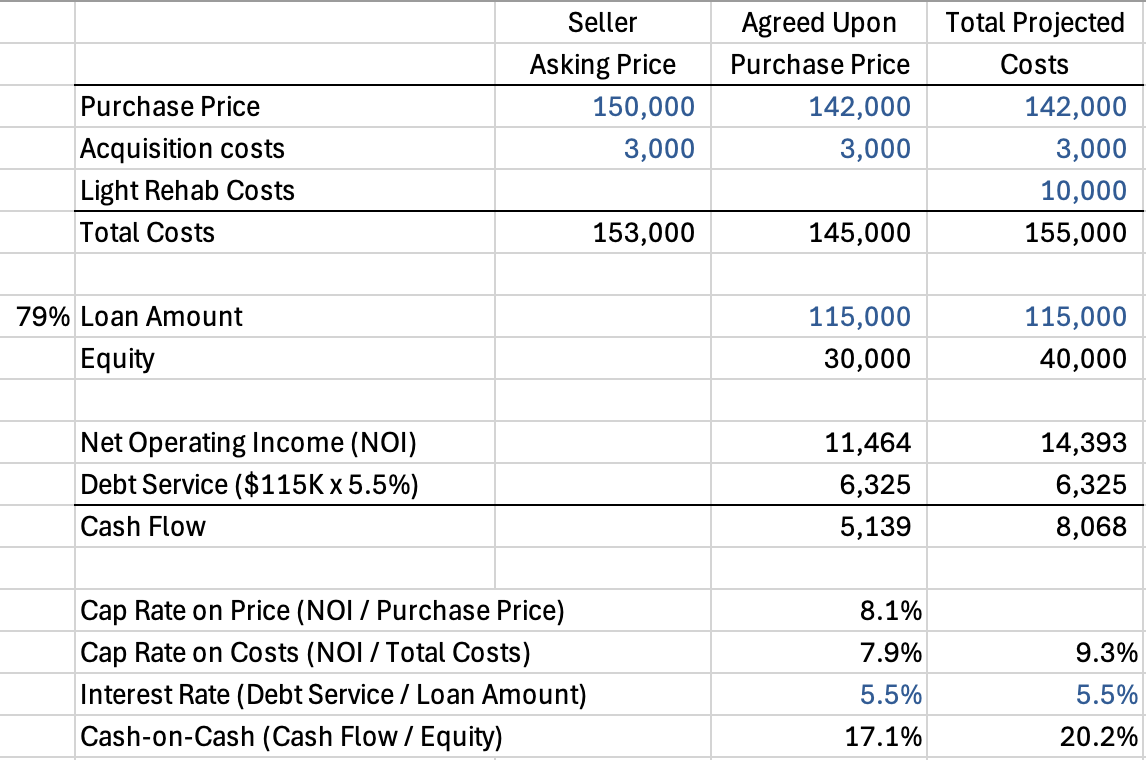
Table 1: Acquisition Financials
What does this tell us?
Equity & Debt
You were able to negotiate the purchase price down to $142,000 from $150,000.
You believe you can get a loan for $115,000 (79% of $145,000).
Your equity required at time of purchase will be $30,000, in line with your budget.
You will need to come up with another $10,000 to complete your light rehab.
Financial Return Projections
Your cap rate on cost is 7.9% and your interest rate is 5.5%.
You have positive leverage (7.9% > 5.5%) giving you a cash-on-cash return of 17.1% at time of purchase.
You believe you can increase the NOI from $11,464 per year to $14,393 per year after the light rehab of both units, bringing your cap rate on cost up to 9.3% and your cash-on-cash to 20.2%.
These are much better return projections than you could find in Denver.
You use a purchase and sale agreement template and hire local vendors to perform your due diligence. The local broker refers you to a debt broker who helps you get a loan in line with your projections.
The due diligence did not uncover any significant deferred maintenance items. Phew!
None of this was quick or easy, but you got through it OK.
Key Takeaways:
Get to Know the Market: talk with a local broker and tour the market with them.
Be Patient: it is only by looking at many deals that you start to have a sense of the market and the deal that looks better than the rest.
Build a Team: having a (local) team that can help you is critical. You want a team that does each function regularly as they know the pitfalls.
The Operating Years
Initial Onboarding
Despite being a flight away from the property, the initial onboarding went smoothly because you used the local property management and accounting team referred to you by your broker. They helped you with the “boots on the ground” work such as interacting with the tenants and directing vendors.
Year 1 - Smooth Sailing to Build Up Cash
This real estate investing is easy!
Money shows up in your account on the 10th of every month. The property manager is handling all the tenant requests. The tenants are paying rent. You are building up cash so that you can spend $10,000 to do the light rehab in the future and increase the rents.
So far so good.
Year 2 - Tenant Default, Light Rehab of Unit 1
Ugh! Right at the beginning of year 2, one of the tenants defaulted on their lease and moved out of unit 1 early. There was also $700 of damage to their unit. This resulted in $1,500 less cash flow than your budget due to a month of lost rent and fixing the damage.
You decide to take advantage of the unit being vacant and spend $5,000 to do new paint, flooring, and a light fix up of the kitchen. You had just enough money saved up from the property cash flow to make this happen.
You lease the renovated unit for $975 per month, up from $800 per month.
You are back on track.
This is a critical point to reinforce. By building up cash, as opposed to using it to fund your personal lifestyle, you had the money to do the rehab when the tenant defaulted as opposed to scramble to figure out whether to re-lease it at the lower $800 rent or somehow come up with the $5,000 to do the light rehab.
Year 3 - Light Rehab of Unit 2
You learn that the tenant is moving out of unit 2 at the end of the first month of year 3. Fortunately you have been saving the property cash flow and have built up enough to cover the $5,000 to rehab unit 2.
You complete the light rehab of the second unit and lease it for $975 per month, up from $800 per month.
Nice work!
Both units have been renovated and leased at higher rents in line with your initial projections at time of acquisition.
Three Year Financial Summary
Here’s a table that summarizes it all:
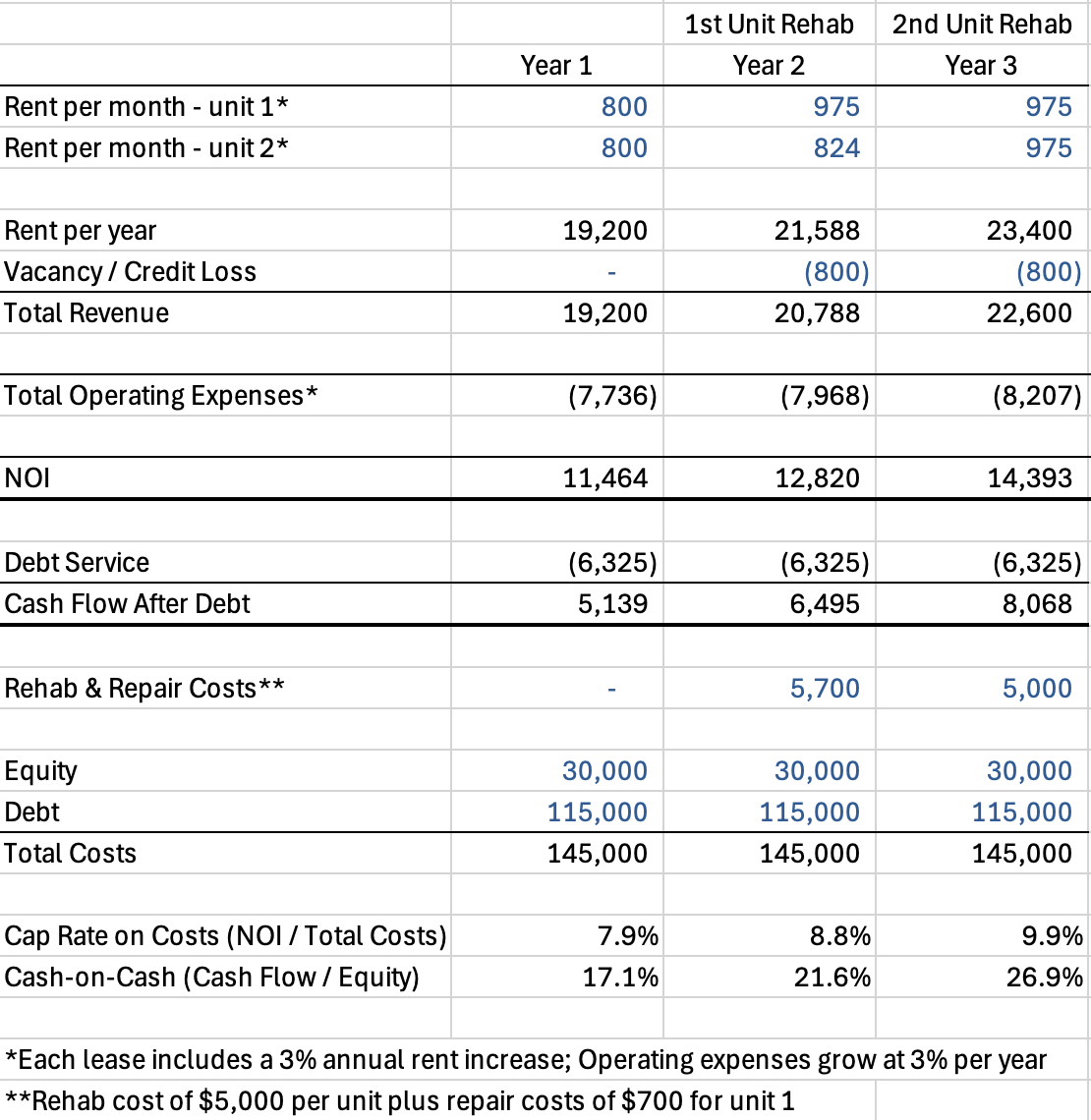
Table 2: Operational Financials
Key Takeaways:
You Had Very Little Drama: yes a tenant defaulted, but you didn’t have to evict them. No major plumbing, electrical, or roof issues came up. There were no lawsuits or insurance claims. It was relatively smooth sailing.
Consistent Economy: the economy didn’t move drastically up or down. This helped your property to perform as expected.
You Built Up Cash: this was key. By building up cash, you had the flexibility to rehab the units when the opportunity presented itself. Remember, it is impractical (and usually illegal) to evict a tenant during their lease so you can rehab a unit.
You Had No Cash Flow: the flip side of this was that your $30,000 equity investment did not give you any real cash flow as you chose to reinvest it into the property. It is not until you completed the rehab of the second unit and re-leased it that you could enjoy the $8,068 annual cash flow.
You Kept Your Equity Low: your acquisition projection was to increase your equity by $10,000 for the rehab to a total of $40,000. By saving cash flow, you were able to keep your equity at $30,000.
Lower Equity Results in Higher Percentage Cash-on-Cash Return: your original projection assumed you would fund the $10,000 rehab cost with additional equity, bringing your total to $40,000. Instead, you used cash flow to fund the rehab, keeping your equity at $30,000. This is why your actual cash-on-cash return is 26.9% ($8,068 / $30,000) vs. the projected amount of 20.2% ($8,068 / $40,000) on the same $8,068 annual cash flow.
Don’t Get Enamored with the Percentages: a 26.9% cash flow is big! But $672 per month ($8,068 per year) is not going to permanently change your life. Getting meaningful cash flow from real estate investing requires putting much bigger dollars at risk than $30,000.
The Sale
You decide that you have added the value and it is time to sell.
You go back to the broker that helped you buy the property and ask for a broker opinion of value. She believes you can sell it for an 8.0% cap rate on the $14,393 of annual NOI for just under $180,000. See below for the calculations:
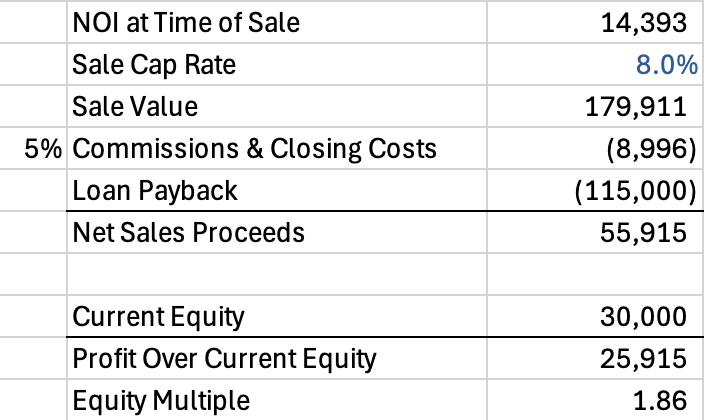
Table 3: Sale Projections
Over the next 90 days, you work with the broker to market and successfully sell the property for just under $180,000.
It wasn’t easy nor without stress. The buyer tried to re-negotiate the sale price the day before they went non-refundable, but you held firm and they agreed to hold the original purchase price.
This nets you $55,915 vs. your equity invested of $30,000 giving you a before tax profit of $25,915 and a 1.86 equity multiple. Note that this equity multiple counts sales proceeds only. A full return picture would also include any cash flow distributions from the property.
Amazing! Well done!
You decide to roll your original equity and the profit into a new deal via a 1031 tax-deferred exchange. This both deferred your capital gain taxes and allowed you to put $55,915 (less transaction costs) into your next deal.
Pro tip: 1031 exchanges can be expensive, especially when you are dealing with smaller deals like this. Make sure you understand the costs before you decide to pursue this path.
Key Takeaways:
Sale Timing: you sold when the property was stabilized at higher rents than your purchase. This allowed you to drive up the sale value.
You Got Out in Three Years: getting in and out in a relatively short amount of time minimizes your chance of a major physical problem (fire, plumbing leak, roof failure, etc.).
You Completed a 1031-Exchange: this is a good way to grow your equity over multiple deals so that the cash flow becomes more meaningful.
Closing Thoughts
This is an example of a deal that went really well.
You built up cash to pay for your light rehab, keeping your equity low.
This cash cushion allowed you to jump on the light rehab when you had a vacancy.
By sequencing the light rehab over time, the property was never 100% vacant, allowing you to maintain positive cash flow.
Your post-light rehab rent projections were accurate. You thought you could increase the rents to $975 per month and you were able to do this.
Luck was on your side. You didn’t have any major tenant or property problems. The economy remained stable.
Real estate investments don’t always go this smoothly, but a lot of them do.
By being proactive in fixing up the units, you were able to add value and significantly increase your equity.
Well done!