How To Find Your First Real Estate Deal: A Step-by-Step Guide
From online research to broker relationships—putting in the reps that lead to your first investment
We have covered a lot so far. Today we are going to dig into how to find your first deal.
Before we do this, let’s do a quick recap of what we have covered:
HOW to invest - REITs, LPs, self, with a partner, or as a GP: 5 Ways to Invest in Real Estate (From $60 to All-In)
WHAT to invest in: Asset Classes Explained: Industrial, Office, Retail, Multifamily, and 1-4 Unit Residential
TAX advantages: 5 Tax Advantages That Make Real Estate Investing So Powerful
BUILDING A TEAM: You Don’t Have to Do Everything Yourself: Building Your Real Estate Team
Finding your NICHE: Stop Chasing Every Deal: Why Successful Investors Pick a Niche
Choosing your STRATEGY: The Risk-Return Spectrum: Choosing Your Real Estate Investment Strategy
How to UNLOCK VALUE: Unlocking Value: What to Do After You’ve Improved Your Property
The simple MATH of real estate: Cap Rates: The Simple Math of Real Estate Investing
Moving forward we are going to address the practical realities of:
BUYING real estate investments: picking a market; working with a broker; analyzing deals; purchase and sale agreements; debt and equity; due diligence; and closing.
OPERATING the property: value add initiatives; leasing; property management; construction; reporting; insurance; and property taxes.
SELLING your property: working with a broker; preparing the property for sale; due diligence; purchase and sale agreements; debt and equity considerations; and closing.
Today marks the start of the series of several newsletters that will explain buying real estate investments.
Let’s dig in.
Understanding What You are Looking For
If you don’t know what you are looking for, you will be like a blind squirrel searching for a nut. You may find it eventually, but you will waste a lot of time in the process.
A few weeks ago I discussed the importance of finding your niche and determining your investment strategy. Let’s build off these concepts and our previous examples.
In the niche newsletter I created four examples of different combinations of asset class, geography, and strategy based on an investor’s time availability:
No spare time: Retail - Tacoma, WA - Turnkey.
No spare time: 1-4 Unit Residential - Nashville, TN - Turnkey.
Some time to be more active: Industrial - San Antonio, TX - Light Rehab.
Time on evenings & weekends: 4 Unit Residential - Los Angeles, CA - Value Add.
Regardless of the asset class, geography, and strategy, the methodology is the same.
Getting in Your Reps
The first step is to start looking at deals. The great news is that you can do this after hours and on the weekend from the comfort of your own home.
How?
By using the power of the internet, your time, and (to quote the musical Hamilton) your “top-notch brain”!
There are many websites out there that list properties for sale:
LoopNet.com - best for commercial properties (industrial, retail, office, larger apartments/multifamily).
Redfin.com or Zillow.com - best for 1-4 unit residential.
Realtor.com - MLS-connected; comprehensive for residential.
Note that Redfin, Zillow, and Realtor will also be filled with properties for sales to homebuyers to live in.
Pick one or two and set the filters to the parameters that fit your asset class and geography niche, as well as your price range. You won’t be able to filter by strategy (turnkey, light rehab, value add). To figure this part out, you will need to review the details of the property listings.
Step 1 - Go Down the Rabbit Hole
In your first pass, dedicate 1-2 hours to click around. Think of this like doom scrolling. You are reviewing the information in a general way to get a lay of the land.
Pay attention to how the assets (and the process) make you feel. Is there real interest in this niche? Do you get excited? Does this put you to sleep?
Do you feel like you could come up with the equity (cash) to buy the property - assume you need 35% of the purchase price - example: $300,000 property x 35% = approximately $100,000 of equity.
If it puts you to sleep or is out of your price range, consider exploring another niche.
Don’t give up. Finding your niche is an interactive process that takes time.
Step 2 - Bring Some Structure
Now it is time to be more methodical by bringing structure to the process.
Get a pencil and a piece of paper (or open excel). Create a simple grid that lists the following details as columns for each property. Each property will be a row.
Address
City or submarket
Square feet or number of units*
Asking (purchase) price
Price per square foot or per unit*
Rough calculation of annual net operating income (NOI, which equals revenue minus operating expenses). This should be on the listing or you can make an estimate.
Cap rate: NOI divided by price.
*Use units for multifamily and 1-4 unit residential. Use square feet for retail, industrial, and office.
I did something similar for industrial properties in Escondido, CA on LoopNet last summer.
Example: My Escondido Industrial Property Search (Summer 2025)
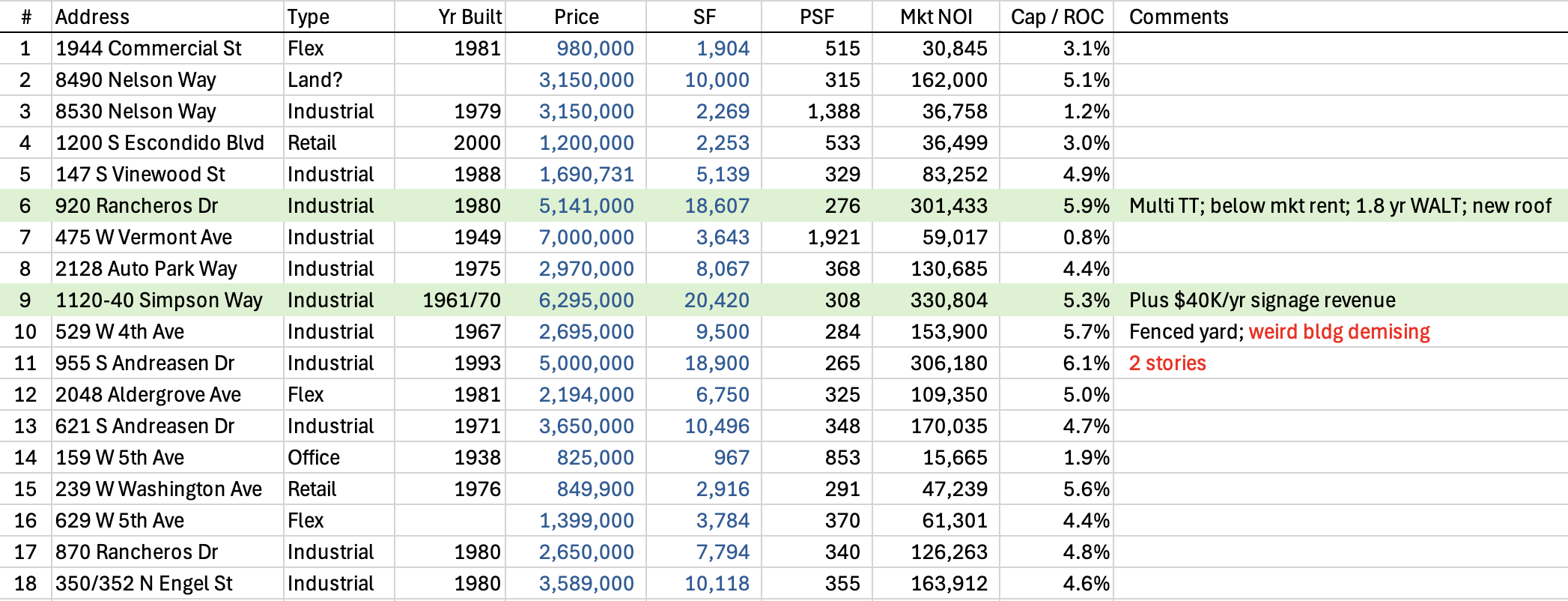
What you are looking for is the properties that are a little better than the rest. In this case I was using cap rate (aka return on cost) as my main guide (column header is “Cap / ROC” in the table above.
Alternatively, I could have used price per square foot (“PSF” in the table above).
For each of the properties that had the higher cap rates (#s 6,9,10, and 11), I reviewed the materials on LoopNet in more detail and added some comments.
I didn’t like #10 and 11 because of some of the physical characteristics shown in red in my Comments column.
This left me to focus on #s 6 and 9.
The whole process took me a few hours.
Step 3 - Talk with Brokers
What?!?!
You mean I have to call someone I don’t know?!
Yes. You can do it. It is just another human being on the other end of phone.
To set you up for success, let’s breakdown the role of a broker.
In regards to looking at a property for sale, the broker that is listed on LoopNet or similar websites is hired by the seller to market the property for sale. The broker only gets paid (by the seller) if the property is sold. Said another way, they are spec’ing their time in hopes that they can successfully sell the property at a price that is acceptable to the seller.
Part of the role of a broker is to talk with prospective buyers about the property they are trying to sell.
They are working through the traditional sales funnel.
They have to talk with many potential buyers.
Some of those will turn into actual leads that spend time focusing on the property.
A smaller amount will actually make offers.
And one will (hopefully) be acceptable to the seller and buy the property.
So what does this mean for you?
If you call a broker and come across as being clueless and unorganized, the broker will see right through you and be unlikely to want to give you any time. A broker’s most precious resources are their time and reputation.
Don’t waste their time.
Be respectful.
Brokers are an essential part of the real estate investing process. A good relationship with 1-3 good brokers may turn out to be the most critical part of your personal real estate team. They are the source of the majority of investing opportunities out there.
But what if you are just starting out? What is realistic for you?
Here’s a script that I recommend:
You: Hello [broker’s name]. I am reaching out to learn more about [XYC property] I saw on [LoopNet]. I have spent the last X weeks researching properties like this in this market and this one stood out to me as one I want to learn more about.
Broker: Good to hear from you. Can you tell me about yourself before I walk you through the property? [Translation: are you someone I should spend my time on?]
You: Happy to. I am newer to real estate investing, but am ready to buy my first deal. I picked this market because XXX. I have the equity to buy a deal of this size (or have lined up investors). I have some ideas on putting a loan on the property, but would also welcome your perspective on loan options. I am looking to establish one or two key broker relationships with the goal of buying multiple properties over the next X years. What questions should I be asking about this property and the market?
—
What works about the script above?
You are being candid in the realities of being new.
You are showing that you have put in the time to focus on a niche.
You are making it clear that you have a path to getting the equity.
You are opening the door to a long-term relationship with this broker.
So what’s next?
Step 4 - Patience and Repetition
Now you need to keep doing steps 2 and 3 until you find a deal that works for you.
Expect to take 3-6+ months until you find a deal that works for you that you can get under contract. This includes:
Building market knowledge (4-8 weeks).
Establishing broker relationships (2-6 weeks).
Finding and analyzing the right property (4-12 weeks).
Expect to review 20-100+ properties online and dive deep into 5-20 of these before you find the right deal for you.
New properties become available for sale all the time. Establish a routine where you check for new properties for sale every two days.
By putting in your reps, you will start to better understand your niche and what works best for you. At some point you will see a property that checks all your boxes and is priced at a level that makes sense to you.
By then you will have talked with multiple brokers and seen many deals. Some of these brokers will even start sending you deals proactively, possibly even before they hit the market.
Important note on 1-4 unit residential deals: make sure you work with a broker that specializes in investment properties, not the homebuyer market. Investment brokers will understand how to analyze a property from an investment perspective.
You will have built a level of micro expertise in your market and established some small level of credibility with brokers in that market.
Most people have very little staying power. They try something and quickly give up.
Be the exception.
Pick a niche.
Be respectful of brokers’ time. Leverage their market expertise.
Put in the time and focus to understand the market.
Before you know it, you will have found a deal that looks like it works for you.
So what do you do when this happens?
Call the broker immediately - good deals move fast.
Ask for the offering memorandum or marketing package that provides the details about the property.
Request a tour if you are local to the market (or even a video tour if you are not).
We’ll cover the purchase process in detail next week.
Professor Bateman