Why the right move at 25 is the wrong move at 55 — matching your strategy to your time, money, and investment horizon
Last week I kicked off the series on mindset, focusing on three key areas:
Your real estate investing goals.
Your demeanor & tolerance for risk.
Your skills.
Taking the time to understand how each of these relate to YOU is critical to clearing through the noise to learn more about yourself and your goals. You do this by talking with others and journaling. Both of these techniques allow you to think and get clarity.
Don’t watch another YouTube video by an investing guru.
Take…the…time…to…think.
Thinking is underrated. It is a neglected habit in this world. Be the exception and make time each week to think.
Once you have clarity on your goals, demeanor, and skills you need to add three other things to your foundation to bring clarity to how you approach real estate investing. They are:
Your available time.
Your investable capital and income stability.
Your time horizon.
Today we will discuss these foundational pieces and how they influence your investment strategy under four different potential personal scenarios:
Expanded Foundation: Available Time, Investable Capital, & Time Horizon
Scenario 1: Your 20’s
Scenario 2: Your 30’s & 40’s if No Children
Scenario 3: Your 30’s & 40’s With Children
Scenario 4: Your 50’s & Beyond
How To Think About What Makes Sense For You
Let’s dig in.
Expanded Foundation: Available Time, Investable Capital, & Time Horizon
I will start by defining each of these and explaining why they are important. I will be referencing the investment options described in 5 Ways to Invest in Real Estate (From $60 to All-In).
Available Time
How much time do you have in your life to give to personal real estate investing? Someone in their early 20’s or an empty nester will have more time than someone with children. The less time you have, the more you want to rely on others to do the work.
Low Time Available: consider REIT shares (public stocks) and limited partner (LP) investing.
Higher Time Available: option to own directly via house hacking, 1-4 unit residential, or acting as a general partner (GP).
Power Move: work as an employee of a GP where you are paid to learn and have the potential to invest or participate in the success of the investments as you get more senior at the company.
Investable Capital
Investing in real estate requires capital (aka money). Unless you are buying REIT shares, you need at least $10,000 to make a meaningful investment. That assumes you borrow 80%+ of the costs and buy in a lower cost market.
A typical investment will yield 3% to 10% cash on cash. The math is not that exciting if you only invest $10,000: 6% x $10,000 = $600 per year ($50 per month). You have to think of this as (i) an income supplement as opposed to an income replacement or (ii) a path to doubling your money multiple times over multiple investments ($10,000 to $20,000 to $40,000 to $80,000 over several investments).
Low Investable Capital: choices limited to REIT shares and possibly a house hack.
Higher Investable Capital: you may be able to invest as an LP (most LP investments have a $25,000+ minimum) or buy a 1-4 unit residential property.
Power Move: work as an employee of a GP.
Time Horizon
Time horizon is the amount of time you have until you want to enjoy the benefits of compounded growth and start using your income for (semi-) retirement.
Someone in their early 30’s has a very different time horizon than someone in their late 50’s. We humans have a hard time thinking long-term. Remember, your investments can grow significantly over 20+ years.
Putting It All Together
Let’s use these three criteria, plus the concept of skills and real estate experience, to create four scenarios:
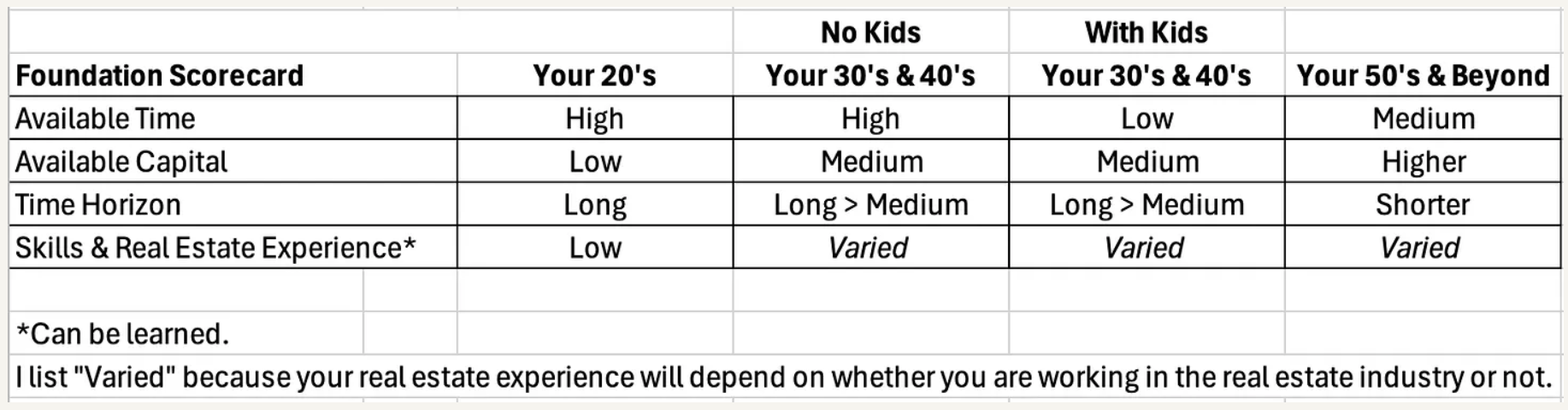
Table 1: Foundational Scorecard
This gives us a general sense of how these criteria change as you go through different stages of life.
Let’s explore investment options under each scenario using the investment options and example investors described in 5 Ways to Invest in Real Estate (From $60 to All-In):
Perfectly Passive Penny: owns REIT shares (stocks of public real estate companies).
Hands Off Harry: invests as a limited partner (LP).
Freakout Frank: invests as a limited partner (LP) but tries to micromanage the work of the general partner (GP). Don’t be Freakout Frank.
Active Alice: buys a duplex and lives in one unit while renting out the other. This is known as house hacking.
Patient Peter: buys 1-4 unit residential properties to hold for cash flow. Pro Tip: a variation on this approach is to sell or refinance each property after 3-5+ years and then repeat the process.
Rockstar Reggie: works as an employee of a real estate company and participates in the company’s property success after 5-10 years.
All In Alex: creates a real estate investment company and raises money from LPs.
Scenario 1: Your 20’s
You are young and have a lot of drive and time, but you have little money and experience. Unless you have $10,000 to $25,000 of capital to do a house hack like Active Alice, your investment options will be limited to REIT shares.
Definitely try to work for a GP like Rockstar Reggie. You will be paid to learn and potentially have a path to invest or participate in the success of the investments.
Scenario 2: Your 30’s & 40’s if No Children
By now you are earning some money, developing skills, and (hopefully) building up your real estate experience. Your investable capital has grown and, because you don’t have children, you still have a good amount of free time in your life.
You now have more investment options: (i) invest as an LP like Hands Off Harry or (ii) start buying 1-4 unit residential properties like Patient Peter.
You may have even had a nice financial windfall that allows you to go without a salary for a couple of years and take on the risk and potential reward of creating your own real estate company.
Scenario 3: Your 30’s & 40’s with Children
This is just like scenario 2, except you have children. Children will take up a TON of your time (and money).
Proceed carefully if you want to buy 1-4 unit residential properties like Patient Peter. You will probably need to hire a property manager to do most of the work. If you try to do it yourself, it will take up a lot of your time that you could be spending with your family.
And proceed extremely carefully if you want to create your own company. This will take up even more time in the early years.
Scenario 4: Your 50’s & Beyond
At this stage you have likely been working for 25+ years and (hopefully) have an established career. You have more investable capital and, if you are an empty nester or never had children, you have a decent amount of available time — although your energy level may not be like what it was in your 20’s or 30’s.
All investment options should be available to you with two caveats:
If you have not worked in the real estate industry, you are unlikely to be able to get a job working for a GP (Rockstar Reggie).
Creating your own company takes 2-5 years to get profitable and start paying you a salary. Be realistic about how long you want to keep working and whether or not you have the time horizon to recover if the company fails.
Bringing It All Together
I have put all four scenarios in a single table below.
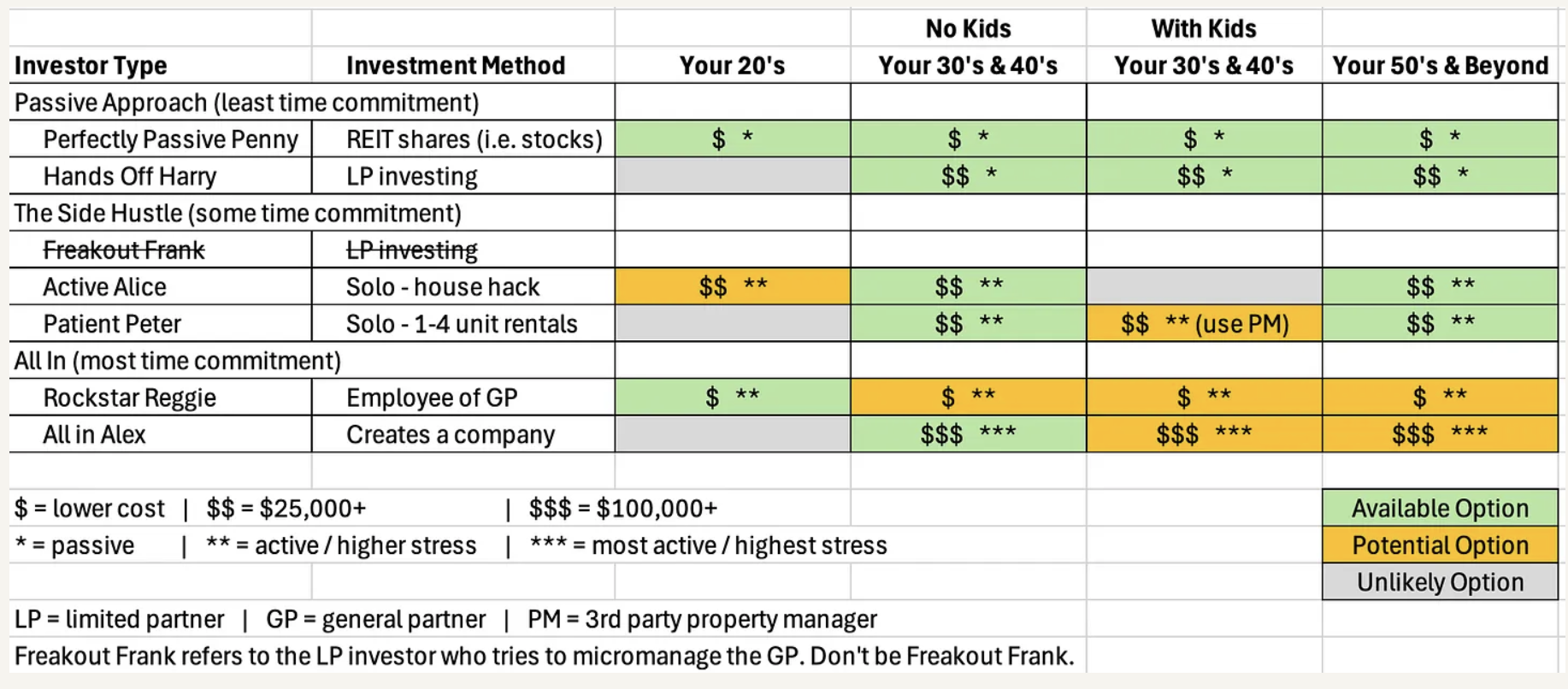
Table 2: Investment Options Comparison
Keep in mind this is not set in stone. My intent is to get you thinking about what your options are at different stages of life.
Table 2 says nothing about the risk-return spectrum and your comfort with stress. Someone who wants to minimize stress may focus on the passive approach and never move into the more active “Side Hustle” or “All In” approach.
Nor does table 2 address your goals (cash flow vs. net worth growth). It summarizes the WAYS you can invest. You will need to filter through individual investment opportunities to determine the ones that are right for you.
How To Think About What Makes Sense For You
With the caveat that each of us is unique, I recommend taking the following approach:
Don’t make any investments that make you lose sleep at night. Be realistic with yourself. We each have a certain amount of risk we are comfortable with.
Work your tail off in your 20’s and 30’s. This is often the peak of your energy. Keep pursuing opportunities that expand your future options.
If your demeanor can handle it, do riskier deals in your 20’s and 30’s. Even if they fail, you still have time to recover. This is when you can focus more on shorter-term, high-payout (and riskier) investments.
As you get closer to your late 40’s and 50’s, start adding investments that give you cash flow. You want to get to the point where your real estate investments replace or materially supplement your salary.
If you are in your 50’s or 60’s+, you have fewer options as your time horizon is shorter. If you really want to build up passive real estate income, you will need to make bigger investments ($1,000,000+) to generate meaningful ($60,000+) annual income (assumes an investment that yields 6% annual tax efficient cash flow). You also have less time to recover if a deal goes bad. This is the reality of your situation.
If you take the LP investing route, invest with people you trust. If you are new to this, ask people who have already invested with the GP. Be very careful about investing with someone you don’t know.
Reality check: despite what you see and read, there is no “get rich quick” strategy unless you take on a ton of risk and everything works out. This is true of all investments, not just real estate.
Here’s what worked for me:
20’s: I worked for multiple, non-real estate companies. I didn’t gain any real estate experience, but I developed strong analytical and operational skills.
30’s: I worked for an industrial real estate company (Rockstar Reggie) and eventually got to invest and participate in the company’s investments. This grew my net worth.
40’s: I continued as Rockstar Reggie and started also investing as an LP (Hands Off Harry) in multifamily deals where the strategy was to hold long-term for cash flow.
50’s: My passive income got to the point where working for a company was a choice, not a financial requirement. Financial freedom was attained.
20+ years working for a real estate company + investing as an LP + clarifying my goals + luck + patience = financial freedom.
Everyone’s path is unique.
Think, plan, and then take action.
And then work your tail off and be patient.
You got this.