Why Most People Never Make Their First Investment
The self-knowledge that separates the investor who act from the ones who just read about it
Over the past 42 newsletters we have covered many topics through eight series:
Introduction to Real Estate Investing
Investment Fundamentals
The Acquisition Process
Owning & Managing Real Estate
Executing Your Business Plan
Sales & Refinances
Case Studies
General Partner & Limited Partner Investing
I have tried to strike the balance between making the information straightforward enough that anyone can follow while providing enough details to make it actionable.
If you are like most people, you are either (i) reading each newsletter and planning to take action when the time is right or (ii) filtering the newsletters to a folder to read when you have more time.
Taking action is hard. It requires building momentum by taking small steps that compound into big results.
I am here to help you do this.
This is why today I am kicking off the series on mindset. Understanding yourself and developing a custom path to success is key to real estate investing (and to life!). Today we will cover:
Your real estate investing goals
Your demeanor & tolerance for risk
A realistic assessment of your skills
How these combine together
Let’s dig in.
Your Real Estate Investing Goals
Why do you want to be a real estate investor?
Stop reading and take 60 seconds to think about this. Write down a few words that describe why.
You may have written things down like:
To be rich
Financial freedom
It’s a great investment class
It is tax efficient
It sounds cool
All of these are fine answers and I have said them all myself. But they are only the start.
To really understand your goals, you need to dig deeper. You dig deeper in two ways:
Sharing Your Goals With Others
Saying something out loud allows you to test your ideas. You are forced to be specific. This is best done with (i) people who know you well or (ii) people who have already achieved what you want.
Pro Tip: take this to the next level by forming a group with 1 or more other people you trust who also want to be real estate investors. Take turns sharing your goals and getting feedback from the group. This is known as a mastermind. I have a mastermind with a good friend that we have had going for 10 years. I can’t speak highly enough of how beneficial it is for my growth and goals.
Journaling
Just as saying your ideas out loud makes them more concrete and specific, journaling does the same thing. Journaling isn’t just for feelings. It is a tool to reflect on and further refine your ideas.
Pro Tip: buy a single purpose notebook to use for all your real estate investing ideas. A single purpose notebook is just as it sounds: one notebook, one purpose. I have many single purpose notebooks for various projects in my life such as investing, teaching, board work, and consulting. My two favorite types of notebooks are Moleskine Journal (soft cover, 5” x 8.25”) and Circa by Levenger. The Moleskine is for ideas and notes. The Circa is for active projects.
As you talk and write about your real estate investing goals, they should become more specific. Here are some examples of what they may evolve to:
To diversify my income beyond just my salary.
To increase my net worth to $XX.
To create a diversified portfolio beyond just my salary and stock investments.
To create a portfolio to pass on to my children.
We will make these goals even more specific in the next couple of newsletters. For now, keep thinking, talking, and writing about your goals.
Your Demeanor & Tolerance for Risk
It is an important and wonderful thing to have goals, but they are unrealistic without further understanding yourself and your tolerance for risk.
Let’s start with a few simple questions:
Do you like to be in control?
What is your tolerance for risk & uncertainty?
What is your base level of stress and anxiety?
How are you with confrontation?
As I illustrated in the four case studies, real estate investing is filled with uncertainty - some controllable and some outside your control. It is not for the faint of heart.
Most people choose the certainty of a salaried position and let the owner of the business deal with the stress and uncertainty of being a leader.
This is a fine approach and there are still ways to be a real estate investor without turning into a stress case.
Here’s a summary that maps the 5 ways to invest in real estate to different types of demeanor and risk tolerance.
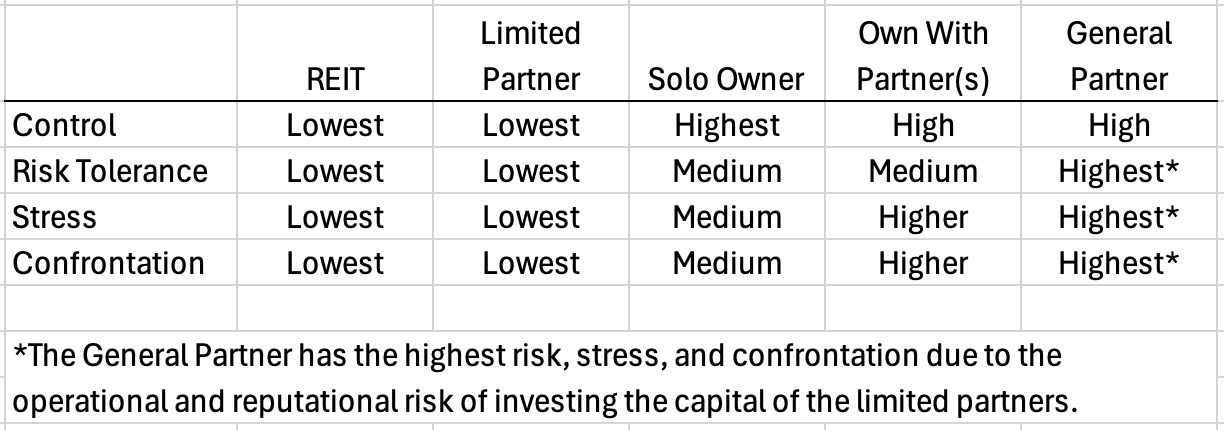
Table 1: Trade-Offs in Investment Methods
As the saying goes: you can have anything you want, but you can’t have everything.
As Table 1 shows, the further you are away from the front lines of real estate investing, the less stress AND control there is. For many, the fees and promote paid to the general partner are well worth the avoidance of stress from operating the real estate yourself.
Use your journal and your conversations with others to better understand your tolerance for risk. There are no wrong answers. Be a student of yourself. This will help you gain clarity and take action.
Now let’s add a third element beyond goals and risk tolerance.
A Realistic Assessment of Your Skills
Each of us has different skills. This is one of the things that makes life so interesting.
These skills lend themselves towards being more (and less) successful at certain functions. For example:
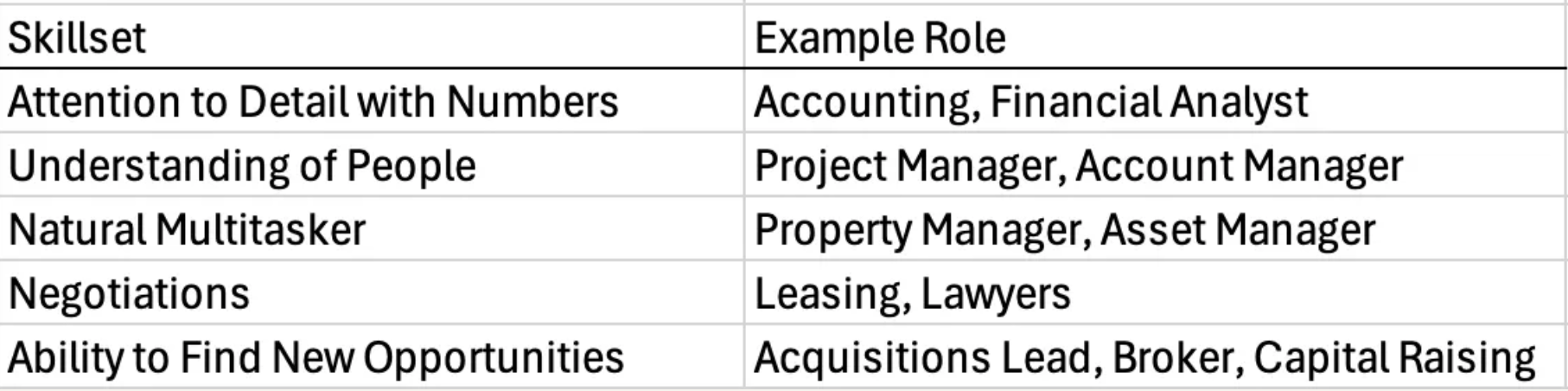
Table 2: Skillsets and Roles
This is just a partial list. Each of us is unique and cannot necessarily be put into a simple box.
The key is to take the time to understand yourself by journaling, talking with others, and taking one or more personality assessments such as Myers-Briggs or CliftonStrengths.
Be realistic. Ask others for their honest assessment of what you are good at and what you are not. The latter will help you understand what you may need to rely on others for.
As I discussed in Building Your Real Estate Team, you don’t have to do everything yourself. But if you don’t know what you are good at, you may focus on the wrong things.
How These Combine Together
Let’s bring all this together. Today I have discussed the need to understand:
Your investing goals
Your demeanor and tolerance for risk
Your skills
These will become foundational to how you think about becoming a real estate investor. And…they will change over time.
Let’s look at mine in three phases over the last 20+ years.
Phase I: Clueless and Driven - my 20’s and early 30’s
My Investing Goals: get rich.
My Demeanor & Tolerance for Risk: tried working as a broker for 100% commissions and hated it. I could barely sleep at night. Transitioned to a salary position where there was the future potential to participate in the success of the deals. High tolerance for risk as long as I had a salary.
My Skills: strong analytical and writing skills combined with excellent organizational skills made me a good fit for a financial analyst and transaction manager. Very high drive and work ethic, combined with humility. Pro Tip: Drive + Humility = A Magic Combination.
Phase II: Developing Expertise & Focus - my 30’s and early 40’s
My Investing Goals: get my net worth to $10 million.
My Demeanor & Tolerance for Risk: high tolerance for risk as long as I had a salary. I had the benefit of my wife also working. I invested in as many of my company’s deals as my boss would allow.
My Skills: leadership and asset management skills based on strong analytical, writing, and organizational fundamentals. Growing understanding of what makes a good investment. I had now been through a major economic cycle (the great financial crisis of 2008).
Phase III: Further Expertise & Goal Clarity - my 40’s and early 50’s
My Investing Goals: replace my salary with passive real estate investment income.
My Demeanor & Tolerance for Risk: expansion of my understanding of wealth beyond just financial. I developed a growing appreciation of being wealthy in free time and having control over my schedule. I realized the “cost” of giving so much of my productive working hours to a single focus (my job).
My Skills: big picture, strategic thinking combined with having a teaching mindset and experience. I had been through another major economic cycle (the 2020 Covid pandemic). The value I now have is less about “doing” and more about advising, teaching, and mentoring.
Let’s lay it out in a single table:
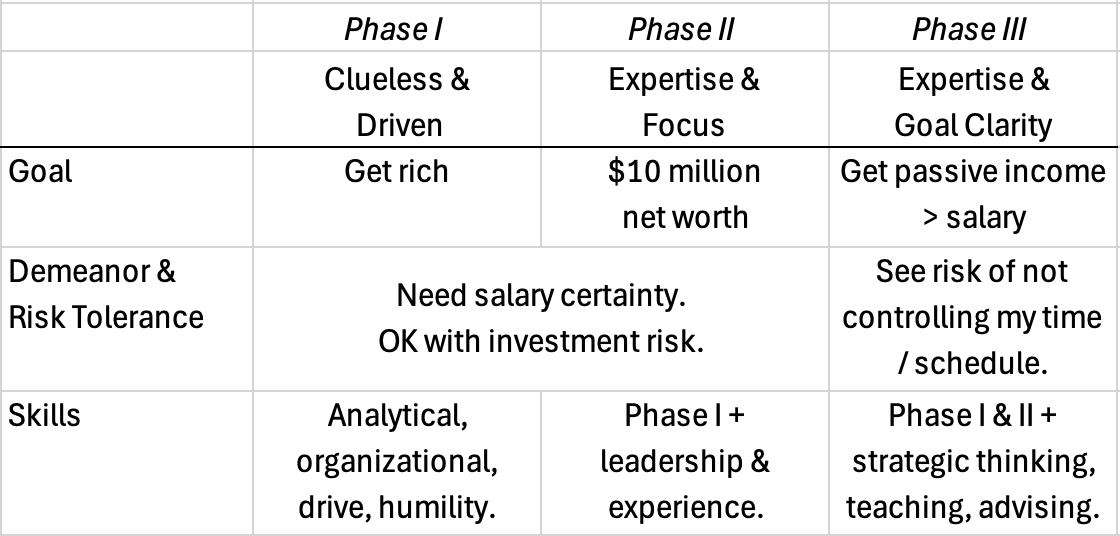
Table 3: My Evolving Mindset Foundation
One person.
Three distinct phases.
Evolving investing goals.
I didn’t know my life would work out this way. The clarity came from a combination of (i) putting my head down and working my tail off, (ii) being introspective and curious about my goals and skills, and (iii) having the courage to make a change.
Each of us is a unique being that only gets one life.
Don’t fly blind.
Take the time to understand who you are today and who you are evolving to be.
This will be foundational in helping you to become a real estate investor.