Case Study 2: The Deal Where Everything Goes Wrong
Investing $60,000 in an out-of-state fourplex
Today we will continue our case study series with an investment in an out-of-state fourplex.
Last week I talked through a $30,000 investment in a duplex where you combined discipline and luck to create a successful first investment.
Let’s review what went right:
You had a clear focus and were patient in finding your first deal.
You underwrote accurately, with both the rehab costs and the post-rehab rents working out as you thought they would.
You built up cash so that you were able to rehab the units when they became vacant.
You had a successful sale.
You were able to turn your $30,000 investment into $55,915 in 3 years (excluding cash flow and before paying any taxes).
Nice work!
Now let’s add a sobering dose of reality.
Whether a deal goes well or poorly, you will never be able to definitively tell how much of the results were related to action you took or due to luck.
Be careful.
Most of us have a bias to think that any deal that went well is the result of our excellent decisions and actions. We think we are great, even invincible at times.
On the flip side, we tend to blame poor performance on things outside of our control like the market and the economy.
The reality is we will never know.
So for this second case study, I will describe an example of things going poorly.
As with last week, we will follow a consistent format:
The Target Niche
The Acquisition
The Operating Years
The Sale or Refinance
You may learn more from the mistakes than from the successes.
Let’s dig in.
The Target Niche
You are coming off nearly doubling your money with your investment in a duplex in Milwaukee, WI. You are feeling good, maybe even a little cocky.
You decide to stick with this niche, but go a little bigger:
Asset Class: fourplex (1-4 unit residential)
Geography: Milwaukee, WI
Strategy: Light Rehab
Key Takeaway:
Stick with What is Working: you spent three years in this market and had success. It makes sense to continue to focus there.
The Acquisition
You follow the same approach as you did to buy your duplex. As you have already invested in this market, you feel more confident in your ability to review properties for sale.
You are also doing a 1031 tax-deferred exchange so you can defer the tax from your duplex sale. This means you have time pressure to identify and close your next deal.
Within 30 days, you find a 4-unit residential property that you like. It is a little more run down and not on as good a street as your first property. You have to push up your rent assumptions to make the deal work in your underwriting assumptions. But…you are under time pressure with the 1031-exchange so you don’t want to take too long.
You have the broker write up an offer for you and, after a few rounds of negotiation, you come to an agreement on price and other deal terms with the seller. Here are the financial details:
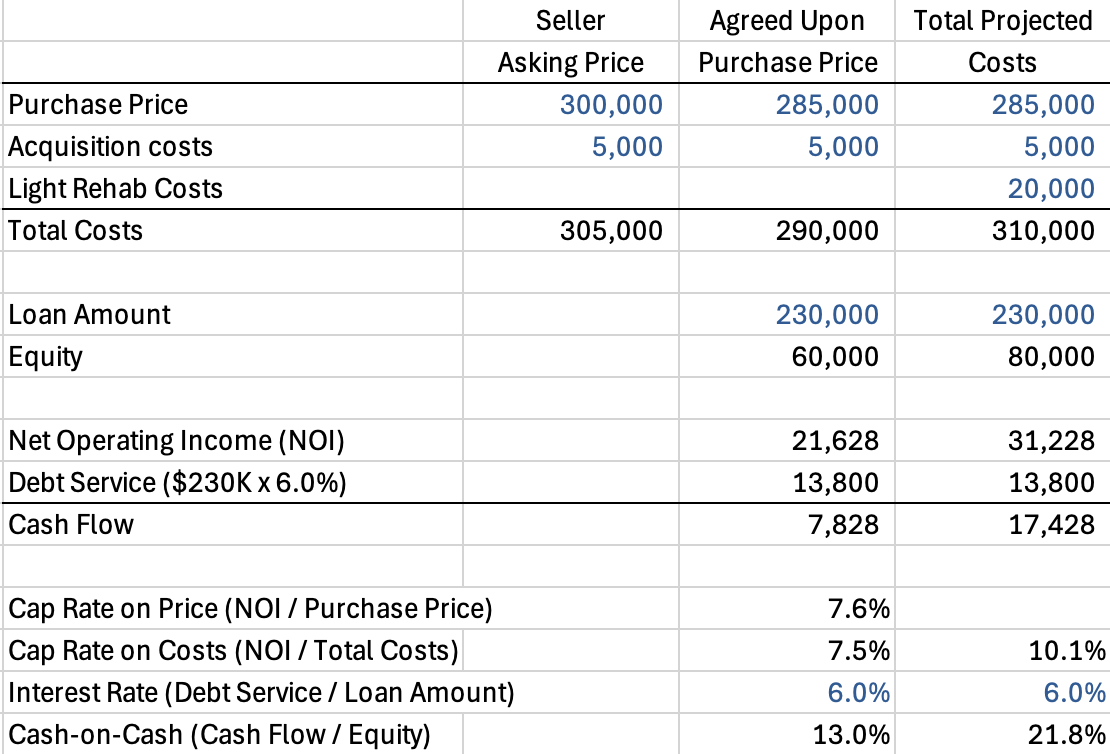
Table 1: Acquisition Financials
What does this tell us?
Equity & Debt
Your equity requirement to close is $60,000. With $55,915 coming from the 1031-exchange, you have to invest an additional $4,085.
Based on your experience with the duplex, you believe you will be able to fund the $20,000 rehab costs out of cash flow.
The interest rate on the debt is 6.0% vs. your first deal at 5.5%. This lowers your cash flow. Market interest rates have gone up in the 3 years since your first deal.
Financial Return Projections
The cap rate and return on cost economics are similar to your first deal, but not quite as good. In your first deal, you projected a 7.9% cap rate on total costs. This time you are projecting 7.5%. But, you believe it will stabilize at 10.1% vs. your first deal at 9.3%. This is because you are getting more aggressive in your rent assumptions. In your first deal, you projected rents going from $800 per month to $975 per month post-rehab. In this deal, you are projecting rents to go from $800 per month to $1,000 per month.
Your cap rate on cost is 7.5% and your interest rate is 6.0%, so you still have positive leverage.
This is where you run into problem number 1: your due diligence uncovers that something is wrong with the plumbing. The sinks don’t drain well and the toilets seem to clog. You try to get more time before closing to figure this out, but the seller is unwilling to give you the time you need.
With the pressure of the 1031-exchange, you brush it aside and hope it won’t be a problem.
Key Takeaways:
A 1031-Exchange Adds Time Pressure: being in a 1031-exchange gives you less negotiating leverage with a seller. You can’t just walk away from a deal without putting your 1031-exchange at risk.
Interest Rates Are Always Changing: the 5.5% interest rate you had in your first deal is gone. The new reality is 6.0%.
The Operating Years
Initial Onboarding
The initial onboarding goes smoothly because you used the local property management and accounting team from your first deal.
Year 1 - Water Damage
Things don’t go smoothly in year 1. That plumbing issue comes to bite you when you have a minor flood at the property. The toilet in one of the top floor units overflows. This floods their unit and part of the unit below.
You try to get the damage covered by the insurance company, but they deny the claim. It didn’t help that you neglected to tell the insurance company that your inspection report showed some plumbing problems.
Overall, the damage works out to $2,000 and you elect to give the tenant a $400 rent credit for the disruption.
Not a major setback. You have the cash to address the issue and feel the property will get back on track.
Year 2 - Light Rehab of Units 1 & 2
Two of the tenants move out in the beginning of year 2. You had $7,460 of cash flow in year 1, but used $2,000 for the water damage. This leaves you with $5,460 to renovate 2 units.
Instead of investing an additional $4,540 of equity into the property so you have the $10,000 needed to do the renovation ($5,460 + $4,540 = $10,000 or $5,000 per unit), you decide to find a cheaper contractor and reduce your scope to get it all done for $5,460 or $2,730 per unit.
This does not go well.
Not only does the “cheap” contractor do a bad job on the construction but they also hit you with a bunch of unfair change orders. You try to push back, but the contractor threatens to put a mechanic’s lien on your property if you don’t pay. The net result is that you spend $10,000 and have a poorer quality construction than if you had used your original contractor.
To make matters worse, the other owners of similar properties in the market have reduced their rents. Instead of leasing your renovated units at the projected rent of $1,000 per month vs. the in place rent of $800, you are only able to lease them for $900 per month.
The challenges keep piling on when you almost have another flood. You conclude you need to come up with a permanent fix for the plumbing issue. You spend $5,800 to complete this fix.
With the combination of the plumbing fix and the change orders for the unit rehabs, you have invested an additional $10,000 of equity in the deal by the end of the year.
Year 3 - Light Rehab of Unit 3
The tenant in unit 3 moves out and you decide to rehab it. You go back to your original contractor to do the work. Unfortunately, costs have gone up and the renovation costs you $6,000.
The leasing market is still pretty weak, so it takes you two months to find a tenant. That tenant pays $927 per month.
Year 4 - Light Rehab of Unit 4
The tenant in unit 4 moves out and you rehab it at a cost of $6,500. The leasing market is improving. You lease it for $975 per month.
Four Year Financial Summary
Here’s a table that summarizes it all:
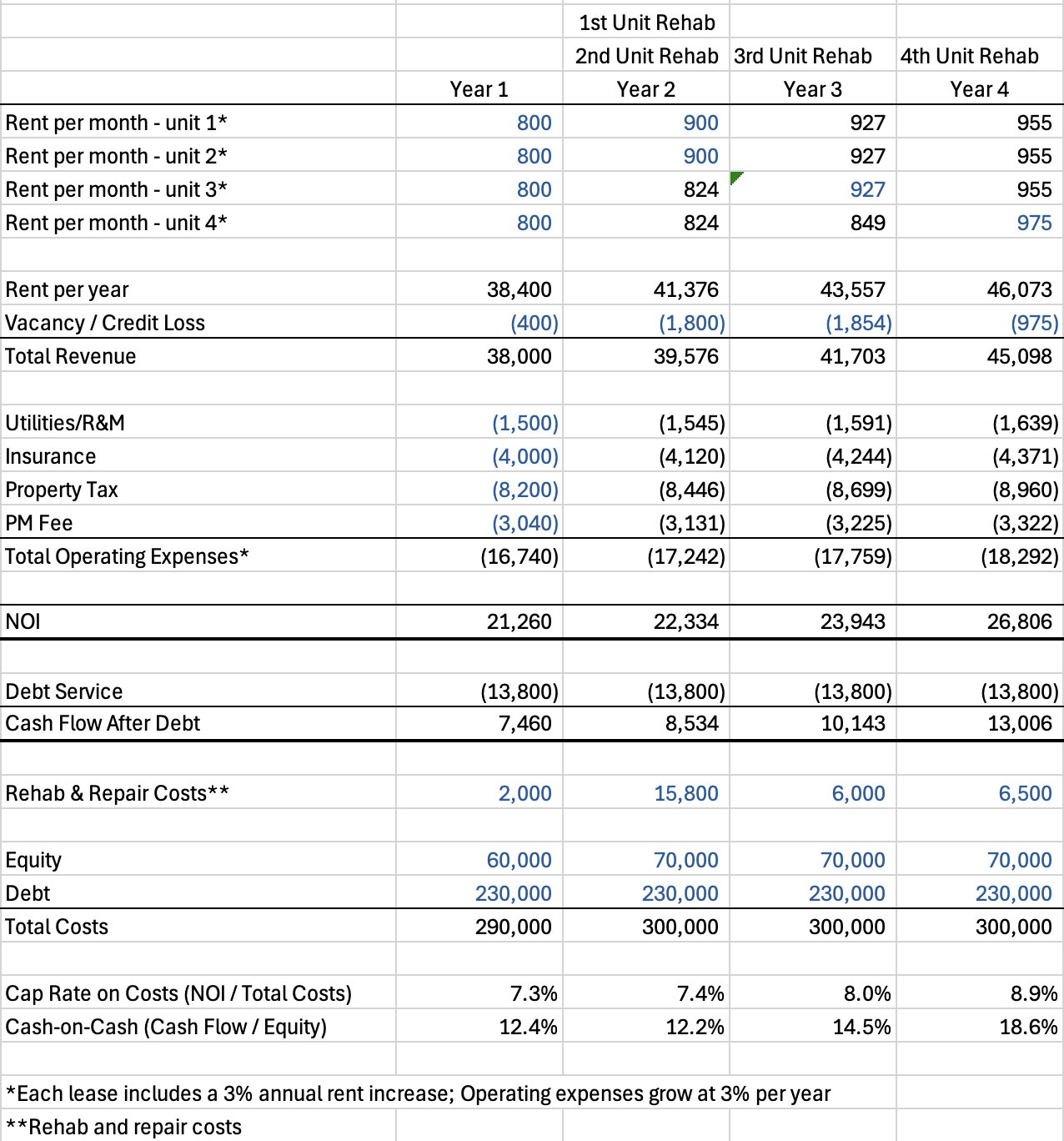
Table 2: Operational Summary
Key Takeaways:
You Ignored a Red Flag: you discovered a potential physical problem during due diligence and effectively ignored it. This ended up costing you $2,000 in damages and $5,800 in repairs, plus the rent credit to the tenant. This also resulted in your year 1 NOI being slightly less than your acquisition projection due to the tenant rent credit.
You Hid Information: not disclosing a defect to your insurance company can void coverage. Insurance is there to transfer risk to the insurance carrier. Don’t waste it by hiding information.
You Increased Your Equity: the timing of the repairs and unit renovations meant you had to increase your equity by $10,000 to $70,000.
Rents Were Lower Than Expected: you thought post-rehab rents would be $1,000 per month. They ended up being lower.
Going With the Cheap Contractor Cost You: as I discussed in Understanding the Critical Role of Contractors, the cheapest contractor is not always the best. In this case, it ended up costing you much more due to change orders. Additionally, you got poor quality work.
The Sale or Refinance
It has been a rough road. You spent more than you had planned and did not increase the rent (and NOI) as much as you hoped.
You are fed up with the property and have “deal fatigue”. You want to sell.
You go back to the broker that helped you buy the property and ask for a broker opinion of value. She believes you can sell it for an 8.50% cap rate on the $26,806 of annual NOI for just over $315,000. See below for the calculations:
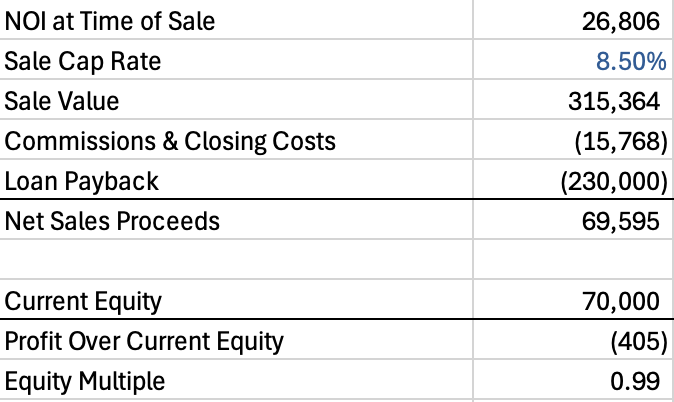
Table 3: Sale Projections
Wait what?!
You did all this work to lose $405?!
Yes, that is what the sale projection shows.
Note that this equity multiple counts sales proceeds only. A full return picture would also include any cash flow distributions from the property.
On the positive side, your cash flow after debt service is now $13,006 per year (18.6% cash-on-cash return). This is solid, but does not meet your goals of creating more equity to keep buying bigger and bigger properties.
You will need to either wait for the market to improve or get most of your original $70,000 of equity out and try to invest in a better deal.
Key Takeaways
Cap Rates Move: cap rates are always changing. In this case they increased from 8.0% to 8.5% vs. your duplex sale.
Lower NOI = Lower Value: the rents did not end up what you projected. This reduced the stable NOI that is used to value the property for a sale.
Closing Thoughts
This is an example of a deal that had a number of problems.
Property Damage: the plumbing issue resulted in emergency repairs and costs for a permanent repair.
Rents Lower Than Projections: your property does not operate in isolation. It is affected by what competitive properties do (as well as the economy). In this case, your competition reduced their rent which brought your post-rehab rent down.
Capex Timing Increases Equity: in the duplex deal, you were able to use cash flow to fund your unit rehabs. In this deal, you had to fund an additional $10,000 for rehab costs and plumbing issues.
The 1031 Exchange Fueled Many Problems: the time pressure of completing the 1031 exchange led you to ignore the plumbing issue, which increased your costs, which made you go with a cheap contractor. 1031 exchanges are a great strategy but come with their own burdens. Be careful.
So how much of this was bad luck vs. your decisions?
You will never know.
Certainly ignoring the red flag of the plumbing issue didn’t help. Additionally, maybe you should have taken the time to better understand the competition when you were projecting your market rents.
Not all deals work out.
The key is to not get wiped out by losing all your equity. By staying in the game, you can always invest in another deal or work your way out of a problem asset.
Take your punches and keep pushing forward.