Developing Your Leadership Skills
The power of reading non-fiction and creating a reading journal
Reading non-fiction has made me a better leader.
No question. No debate.
I have learned so much through the reading process, not just about other subjects, but also about myself.
Last week we talked about getting organized. Soon we will be moving on to all the things that will come with operating your property: (i) proactively executing your business plan, (ii) reacting to issues, and (iii) leading others to accomplish your goals.
You need to develop your own tools to do these well. Not just the specifics of real estate, but also the fundamental leadership skills needed for these functions in anydomain.
That is why this week we will talk about reading as a foundational practice to understand yourself and develop your leadership skills.
We will cover three topics:
The list of some of my favorite books that talk about key skills to develop.
How to remember what you read by creating your own reading journal.
The most important skills all leaders need.
Let’s dig in.
Why Non-Fiction
Fiction is tons of fun, but non-fiction helps me grow.
It makes me a better leader, investor, employee, and professor.
It makes me a better person.
It expands my perspective and helps me think.
Non-fiction books are also an insane bargain. For less than $20 (or free at the library) you get a comprehensive presentation of someone's deep research into a subject.
That person put 100's of hours into creating it.
An editor read many drafts to perfect the organization and main points.
All of this is then there for anyone to buy for less than $20. What a deal!
So here’s a list of books I recommend to make you a better leader, not only of your properties, but also of your life and everything else you do.
Recommended Reading List
Understanding Yourself: if you don’t understand yourself, you will limit your growth.
Emotional Intelligence 2.0 by Travis Bradberry and Jean Greaves: probably one of the most foundational discussions of not only how to understand emotional intelligence (aka EQ), but also how to develop it. Emotional intelligence is critical to working with others.
Mindset by Carol Dweck: one of the most influential psychology books of the last decade. Do you have a fixed or growth mindset? Read this book to understand the importance of a growth mindset and how to develop one. It may change your entire perspective on life.
Grit by Angela Duckworth: understand the need for consistency of effort over the long run to achieve your goals.
Quit by Annie Duke: Duke is both a university professor and former world poker champion. She discusses our bias against quitting and shows you the formula for when you should quit.
Clear Thinking by Shane Parrish: a guidebook on how to make better decisions.
Your Career & Leadership: read to help guide your career and become a leader.
Legacy by James Kerr: short lessons on leadership based on the legendary New Zealand national rugby team. I think I have read this four times.
The Wisdom of Andrew Carnegie as told by Napoleon Hill: this was the precursor to Think and Grow Rich. It is an interview with Andrew Carnegie full of his principles for a successful life. These lessons from 1908 still hold true today.
The Infinite Game by Simon Sinek: a discussion on a more grounded form of leadership that yields better results.
Atomic Habits by James Clear: the incredibly popular book on the importance of habits and how to develop them. Over 25 million copies sold. Read it. Live it.
Money and Investing: these will help you think about investing at a more foundational level than just real estate.
What to Make of a Life by Jim Collins: helps you understand the power of what happens when you find the things you are naturally good at.
The Psychology of Money and The Art of Spending Money both by Morgan Housel: these books help you understand the major role that psychology plays in influencing all of our decisions about money.
The Simple Path to Wealth by J.L. Collins: this guy is the master of helping you understand the stock market and its importance as a passive vehicle for wealth creation. He also explains what IRAs, 401Ks, and 529 plans are.
The Algebra of Wealth by Scott Galloway: wealth = focus + (stoicism x time x diversification).
The Five Types of Wealth by Sahid Bloom: helps you think beyond wealth as being limited only to money.
Living a Good Life: making money is a way earn your freedom, but it is a pointless exercise if you don’t live a good life.
Transitions by William Bridges: explains the three steps we go through when making transitions in life.
30 Lessons for Living by Karl Pillner: based on interviews with people in their 70s, 80s, and 90s. A great way to learn from those that have “been there, done that” in the journey of life.
The Daily Stoic by Ryan Holiday: I read this every morning. One page per day. I can’t speak highly enough about stoicism. It is the 2000+ year old philosophy that is anchored on the concept of distinguishing between what you can and cannot control. Don’t waste your time getting emotional on what you cannot control. All of Holiday’s seven+ books on stoicism are outstanding.
That’s my curated list of 15+ favorites from the 50+ non-fiction books I have read in the last five years.
Now what?
Let’s say you choose to read some or all of these books. Pick one that looks interesting. Create a dedicated 20-60 minute uninterrupted block to start reading. Keep going if it interests you. Move on to another book if it doesn’t.
Remember, I didn’t magically read all of these at once. I found one that was interesting (Atomic Habits) and kept following my curiosity.
The list I am sharing here is a manifestation of the power of compounding in action.
I have found that 10-12 books per year is my pace. I tend to go through spurts, reading three books in six weeks and then not reading anything for a month or two. Find your own rhythm but make reading a priority.
Ideally, you want to retain the key learnings from each of these books to be able to refer back to them when you feel the need. This is what we will talk about next.
Remember What You Read: Create Your Own Reading Journal
I used to mainly listen to non-fiction books via audio. I enjoyed listening while on a hike or during a car ride. It was super convenient.
The downside to this convenience was that I often forgot the lessons of the book months later.
Then I heard about the concept of a commonplace library: the idea of writing down the key points or quotes of a book in a centralized place (ex. notecards by subject or a reading journal).
This required me to restructure the way I read.
I moved to a kindle so I could highlight as I go. Highlighting is key to be able to go back and reference the important parts of the book.
I bought a Moleskin journal that is dedicated to summaries of the books I read. One to two pages of notes per book. Here are the specific steps:
Read the book in any format that allows you to highlight specific passages.
Once you finish the book, set it aside for a week or so.
Come back to the book with fresh eyes to go through the highlighted sections. Summarize the key concepts in your dedicated journal. I don’t bother with quotes or putting in everything I highlighted. I just want to capture the key concepts. I like being limited to 1-2 pages of notes.
I now have a journal full of knowledge that I can refer back to. It is one of my favorite possessions. These pictures will give you a better sense of it.
Note: if you absolutely have to listen on audio, consider carrying around a notebook to take notes as you go.

Image 1: My Moleskin Journal Dedicated to Reading Summaries
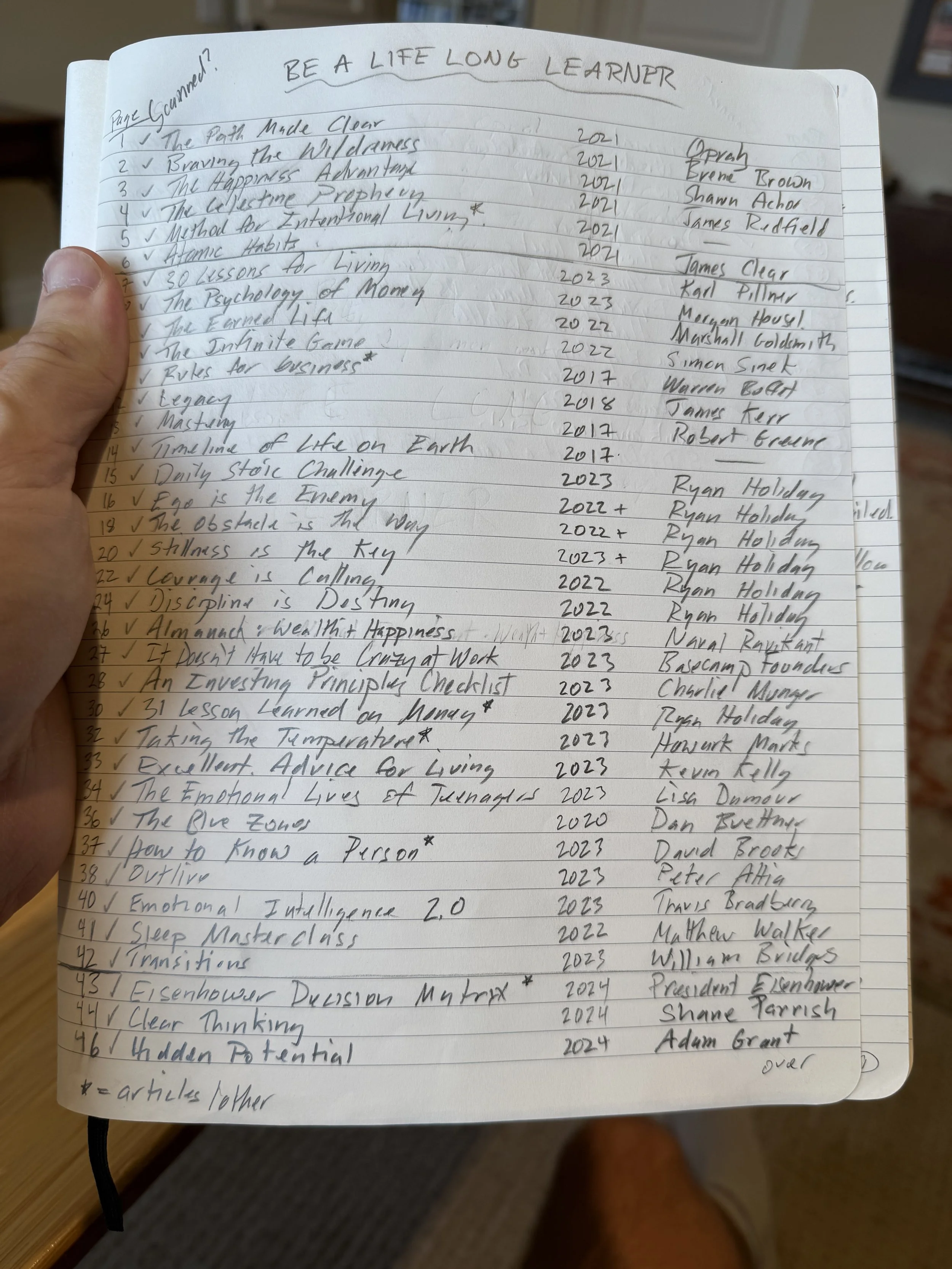
Image 2: The Table of Contents
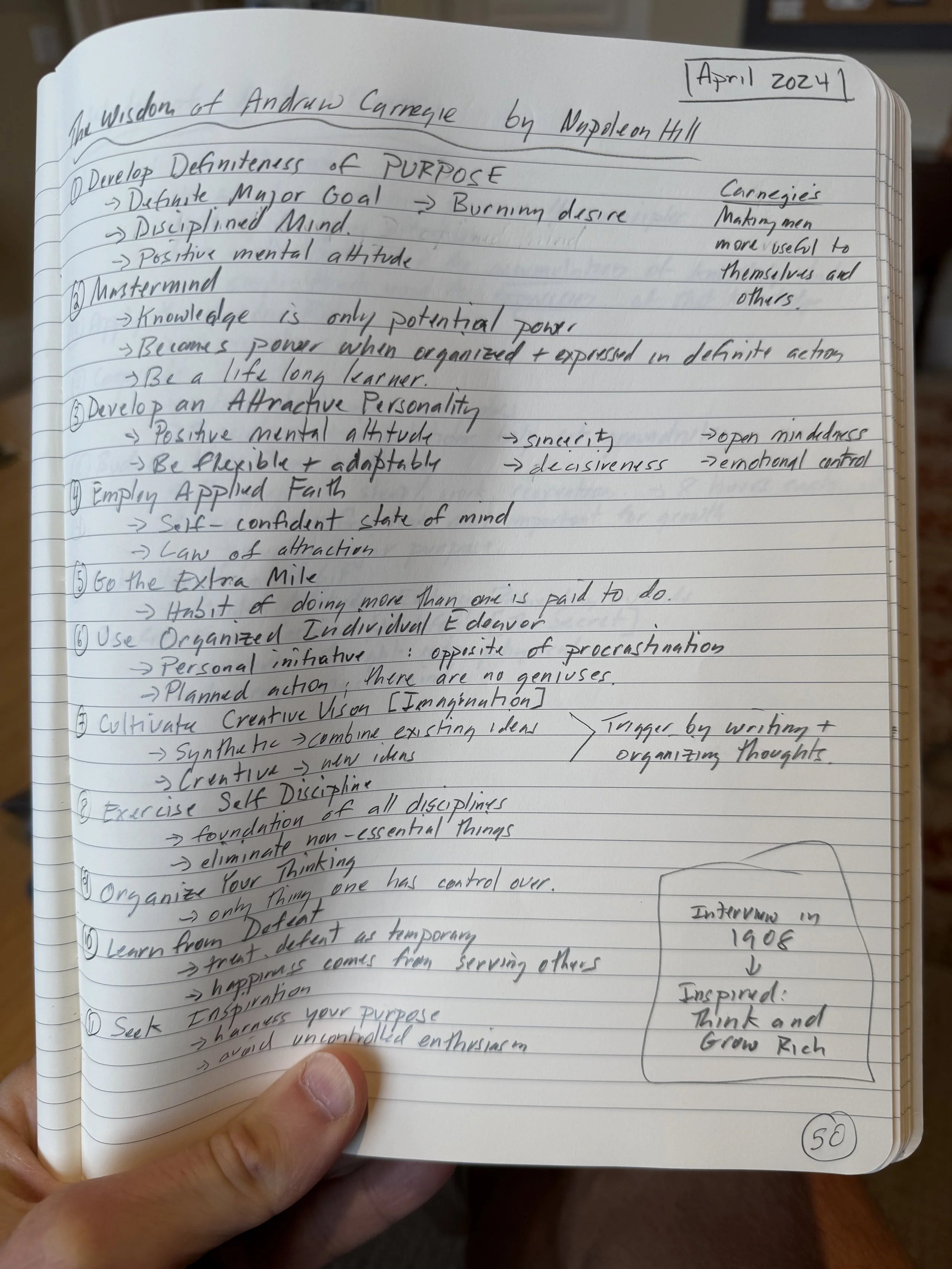
Image 3: An Example of a Book Summary
Anytime I am making a big decision or think of something that I have read and want to re-visit, I turn to my reading journal.
So what have I learned about leadership through reading and becoming a leader at work?
Important Leadership Skills
Be Clear on What You Want: get priorities correct so as to spend time on the correct things.
Measure Success: figure out how to measure whether you are achieving your goals. Measure what matters. Results will follow
Be Driven & Humble: this is the magic combination. Recognize you can always learn from others. You don’t want to be the smartest person in the room.
Give credit to others. Take the blame for mistakes.
Embody the leadership skills you admire. People will watch what you do more than what you say.
Build and Rely on Your Team: don’t do everything yourself. Assemble a team of people that are good at specific areas. Trust them and give them room to do things their own way. Don’t micromanage them.
Respect Differences: other people’s ways may be different from your own. It is results that count, not the methods.
Be Prepared: for meetings and discussions. This means doing the reading and research in advance and expecting the same from others.
Create Focus Time: progress happens in dedicated blocks of time, not in endless meeting and emails. Set aside regular blocks of 90-120 minutes to actually think and do work.
Take a Walk: my best ideas come from my hikes and bikes in nature. Get out of the office to think. Walking 1:1 meetings can be great too.
Be Curious: ask lots of questions. Always be learning.
Create Relationships: the team you work with are not robots. They are people with feelings. Build up your “relationship bank” with others so that you can “draw” from it when you need to have challenging conversations. You need to establish trust before you can work through conflict.
Don’t Be a Jerk: this should be obvious, but some people still behave poorly. Everyone is dealing with something challenging outside (or sometimes inside) the office. Be kind. Be helpful. Give people the benefit of the doubt.
Leaders make decisions with or without perfect information.
Reading and Leadership
Readers are leaders.
For me, much of growth and leadership is integrating information from different areas and applying them to the situation at hand.
Reading is foundational to this.
Read. Read. And then read some more.
It will make you a better investor, leader, and person.