The Many Ways You Can Add Value to Your Real Estate Investment
Options for industrial, retail, office, multifamily, and 1-4 unit residential
Last week we kicked off the series on executing your business plan and I discussed the general ways you can add value to your investment: cosmetic and functional improvements that lead to better leasing (and revenue) performance.
Today we are going to get into specifics by asset class.
As discussed in Asset Classes Explained, there are five main asset classes:
Industrial
Office
Retail
Multifamily aka Apartments
1-4 Unit Residential
There are different ways to add value to each of them. The themes are similar, but the details are different.
In today’s discussion, we will focus on improving the physical building(s) in both cosmetic and functional ways. We will go asset class by asset class.
By the end of this reading you will have a clear menu of options to choose from for yourinvestment. You won’t be an expert, but you will know enough to be dangerous.
Let’s dig in.
Industrial
Industrial is the most straightforward asset class. It is basically a warehouse building made out of concrete with a small amount of office inside. Industrial is used for manufacturing, storing, and/or distributing product. Anything you buy online goes through an industrial building, typically referred to as a warehouse.
So if it is a simple concrete box, there is nothing to do right?
Wrong!
There are plenty of ways to add value:
Paint & Asphalt: It is hard to find a better bang for your buck to change the look and feel of a warehouse than painting the building and doing a new slurry coating (aka painting) the asphalt. It does nothing functionally, but it drastically improves the first impression of tenants.
Signage: Adding signs above each suite can give a better sense of identity. You could also add a monument sign on the street with slots for tenants’ names.
Facade Enhancements: There are ways to make a building look more modern and create better suite identity by adding additional material elements to the exterior. For example: wood panels or metal awnings in sections of the building.
Adding Parking or Re-striping Existing Parking: Industrial users often need space to store their trailers and other materials or for more parking for their employees. Sometimes you can expand or reconfigure your existing site to meet these needs.
Warehouse Improvements: Industrial tenants want functionality. Your space will lease faster and at higher rents with increased functionality. Talk with local leasing brokers to understand the local tenant needs. Then consider improvements to lighting, smoothing the concrete floor, air circulation, power, and truck doors.
Office Improvements: Although the office portion of a warehouse building may be a small percentage of the total square footage, it is important to make it clean and functional. Nothing fancy, but nothing too beat up. Your local leasing broker will guide you.
Let’s move on to retail.
Retail
Retail is much more complicated than industrial. It generally includes multiple buildings laid out across a site with ample parking. Example: a neighborhood shopping center anchored by a grocery store with 20 additional small suites such as restaurants, hair salons, workout studios, and various other stores. Customers are coming and going throughout the day, so traffic (and pedestrian) flow is very important.
With all these moving parts, there are many ways to add value.
Paint & Asphalt: Same concept as industrial.
Signage: Same concept as industrial, but WAY more important for retail. There should be a universal signage program that works for all tenants. It should look like a cohesive center. This often includes a large monument sign (10’+ tall) on the main road with major tenants listed.
Facade Enhancements: Retail buildings often incorporate lots of interesting architectural elements using different materials and elevations. See figure 1 below for an example.
Adding Parking or Re-striping Existing Parking: Same concept as industrial, but even more important. Few things deter retail customers from coming to your center more than not being able to find parking. Get the most parking you can.
Suite Improvements: Most retail tenants want their suite to be a clean, functional box to work with. Retail suites tend to be fairly consistent in size and shape, so national tenants are used to working with these sizes. They will then customize their improvements inside that consistent shape. Go into a few Subway sandwich shops or postal annex stores and you will see what I mean.
Amenities: Retail is about place making. The longer customers stay at your center, the more likely they are to buy from your tenants, and the more rent you can charge. The best retail operators figure out ways to make their centers inviting by adding things like outside seating, fountains, water features, fire pits, and other attractive amenities. They create places people want to hang out in.
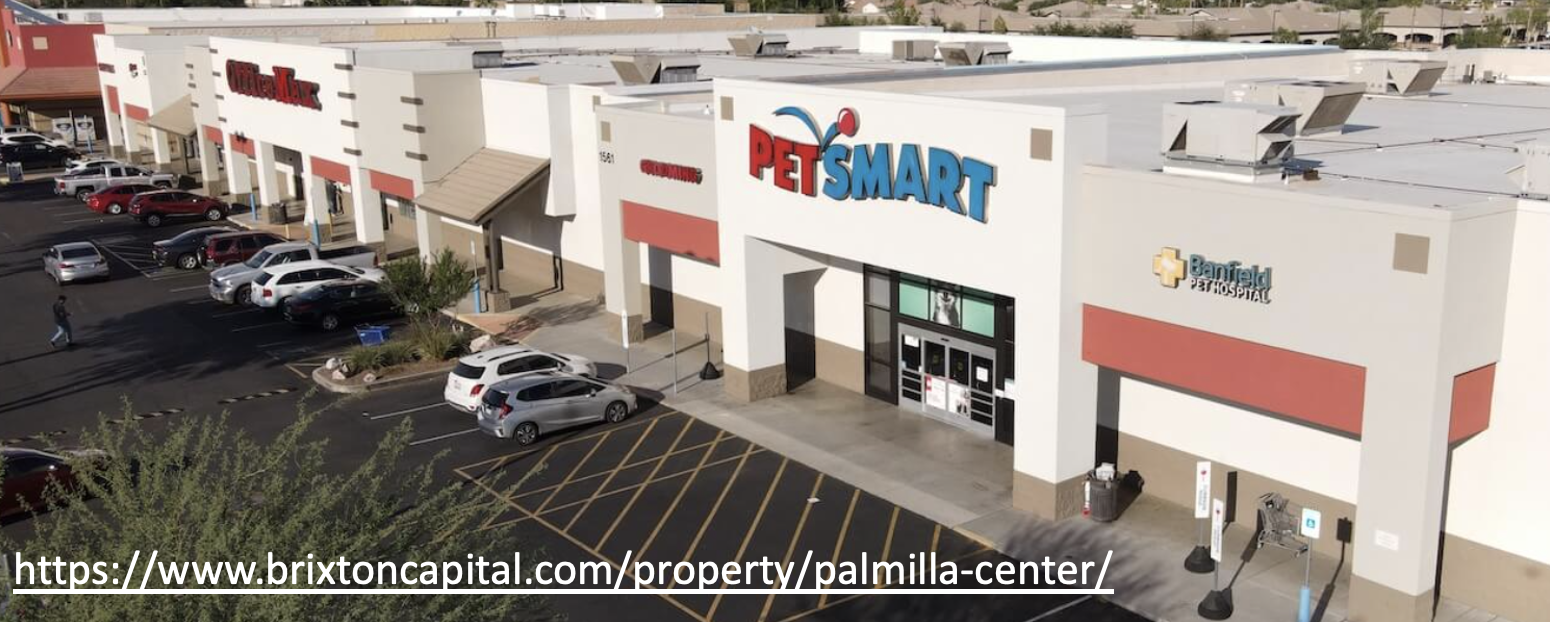
Figure 1: Example of a Retail Facade
Let’s move on to office.
Office
When I refer to office, I am referring to buildings where people generally work on computers. I spent 20+ years of my career working inside office buildings. They can be a single building or an office park.
Here are some ways to add value.
Paint & Asphalt: Same concept as industrial, but not always an option. Many times an office building is made of a stone material and the parking is in a concrete structure. In these cases, there is little to be done.
Signage: Monument and building signage can be very valuable to tenants. Sometimes you can charge extra for these.
Adding Parking or Re-striping Existing Parking: Parking can be very important for office tenants. Sometimes you can even charge more for covered parking (in a structure or under a carport).
Suite Improvements: Office suites, particularly larger ones, are usually customized to the individual tenant needs. It is expensive and wasteful. Imagine if you remodeled an apartment every time a new tenant moved in. Welcome to the wonderful world of office! If you have a vacant suite, work with your leasing broker on a plan to create a clean, functional layout that will work for most tenants.
Amenities: Same concept as retail. Office tenants need to attract employees. Good amenities are appreciated by employees. They include workout facilities, coffee shops, attractive seating for lunch, and anything else that feels inviting.
Let’s move on to multifamily.
Multifamily
Reminder that multifamily is a fancy way of referring to apartment buildings. This could be a single 12 unit apartment building or a 10+ building community with 200+ units or a downtown tower with 300+ units. The higher the number of units, the more likely there are interesting opportunities to add value.
Paint & Asphalt: Same concept as industrial, but apartment buildings are often made out of wood. Sometimes the wood siding needs to be replaced.
Facade Enhancements: Same concept as retail. The more interesting and inviting you can make your apartment community look, the more likely you are to attract tenants.
Adding Parking or Re-striping Existing Parking: Same concept as office, including the potential to charge for covered parking.
Unit Improvements: Here’s where things get different than the other asset classes. Apartment tenants don’t have the ability to customize their space. They “get what they get”. The best multifamily operators do two things to their units that give them pricing power and reduce maintenance costs: (a) they put in the amenities that tenants want the most such as in unit washer & dryers, newer appliances, new cabinet doors, and new countertops and (b) they put durable materials in place that last longer such as luxury vinyl plank (LVP) flooring. These improvements command more rent, lease faster, and cost less to maintain when a tenant moves out.
Amenities: Just like retail and office, multifamily is often about place making. This is where people literally call home. The best operators add amenities residents want most such as secure dog parks, workout facilities, nice pools with seating, BBQ areas, and business centers.
Now let’s see how 1-4 unit residential compares to multifamily
1-4 Unit Residential
Let’s remind ourselves why this is a separate asset class. It is driven by the way it can be financed. Lender’s will consider giving you a loan for your property based on your personal credit. For all the other asset classes, they evaluate and underwrite the propertyperformance. This personal credit evaluation can mean it is an easier entry point for investors.
All the same concepts of multifamily value add apply to 1-4 unit residential, but the smaller size will likely limit the number of amenities you can add.
Now that we have covered all the asset classes, let’s touch upon some additional items that apply to all asset classes.
All Asset Classes
Sometimes you will be faced with the decision of whether to repair or replace a building system. Repairing will be significantly cheaper but replacing will last longer. If a building system is too old or has been left without proper maintenance, replacement may be your only option. This can be true with parking lot asphalt, wood siding, and HVAC units.
There are also two potential value add options that are applicable across all asset classes.
Convert the Use: Your property may be worth more if you convert the allowable use to a different asset class. Example: industrial to multifamily. It is not fast or easy, but can add a ton of value. You could then sell the land/building or redevelop it yourself.
Parcelization: This is the process of dividing an existing piece of land (aka lot or parcel) into two or more legal lots so they can be sold individually. You may have a property with a lot of excess land. Divide it into a separate parcel to sell or redevelop it.
How to Bring it All Together
We have covered a lot. Asset class by asset class. Many ways to add value.
So how do you make sense of it all?
Here’s the formula:
Understand Your Goals + Focus + Talk with Experts + Budgeting + Develop a Game Plan = Setting the Property Up for Success
Understand Your Goals: start here. Re-read Stop Chasing Every Deal: Why Successful Investors Pick a Niche. If you don’t know your goals, you will be lost at how to address each decision.
Focus (aka Think!): now is the time to focus on the list of options within your asset class. Which are most appealing to you? Drive the neighborhood your property is in and look at what your competitors are doing. Take pictures and keep notes.
Talk with Experts: this is the most important step where theory meets reality. Share your ideas and brainstorm with the local team (brokers and/or property managers) that will lease your building. They are the market and leasing experts. Ask them what they think of your property. Ask them to rank the list of options I gave you in order of priority and impact. Ask them what else they recommend doing. Check back on You Don’t Have to Do Everything Yourself: Building Your Real Estate Team to understand how to build the right team around you.
Budgeting: once you have narrowed and ranked your list of initiatives, it is time to start getting a rough sense of cost. You need a budget to work with. This is where contractors come in, which is next week’s topic.
Develop a Game Plan: Finally, look at all the information together and come up with a game plan. Don’t hesitate to circle back with the leasing team to re-visit the list now that you have a better sense of costs.
You may need to stagger your plan over multiple years due to construction lead times, seasonality, budget constraints, or timing of your leases.
Be patient and realistic.
As with many things in life, it can feel overwhelming. By breaking it down into manageable parts, you can make progress.
You can do this!
Step by step.
One piece at a time.
Stay calm and carry on.