New Series Kickoff: Owning & Managing Real Estate
Starting with your complete glossary of real estate terms, from AM to WALT
We have covered a lot so far. I like to think of it as three main subject areas:
Introduction to Real Estate Investing
Investment Fundamentals
The Acquisition Process
Today kicks off the next series of topics:
Owning and Managing Real Estate
We will be covering the following over the coming weeks:
Understanding the terms (aka the jargon and acronyms)
Getting organized for success
Developing your leadership skills
Day to day activities
Reading reports
Property management and accounting
Contracts 101: what’s in a vendor service agreement
Insurance and property taxes
Leasing
Contracts 101: what’s in a broker listing agreement
Contracts 101: what’s in a lease agreement
Construction
Contracts 101: what’s in a construction agreement
Investor and lender issues
Ways to add value to your property
Executing your business plan
What to do next
My core background is in real estate operations. It is a dynamic and exciting aspect of the business, filled with both opportunities and challenges.
I will be your step-by-step guide.
This week we will focus on understanding the terms specific to real estate.
Think of this as your real estate glossary.
So grab your favorite beverage.
Sit back and relax.
Let’s dig in.
Why Are There Commercial Real Estate Specific Terms?
Those of you that have worked in various industries, or even followed a particular sport, know that each domain develops their own acronyms and jargon. This is because:
It is often more efficient to use an acronym.
Each domain has its own unique specifics.
Commercial real estate is no exception.
If you work for a company, you will even find that each company has their own additional layer of terms.
Don't worry. You will figure it out.
The key is to pay attention, be patient, and ask questions. Asking questions is not a sign of ignorance. It is a sign of being a learner. This is a good thing.
The list that follows is broken into sections. You can also find it on my downloads page. Keep it handy for future reference.
Teams & Departments
This is a list of the team that is most involved in property operations.
AM (Asset Manager or Asset Management): the team or team member that oversees and drives theproperty business plan. Think of them as the chief operating officer for a property or collection of properties. Example usage: 'I need to run this by the AM before we commit to the capital expense.'"
PM (Property Manager or Property Management): the team or team member that oversees the day to day operations including tenant and vendor interaction. They are in the “front line”, whereas the AM team is a step removed. Example usage: 'The PM will take lead on communicating that to the tenants.'"
CM (Construction Manager or Construction Management): the team or team member that oversees the construction. The PM team often does some construction, but the CM team handles the bigger and/or more complicated jobs. Example usage: 'The CM should handle the roof replacement as it is a more complicated job.'"
PA (Property Accountant or Property Accounting): the team or team member that oversees the accounting and reporting.
Leasing: the team or team member that oversees the leasing of the property, often working with leasing brokers.
Broker: the team or team member that provides 3rd party services for a commission. There are brokers that specialize in leasing, property sales, and even insurance.
Landlord aka Lessor: the property owner (i.e. you).
Tenant or Lessee: the tenant.
Acquisitions
These are the terms that will come up during an acquisition of a property.
OM (Offering Memorandum): a detailed summary of the property and forecasted financial performance prepared by the broker selling the property. Potential buyers use this to create an initial understanding of the property and its value.
Investment Memorandum: a detailed summary of the property and forecasted financial performance prepared by the buyer of the property (i.e. you). Think of this as the OM with your updated financial projections and business plan.
Base Case Underwriting Model: the multi-year financial projection prepared by the buyer of the property (i.e. you).
PSA (Purchase & Sale Agreement): we covered this in Demystifying Real Estate Purchase Agreements. It is the legal document between a property buyer and seller.
DD (Due Diligence): we covered this in Due Diligence: Your Property Investigation Checklist. This is the investigation done by the buyer of a property before they go non-refundable with their deposit.
Go Hard or Non-Refundable: we covered this in Due Diligence: Your Property Investigation Checklist. This is when buyer completes the due diligence, waives contingencies, and “goes hard” with their deposit.
PCA (Property Condition Assessment): we covered this in Due Diligence: Your Property Investigation Checklist. A 3rd party summary of the physical conditionof the property. It is sometimes referred to as the “engineering report”.
Phase I or ESA (Environmental Site Assessment): we covered this in Due Diligence: Your Property Investigation Checklist. A 3rd party summary of the environmentalcondition of the property.
Survey or ALTA Survey: we covered this in Due Diligence: Your Property Investigation Checklist. A 3rd party summary of the title conditions of the property.
Reporting
The reports will be your guide to how the property is performing.
Rent Roll: the list of units / suites at a property with information on square footage, tenants, rent, lease start, lease end, and many other pieces of information. Each company has their own version of the rent roll.
% Leased:leased square feet divided by total square feet. Example: “the property is 95% leased”.
% Occupied:occupied square feet divided by total square feet. Example: “the property is 95% leased, but only 90% occupied because one of the tenants moved out before their lease expired”.
WALT (weighted average lease term): Average lease term based on lease length weighted by tenant square feet. Bigger tenants have more impact on the WALT than smaller tenants.
Rollover Retention Ratio: percentage of tenants (by square feet leased) whose lease expired and renewed. This is expressed for a specific time (ex. one year) and calculated based on square footage. Example: “the rollover retention ratio is 65% for the last year”.
% Above (or Below) Market: comparison of rent for in place leases vs. market rent. Example: “market rents have gone up so much that in place rents are now 30% below market”.
A/R (Accounts Receivable): we introduced this in Due Diligence: Your Property Investigation Checklist. This shows which tenants have underpaid (or overpaid) their rent and other charges.
Tenant Ledger: we introduced this in Due Diligence: Your Property Investigation Checklist. This shows all the charges and payments associated with each tenant. The A/R report is a moment in time. The tenant ledger is the full history.
General Ledger: this shows the charges and payments (debits and credits) associated with ALL property activity, not just the tenants. Example: it includes expenses charged and paid.
NOI (Net Operating Income): we went through most of this in Due Diligence: Your Property Investigation Checklist. NOI = revenue minus operating expenses. NOI is used to value properties under the cap rate methodology as discussed in Cap Rates: The Simple Math of Real Estate Investing. A couple more specifics:
Gross Potential Rent: if all units were leased at market.
EGI (Effective Gross Income): all the revenue for a property beyond just rent but subtracting vacancy and collection losses.
Operating Expenses: day to day expenses to operate the property such as utilities, maintenance, repairs, insurance, property taxes, and property management fees. It does not include capital expenses, tenant improvements, commissions, or debt service. These are “below” the NOI and factored into the calculation of net income.
Net Income: NOI minus capital expenses, tenant improvements, commissions, and debt service.
Gross Receipts: the rents actually collected for a given period (ex. one month). This is typically used for the calculation of the property management fee. Example: $10,000 gross receipts x 5% fee = $500 property management fee that month.
Income Statement: this shows the revenue, expenses, net operating income (NOI), and other activity, usually according to some chosen accounting rules like GAAP (generally accepted accounting principles). These are usually presented in a monthly format with an annual total.
Cash Flow Statement: similar to an income statement, but this will show the actual cash activity. You may care more about the cash flow statement if you are an investor who wants regular cash distributions from your property.
Budget: whereas income statements and cash flow statements show the actualactivity, a budget shows the projected activity. It is usually done 12-24 months at a time.
Cap Rate and Return on Costs: I did a whole newsletter on this Cap Rates: The Simple Math of Real Estate Investing. If you are at all in doubt, I suggest revisiting it.
Cash on Cash Return: annual distribution to investors divided by original equity. Example: $10,000 distribution divided by $100,000 original equity investment = 10% cash on cash return.
Equity Multiple: total cash returns from an investment divided by original equity. Example: $200,000 total distributions (annual plus proceeds from sale) divided by $100,000 original equity investment = 2.0 equity multiple.
IRR (Internal Rate of Return): time weighted calculation of all distributions to an investor, including from the sale, relative to the original equity investment. Ex. 18% IRR over the 5 year hold period.
Hold Period: how long the investor owns the property, from acquisition date to sale date. Ex. 5 years.
FMV (Fair Market Value): what the property could sell for today. Ex. $200,000.
Cost Basis: total equity invested plus the loan balance. Ex. $100,000.
Tax Basis: for income taxes based on tax rules. Remember: depreciation reduces your tax basis. Ex. $85,000.
PSF (Per Square Foot): usually a dollar amount divided by the square footage. Ex. “I bought the property for $100 psf” or “the lease rate is $1.25 psf per month”.
Capex: Capital improvement costs. Examples: roof replacement, tenant improvements, asphalt replacements, building painting.
Leasing
Leasing is a critical function of real estate operations. Here are the key terms to know.
Exclusive Listing Agreement: agreement between a landlord and listing broker agreeing that (a) broker is the exclusive agent for the leasing (not necessarily the sale) of the property, (b) the fee that the listing and procuring broker will be paid when they lease the space and (c) the duration of the agreement.
Listing Broker: broker representing the building owner aka landlord in a transaction. The listing broker markets the property on behalf of the owner.
Procuring Broker (aka Tenant Rep Broker): broker representing the tenant or buyer in a transaction.
MLR (Make Lease Ready) aka White Boxing: proactively performing tenant improvements to a space before there is a tenant. This helps with marketing.
LOI (Letter of Intent): a typically non-binding agreement between owner and prospective tenant that outlines the key terms of the transaction such as lease rate, annual increases, duration of the lease, tenant improvements, options, etc.
Lease: a binding agreement, typically 15 pages with 20+ pages of exhibits documenting in detail the terms of the lease. For industrial, office, and retail leases, this is typically prepared and negotiated with the assistance of legal counsel.
LC (lease commissions): commission on the total base rent the tenant pays during the term of the lease (before any renewal term). Typically paid 50% upon lease execution and 50% upon tenant occupancy.
TI (tenant improvements): one time cost at start of lease, often expressed as a certain amount psf.
Starting Rate: initial lease rate over the term of the lease.
Effective Rate: average lease rate over the term of the lease.
Lease types relative to expense pass through under a lease:
NNN (Triple Net): typically for industrial and retail; 100% pass through of property operating expenses such as common area maintenance, property tax and insurance.
Base Year/Stop (typically for office): 100% pass through of expense increases over the year in which the tenant first occupied the space (e.g., at the end of the first year of the lease/base year, the actual operating expenses are calculated and become the tenant’s base year; at the end of consecutive years, the tenant will pay all amounts above the established base year amount) .
Gross: no pass through of expenses to the tenant. Typical for residential rentals.
Modified Gross: pass through of some but not all expenses directly related to the leased premises.
MLA (Market Leasing Assumptions): key lease terms from the underwriting or budget; include starting lease rate, growth in lease rate per year, free rent, tenant improvements, make lease ready costs, commissions and lease term.
Loss to Lease: gap between today’s market asking rents and the average in-place rent.
Lease Trade Out: difference, usually in a %, between the previous lease rate and the new lease rate at time of renewal or replacement tenant.
Stacking Plan: visual summary of where tenants are located in a property, usually color coded by lease expiration date.
Rentable Square Feet: the square footage of the leased premises for which rent is charged; Includes a portion of the building’s shared/common area space. Different from…
Usable Square Feet: the square feet of the leased premises exclusively controlled by the tenant as opposed to part of the common area. Both used to calculate…
Load factor: percent increase of rentable square footage over usable square footage minus 100%. Example: “the building has a 15% load factor”.
Debt
We covered a lot of these in Debt: An Amazing Tool with Strings Attached.
Term: the length of the loan, typically expressed in years. (e.g. “3+1+1” is a three year loan with two one year extensions.)
Fixed Rate Loan: interest rate is fixed for the entire loan. Fixed rate loans tend to be longer than floating rate loans.
Floating Rate Loan: interest rate changes at a fixed frequency (ex. monthly) in accordance with an index.
Index: a specific measure that changes over time.
10-Year Treasury Rate: example of an index. Comes in other durations like 1 and 5 years. Reflects the “risk free” rate because tied to the US government. 4.34% as of this writing. 3.38% as of March 2023.
SOFR (Secured Overnight Financing Rate): example of an index often used for floating rate loans. Replaced the index LIBOR. 3.64% as of this writing. 0.30% as of March 2022.
Fed Funds Rate: reflects the costs banks charge each other to borrow funds overnight. When people say “the fed increased interest rates”, this is what they are referring to. The federal government uses this to control inflation (increase) and stimulate the economy (decrease). 3.64% as of this writing. 0.25% as of March 2022.
Basis Points or “bps”: a portion of a percentage point where 100 bps is equal to 1.00%; often used in relation to the interest rate on a loan (e.g., “250 bps over SOFR” means 2.50% over SOFR).
Point: 100 bps or 1%. (e.g., “The lender is going to charge a point origination fee”.)
Spread: the interest rate above an index. Examples:
SOFR + 2.50% = 2.50% above the SOFR rate of 4.80% = 7.30% interest rate (floating rate).
5-Year Treasury + 1.90% = 1.90% above the treasury rate of 3.30% = 5.20% interest rate (fixed rate).
Origination Fee: fee charged by a lender to give the loan.
Interest Only Loan: a loan without amortization (repayment of principal each month).
Amortizing Loan: a loan with amortization (repayment of principal each month).
Hedge: typically a cap or a swap.
Cap: an agreement between a borrower and a 3rd party to establish the maximum amount a floating rate index (SOFR) can increase. (e.g. a 6.00% cap on SOFR for 2 years). The borrower pays a one-time fee to the 3rd party providing the cap.
Swap: an agreement between a borrower and a 3rd party to convert a floating rate index (SOFR) to a fixed rate for a specific period of time. Money is exchanged between parties whenever the index adjusts. Both parties are making a bet on whether interest rates will increase or decrease. A borrower may want a swap to reduce uncertainty.
Equity and Joint Ventures
We haven’t gotten to equity and joint ventures yet, but here is a preview for some of the terms we will cover.
GP (General Partner) or Operator: company or individual that operates the property day to day.
LP (Limited Partner) or Equity / Money Partner: company or individual that provides money to buy the property. They could have many or no approval rights.
Major Decisions Rights: rights the LP has to approve certain decisions.
JV (Joint Venture) or LLC (Limited Liability Company) Agreement: agreement between GP and LP that details all the terms under which the partners will operate.
SPE (Special Purpose Entity): legal entity, typically a limited liability company (aka LLC) that the partners are members of through which they own the property. They use this to shield their liability exposure to just this investment.
Entity Organizational Chart: boxes and arrows showing the legal ownership structure.
Signature Block: legal structure of entities authorized to sign on behalf of the legal entity.
Fees: fees paid by the property to the operator for certain functions. These are negotiated between the GP and LP. These fees and functions are in addition to those performed by a broker. All investors (both GP and LP) pay the fees. Examples are shown in the table below.
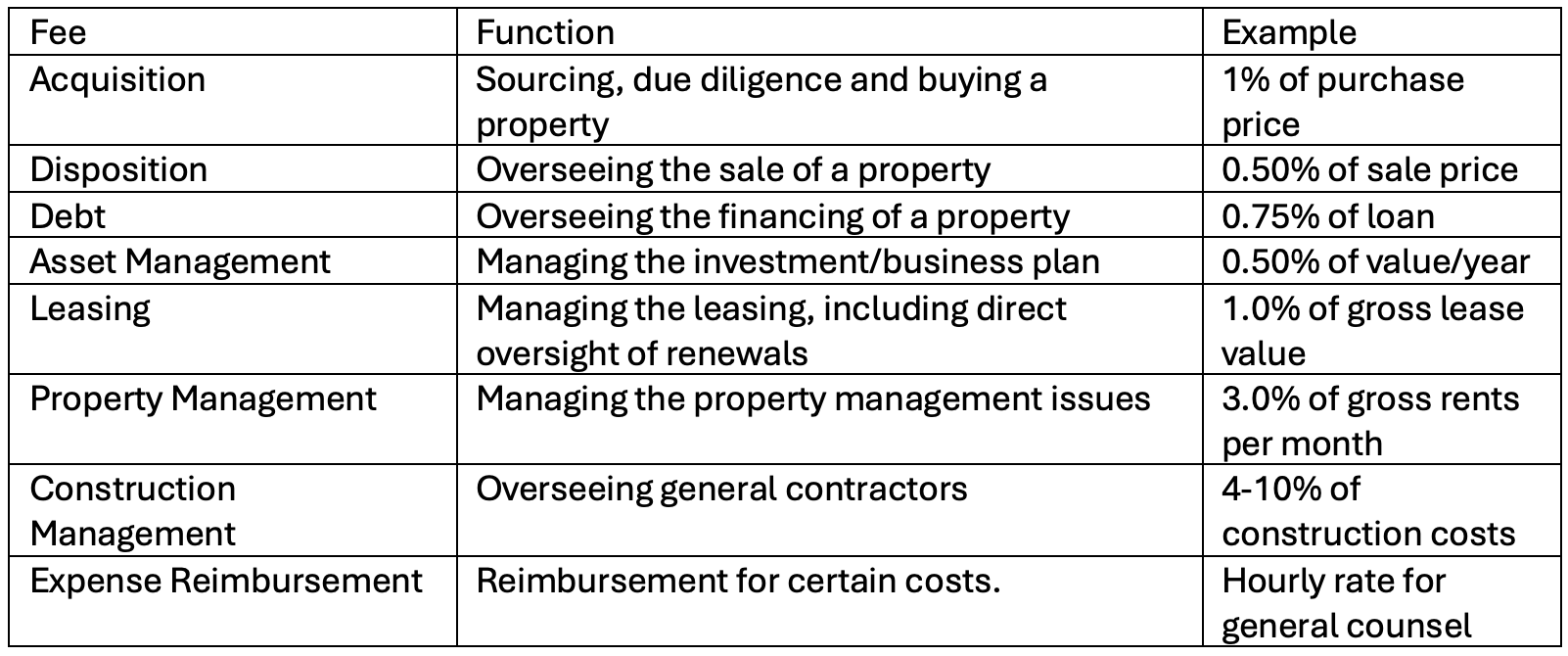
Table: Example Fees Charged by a GP
Promote: money that the GP earns if the investment does very well. Example: GP invests 5% ($50K) of the $1M equity required. LP invests $950K. GP gets 20% of all proceeds above an 8% IRR.
What to Make of All These Terms
Is your head spinning yet?!
You just read a glossary of real estate terms. Well done!
Will there be a test?
No.
But…
You will come across many of these as you invest and work in the commercial real estate industry. You will remember some and forget others.
Just know that this set of information is here for you when you need it. Download an editable file of the glossary on the downloads page.
Add to it as you discover new terms.
Remember that the key is to pay attention, be patient, and ask questions. Asking questions is not a sign of ignorance. It is a sign of being a learner. This is a good thing.
Always be learning!