Why the Highest Rent Isn't Always the Best Deal
How to market your space, understand a letter of intent, and see what an offer is really worth
Last week I introduced the 4 tools you can use to accurately project your rents: competitive set, lease comps, understanding your local market, and working with brokers.
Today we are going to take the next step to understand how to (a) bring prospective tenants to your property so you can (b) pick the tenants that will be the best fit for your property.
“Fit” is a broad word.
It covers things like rent, concessions, start date, length of lease, tenant credit, tenant improvements, and broker commissions.
Different owners will have different priorities, making “fit” unique to each owner.
Regardless of your priorities, you want to maximize your options. As with anything, having multiple options usually yields better decisions and outcomes.
For example, if you are ready to lease a car, it helps to get quotes from multiple car dealers. Having multiple quotes and options allows you to compare price, timing, and other criteria.
It is often the process of comparing bids that allows you to see what is most important to you.
Getting multiple bids when you are buying something is straightforward. Make the calls or visit the sellers.
Comparing multiple tenants to lease your space is a bit harder. You can’t control when someone needs space, but you can control your marketing outreach to make sure all the tenants that are looking for space to lease consider YOUR space.
This is what we are going to get into today.
How to market your property.
Negotiating the best deal for your property.
Residential and commercial are fundamentally different in these processes, so we will discuss them separately.
Let’s dig in.
Residential: How to Market Your Property
As a reminder, residential refers to both 1-4 unit residential and multifamily (aka apartments). The tenants (aka residents) are individuals, not businesses.
The residential marketing process involves three components:
Value add initiatives to show the units and the amenities in the best light.
Maximizing the exposure of your property to bring in prospective tenants.
Having an effective sales process once a prospective tenant comes in to see the property.
We discussed value add initiatives in The Many Ways You Can Add Value to Your Real Estate Investment.
Maximizing exposure includes all the ways you can get the attention of potential tenants from signage to banners to search engine marketing to social media. These are tried and true marketing techniques across many industries beyond real estate.
The unique aspect of residential real estate is the sales process led by a member of the property management team. The sales person literally walks the prospective tenant through the property, highlighting key features of the property and the location.
For 1-4 unit residential the focus will be on the individual unit and the benefits of the location.
100+ unit apartments are much more involved. There will be a specific tour path the sales person takes all prospective tenants on.
I personally experienced this as a prospective tenant when I went to my first large apartment complex. Here’s how it went.
Leasing Center: it started with a bright and lively leasing center.
Pool: we then walked by the pool, where I saw people sunbathing.
Gym: next it was the renovated gym. In my head I was thinking that I could cancel my gym membership and use this instead.
Unit: we moved on to the unit where the sales person highlighted the renovated kitchen and view.
Dog Park: we ended by walking past the dog park area where I saw dogs running free in a fenced area.
All the while the sales person was listening to my reactions and adjusting the sales pitch, including saying that she already had another person interested in the unit I liked best.
I signed the lease that day. A sales job well done.
The larger and more professionally managed the apartment complex, the more likely they will follow a similar process.
Residential: Negotiating the Best Deal For Your Property
In Leasing: The Engine That Can Turbo Charge Your Revenue, I oversimplified the leasing process by saying that adding value to residential (as compared to commercial) is about making the improvements and watching your hard work pay off as the rents increase.
The marketing section above debunks some of this simplification, but the distinction between residential and commercial still holds.
Fair housing law affects how larger operators manage the leasing of their apartment complexes. This law prohibits discrimination on the basis of protected classes. Larger operators adopt uniform pricing as a risk-management practice. One price for everyone is a clean way to prove you didn’t treat applicants differently.
For buildings leasing under the uniform pricing model, the prospective tenant either agrees to the rent and signs the form lease or doesn’t. It is a “go, no go” decision without any negotiations. The only flexibility the prospective tenant may have is choosing the length of the lease.
The 1-4 unit residential segment is more actively negotiated, but not as extensively as commercial. The negotiations will typically be limited to the rent and length of the lease.
Commercial real estate leasing is all about negotiations. This is where we will go next.
Commercial: How to Market Your Property
Whether industrial, retail, or office, tenants for commercial properties are businesses. Some of the same marketing fundamentals apply, but the primary method for commercial is direct outreach to individual businesses and their broker representatives.
This is where leasing brokers come in.
There are two main types of brokers when it comes to leasing: landlord rep and tenant rep. “Rep” is short for representative. Some brokers do both, but many specialize.
A landlord rep broker specializes in representing building owners in marketing and leasing their property.
A tenant rep broker specializes in representing businesses (i.e. tenants) in finding space for them to lease and negotiating the best deal for them.
Both landlord rep and tenant rep brokers are compensated by earning a commission if a lease is signed. This commission is paid by the owner. We will cover commissions in a future newsletter.
The leasing process is as follows:
Owner hires a landlord rep broker on an exclusive basis using a broker listing agreement detailing the length of the agreement and how much the broker will be paid. We will cover the details of the listing agreement next week.
The landlord rep broker markets the property to brokers and businesses in the area using a leasing brochure. See below for links to some examples.
A prospective tenant will tour a space with or without a tenant rep broker.
If the tenant likes the space, negotiations will begin.
Negotiations are where we will move to next.
Commercial: Negotiating the Best Deal For Your Property
Negotiations play a HUGE role in commercial leasing.
The owner and landlord rep broker set an “asking rate” that is usually shown on the leasing brochure. The tenant rep broker then uses this as a starting point to try to negotiate the best deal for their client (the business that is interested in leasing the space).
At this stage the parties are negotiating a non-binding Letter of Intent (LOI) that outlines the primary lease terms that will be incorporated into a lease. We will cover the details of the LOI next week.
See below for a table that shows how the negotiations for an industrial building might play out, using the example from last week’s newsletter.
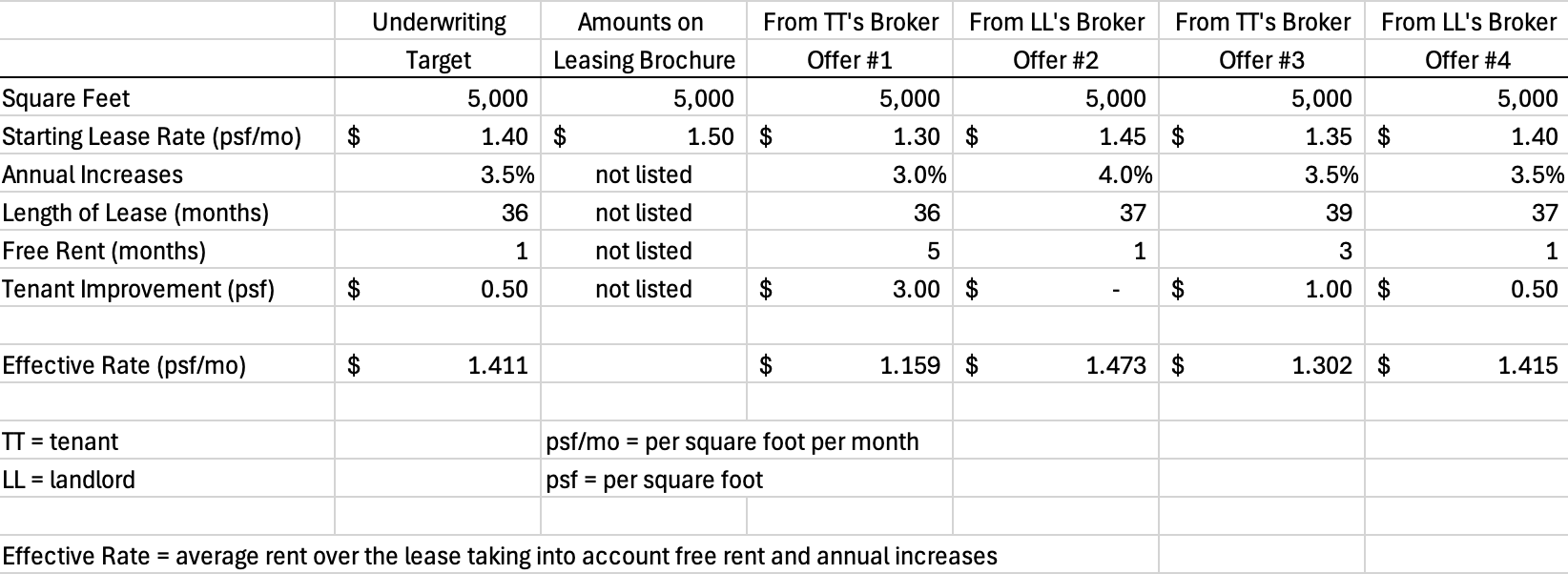
Table 1: Lease Negotiation Example
Let’s break down what is going on in the table above.
Asking Rate vs. Underwriting Target = $1.50 vs. $1.40: the asking rate is higher than the underwriting target to leave some room for negotiations.
Initial Offer from Tenant’s Broker: the broker started aggressively: $1.30 start rate (vs. the asking rate of $1.50) plus 5 months of free rent and $3 psf of TI’s. The effective rate is $1.159 vs. the underwriting target of $1.411. There is still a lot of work to be done.
Over the subsequent three LOIs, all parties came to an agreement on the terms shown in “Offer #4”. Let’s compare the amounts agreed to in Offer #4 vs. the Underwriting Target.
Start Rate: $1.40 vs. $1.40 = good outcome.
Effective Rate: $1.415 vs. $1.411 = good outcome. The owner was able to agree to 1 month of free rent but get an additional month of paid rent to help increase the effective rate (36 months of paid rent + 1 month free rent = 37 month lease).
Tenant Improvements: $0.50 vs. $0.50 = good outcome.
As I said in the beginning with any negotiation, you need to understand the criteria that are most important to you such as:
Maximum starting rent.
When the rent starts: start date plus months of free rent.
Length of lease.
Amount of tenant improvements (TI’s) you are willing to give.
Different owners will have different criteria preferences and these preferences will change over time. Examples:
An owner who plans to hold the property forever may be willing to take a lower starting rent in exchange for a sooner rent start date, no free rent, and no TI’s.
An owner planning to sell (or refinance) the property in the near term may want the complete opposite: maximize the starting rent but be willing to push out the start date and give more free rent and TI’s. This is because they want to maximize the net operating income to sell at a cap rate that maximizes the sales price.
Negotiations are about knowing which criteria are most important to you and the prospective tenant and then finding a deal that both parties can live with.
When it comes to comparing multiple prospective tenants, this can mean running parallel negotiations.
See below for a table that shows the initial offers (#1) from two prospective tenants.
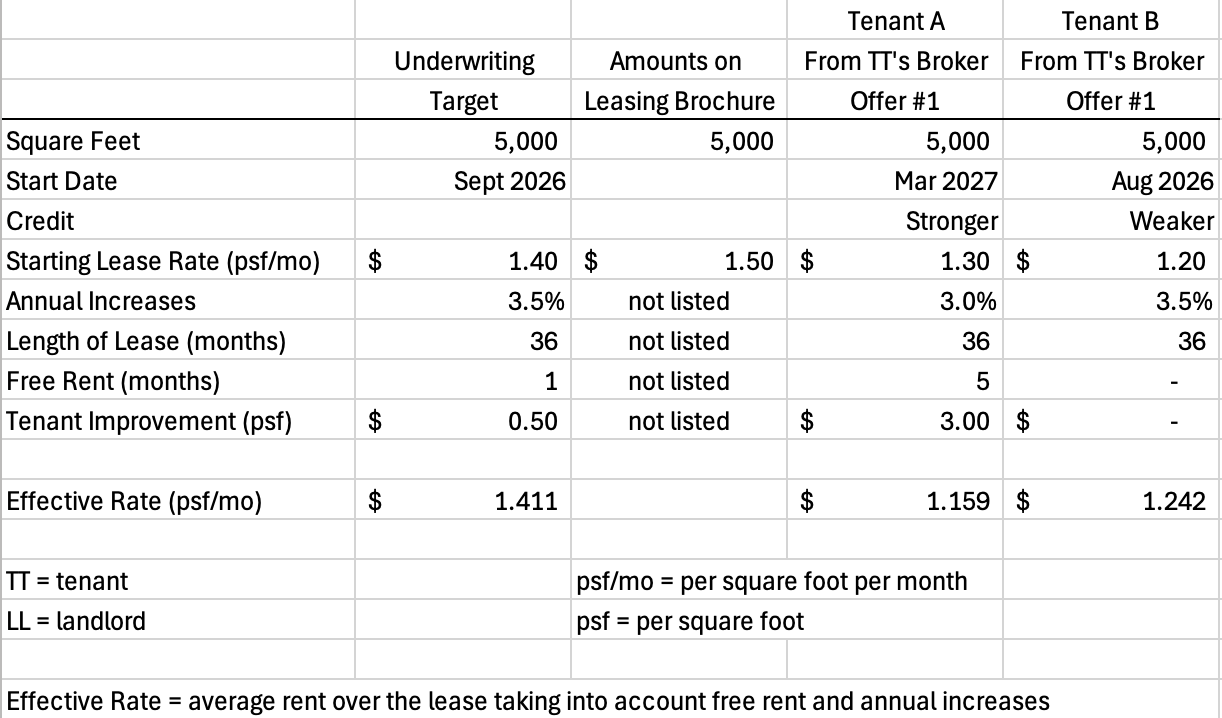
Table 2: Lease Offer Comparison for Two Separate Tenant Prospects
Let’s break down what is going on in the table above.
Starting Lease Rate: both offers are below your $1.40 target. Tenant A’s offer is better at $1.30 vs. $1.20 for Tenant B, but…
Effective Rate: Tenant A’s offer is worse at $1.159 vs. $1.242 for Tenant B.
Credit: Although Tenant B has a better effective rate, they have weaker credit.
Other Criteria: Tenant B’s offer is more attractive in other areas vs. Tenant A:
Annual Rent Increases: 3.5% vs. 3.0%.
Free Rent: none vs. 5 months.
Tenant Improvements: none vs. $3.00 psf ($15,000 in TI’s).
Start Date: I have introduced a new factor showing when the lease will start. You have an underwriting target of September 2026. Tenant A is proposing March 2027. Tenant B is proposing August 2026. That is a 7 month difference. 7 months at $1.40 psf/mo x 5,000 square feet = $49,000 of rent. This is huge, especially for an owner focused on cash flow.
Tenant B is a better deal despite the lower starting rate. You need to get comfortable with the weaker credit, but this is an analysis exercise.
So how do you approach this?
Understand the criteria that are most important to you.
Recognize that these are just the first round of offers. Remember Table 1. Things will evolve during the negotiations.
Accept that you often need to simultaneously negotiate with multiple tenant prospects at once to see where you end up.
Remember that you can say “no.” You won’t come to acceptable terms with all tenant prospects.
Negotiations can go on for weeks and even months. Or they can happen in a matter of days. Here are three real world examples of industrial leases I have experienced.
Example 1: Typical
Negotiations for the industrial building happened over two offers and then moved to the lease negotiations.
Example 2: Extremely Fast
We knew the tenant needed a building immediately and that they were considering multiple options. We skipped the letter of intent and sent them a lease ready for signature with terms that we felt were reasonable. They signed the lease immediately without any negotiations. Very unusual, but true.
Example 3: Extremely Slow
The negotiations with this Fortune 50 company over the LOI took over six months and then the lease negotiations took another year. Painfully slow, but we didn’t have any other tenant prospects.
Closing Thoughts
This discussion highlighted the similarities and differences between residential and commercial. They follow different formulas.
Residential
Effective Marketing + Strong Sales Process = Strong Leasing Performance
Commercial
Hire a Broker + Direct Marketing + Active Negotiations = Strong Leasing Performance
In both cases, you as the owner need to make sure you understand the criteria (ex. maximum rent vs. steady cash flow vs. spending more money) that are most important to you so that you can take action and make decisions that yield the best results for you and your investors.
Take the time to think about what you want, measure the results of your team’s actions, and make adjustments as needed.
You got this.