The 4 Tools to Nail Your Rent Projections
Competitive sets, lease comps, local market review, and broker intel - how the pros figure out what a property will rent for
Last week I gave you an overview of the leasing process and the differences between commercial and residential leasing.
Today we are going to deep dive into how to understand a market and where your property fits into it. This will help you accurately project (aka underwrite) your rent.
Real estate investing is about buying investment properties. This is fundamentally different from buying a home you will live in.
An investment property needs to perform by bringing in rent.
From the tenant’s perspective, rent is an expense. Tenants (i.e. businesses and individuals) want to minimize expenses. Therefore, they want to minimize rent.
Owners want maximum rent. Tenants want minimum rent.
This is where we see the tension of supply and demand.
When you are buying a property, you need to project what the property will rent for. Unfortunately, this is when you know the least about the property and you have a due diligence deadline. You run the risk of making a costly underwriting error if you estimate market rents too high.
But don’t worry. There are ways to mitigate this risk.
Today I will navigate you through the tools and techniques to understand the market in which your property is located. This mitigates risk. They include:
Your competitive set.
Lease comparables (aka lease comps).
Understanding the local market.
Working with brokers.
Macro factors that change market conditions.
How to make sense of it all.
Let’s dig in.
Tool #1: Your Competitive Set
Unless you are developing a property in the middle of nowhere (do not do this!), you should be able to use similar properties in the same market to better understand the leasing prospects for your property.
Similar properties in your property’s geographic market are known as your “competitive set”.
They won’t be exactly the same, but they will be similar. You will take into account things like location, building age, condition, square feet or number of units, multifamily amenities, occupancy, owner, and any other factors you think are relevant.
Creating your competitive set allows you to define your competition. These are the properties you will be competing with for tenants. As with any competitors, each will have strengths and weaknesses.
One property may be in a better location than yours, but have some functional challenges. Another might have worse curb appeal than yours, but have access to cheap electric or some other unique feature. Create your competitive set by:
Putting the buildings and their characteristics in an excel table with a picture of each asset.
Adding notes on the pros and cons of each property.
Adding a row for the asking rent for each property. This is how much the property is “asking” tenants to pay.
Creating a map of each building showing their location relative to your property.
Here is an example of a competitive set for an industrial property.
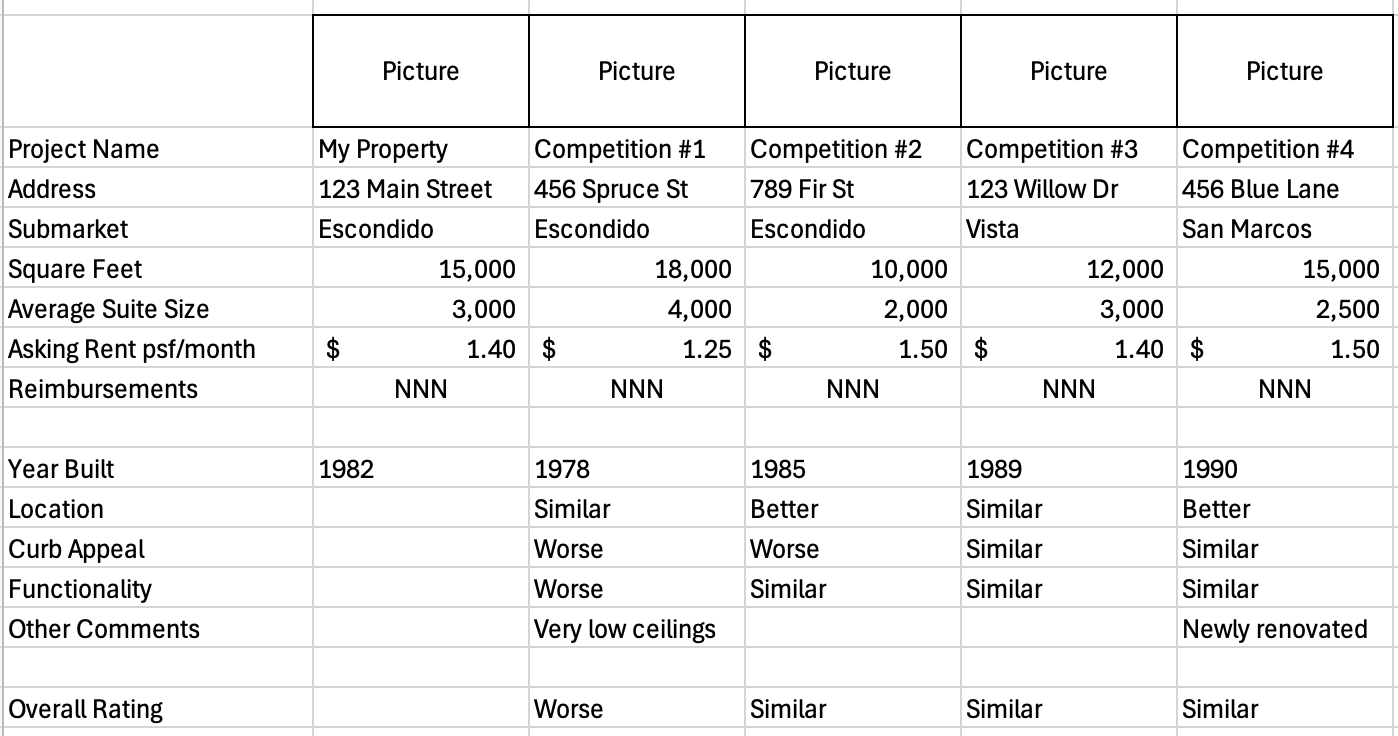
Table 1: Competitive Set Example for Industrial Property
Now let’s add in lease comps.
Tool #2: Lease Comparables (aka Lease Comps)
The competitive set helps you understand the market, but it is limited in that it only includes asking rents.
You want to look at deals that have actually been signed in the market.
This is where lease comps come in.
Lease comps are a table of data that includes details on leases that have been signed in your market in the past 12-24 months. You want recent comps because markets change over time and older comps become stale. Here is an example of a set of lease comps:
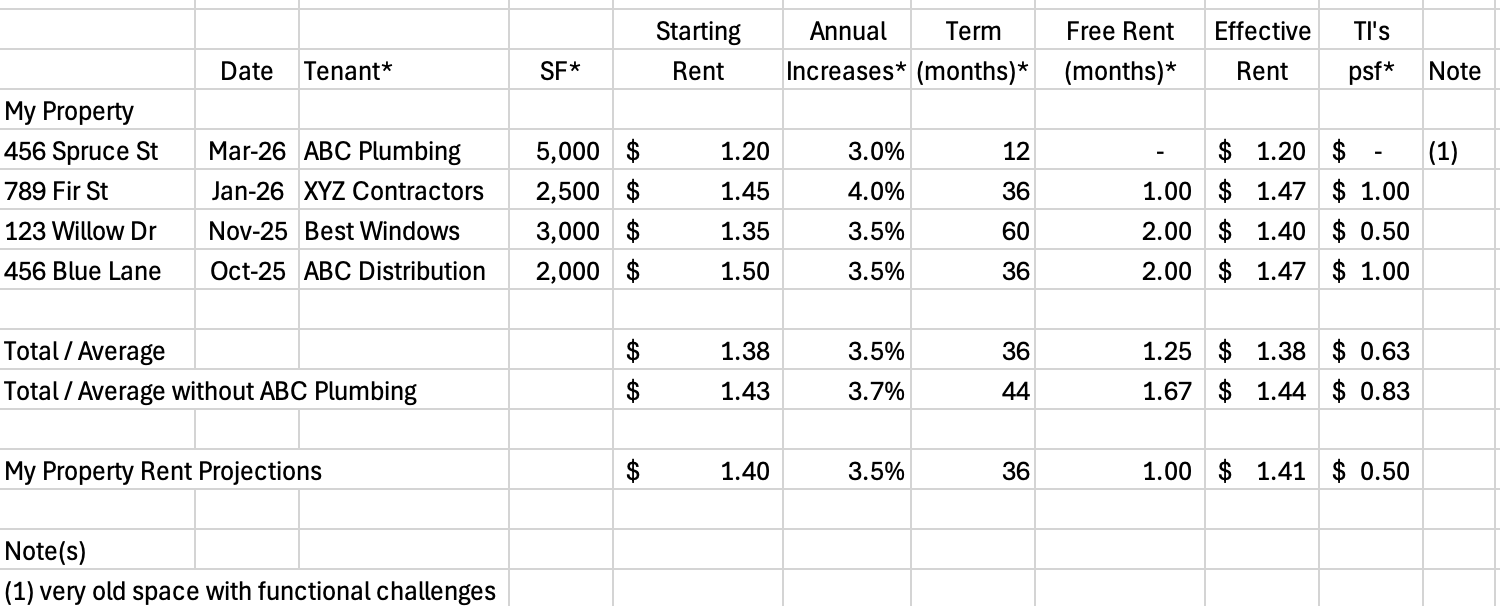
Table 2: Lease Comps Example for Industrial Property
Effective rent refers to the average rent taking into account annual increases and free rent over the full lease term. We will cover this in a future newsletter.
Lease comps are history, not speculation. They are made up of leases that have been signed at properties that are similar to yours.
In the table above, I compared my starting rent projections of $1.40 per square foot (psf) per month to the comp average of $1.38. We are a bit high.
Then I removed the first comp with ABC Plumbing because it was a short-term deal in a challenging space. This brings the average up to $1.43 compared to my assumption of $1.40, which makes me feel more comfortable.
The effective rent also checks out at $1.44 (after removing ABC Plumbing) vs. my assumption of $1.41.
It can be sobering to look at the lease comps relative to what you are projecting for rents for your property. Be realistic. If the lease comps don’t support your projections, this is a red flag.
In this case you better have some secret sauce to convince you, your investors, and your lender why you will be able to hit your rent projections.
I have made the mistake of not taking into account free rent and tenant improvements when looking at lease comps. I relied on a high lease comp to support my rent projections only to find out after I owned the property that the rent was so high because the owner had given 6+ months of free rent and a huge tenant improvement package to get the starting rent unusually high. This is why it is so important to track both free rent and tenant improvements as separate columns.
Don’t make this mistake yourself.
Sometimes you will see a lease comp that looks much higher or lower than the rest. Ask for details on this and consider removing it from your set of lease comps.
Let’s move on from lease comps to understanding your market.
Note on table 2: columns marked with an asterisk (*) refer to data used in commercial, not residential. For residential, the competitive set and the lease comp data are often combined into a single table that includes the asking rent but no lease comps.
Tool #3: Understand The Local Market
Each market has its own unique characteristics. These affect how a market will perform. Characteristics will include:
Population size.
Health of the local economy.
Major employers.
Universities and the quality of education.
Tax policy and whether the local municipality is pro or anti-development.
Access to freeways and airports.
Housing affordability.
Quality of life factors such as entertainment, outdoors, weather, and schools for children.
Any other unique factors of that market.
All of this translates into determining whether people want to live there. Can they find a job that allows them to afford housing, send their kids to a good school, and have a good quality of life?
The key is to understand the market you are investing in and how your property fits into it. Take the time to read research materials and talk with market experts.
Let’s move on to the role of brokers.
Tool #4: Working With Brokers
You may be reading this and wondering how you are going to get all this data to understand the market, develop your competitive set, and build out your lease comps.
There are professional databases out there such as LoopNet & CoStar for commercial and Zillow & Redfin for residential. These can be excellent sources of information but (a) they can cost money for premium subscriptions and (b) there is no substitute for talking with people who work a geographic market every day.
Local market brokers will be your market experts.
The key word in this statement is LOCAL. You want to work with brokers (and property managers for residential) that focus on the market your property is in. Finding a broker who has “done a deal” in that market is different from a broker who focuses on your market.
Always pick the broker with market focus. They live and breathe the market. They are the experts.
They will understand the market drivers, the characteristics of the other owners, and most importantly, what the tenants in that market value most.
They are used to helping investors new to the market understand it. Look at properties for sale that fit your target market and asset class. Find a broker who is selling one or two properties. Then reach out to them to say that you plan to invest in this market and would like to meet them to help get a better understanding of the key market drivers.
Make it clear that you are ready to invest soon, so they know you are not wasting their time.
They will put together competitive sets and lease comps from their database. The good ones will give you an overview of the market by (a) giving you a Google Earth tour of the market in their office and (b) driving you around the market to see the properties that make up the competitive set and lease comps.
Pro tip: don’t just take one broker’s opinion of the market. Try to talk with 2-3 brokers to triangulate the information. Lease comps are facts, but there is subjectivity as to which lease comps to select and how the competitive buildings compare to your building. Be respectful of brokers’ time, but don’t feel you need to be exclusive to just one.
That wraps up the four key tools, but there is one more thing to watch: macro factors.
Macro Factors That Change Market Conditions
So far we have been property specific while also understanding market factors.
But there can also be major changes in market conditions that can completely adjust how all properties in the market perform by fundamentally changing the supply and demand dynamics for a period of time.
Here are some examples:
Major new development(s): rents have been going up so developers decide it is time to build. A few years later, the market is flooded with new supply giving leverage to tenants and reducing rents. This is what has happened to the multifamily / apartment market over the past few years (2023-2025).
Global pandemic: the COVID-19 pandemic of 2020 and the resulting government actions completely changed the dynamics for multiple asset classes:
Apartments: increased demand due to stay at home orders.
Office: reduced demand due to increased amount of remote work.
Industrial: increased demand due to online shopping and consolidation of supply chains to be more local.
Retail: reduced demand due to stay at home orders.
Macro-economic slow down: when the economy slows, demand across all asset classes tends to decrease as both people and businesses cut expenses. The reverse happens when the economy is growing.
War and geopolitical uncertainty: fear tends to make people uncertain and spend less.
Some of these examples affect all markets and asset classes. Some are more local and asset specific. All tend to be uncontrollable from an individual property owner’s perspective. All you can do is decide how to interpret the information and take (or not take) action.
So how do you bring it all together?
How To Make Sense of It All
Competitive sets, lease comps, broker guidance, market factors…it is a lot to take in.
Here’s my guidance on how to make sense of it all.
Analyze the market before you make your first offer. Pick your niche. Take the time to understand the market before you have a due diligence deadline.
Kick the tires. Get out in the market. Walk and/or tour your competitive set.
If you will be adding value to your property, have two versions of your rent projections: (a) before your value add initiatives and (b) after. Compare your lease comps against each. You may even decide to create a second competitive set to compare your “post renovation” property to.
Talk with multiple, local brokers. Don’t just rely on one person’s opinion.
This is not a “one and done” exercise. Revisit the data and talk with brokers regularly. The market will continue to change, as should your projections and asking rates.
Markets go through cycles. Sometimes they favor the owners/landlords. Sometimes they favor the tenants.
At some point during your property ownership, most of you will be blindsided by some macro event that will turn your world upside down (examples: 2025 tariffs, 2020 global pandemic, 2008 great financial crisis, 2001 internet bust).
Welcome to living in an uncertain world. This is life.
When it happens, breathe.
Take it slowly.
Think. Don’t react too quickly.
The tools and techniques described here will help you navigate the market in good times as well as when the world feels like it has turned upside down overnight.
Competitive Set + Lease Comps + Broker Reconnaissance + Local Market Conditions = Accurate Rent Projections
The process is there to help and guide you.
You got this!