Renew or Roll the Dice on a New Tenant?
How to weigh a sure renewal against three prospects — and the tenant rights that can make or break the deal
Today is our fifth and final discussion on leasing where we will get into decisions you will need to make when managing your tenants and leases such as whether to:
Renew an existing tenant or try to find a new tenant.
Give a tenant a right to renew, expand, contract, or terminate their lease early.
All of this will build off of the four previous newsletters on leasing:
Leasing is dynamic.
It involves negotiating rights and obligations of each party (landlord and tenant). Some can be clearly measured financially. Others are non-financial in nature and harder to quantify.
Today I will break down the following:
The big four tenant rights: renewal, expansion, contraction, and early termination.
Defining “Deal Breakers”
Lease analysis example for decision making.
Let’s dig in.
The Big Four Tenant Rights: Renewal, Expansion, Contraction, and Early Termination
As discussed in How to Read Leasing Contracts Without Getting Burned, leases include rights and obligations for both tenants and landlords. Four of the rights that tenants often want that landlords may be more reluctant to give are:
Renewal Options
Expansion Options
Contraction Options
Early Termination Options
They are “options” in that the tenant has the option, but not the obligation, to exercise this right. Some of these options will be “unilateral”, meaning only one party (typically the tenant) has the right. Others will be “bilateral”, meaning both the landlord and the tenant each have the independent right to exercise the option.
Let’s define each one and then see how they factor into decision making.
Renewal Options
Definition: unilateral right of tenant to renew at the expiration of their lease.
Example: two 3-year options to renew at 100% of market rent.
Why Tenants Want It: gives them the right, but not the obligation, to continue running their business in that location.
Why Landlords Don’t Like It: a renewal option encumbers the space and reduces the landlord’s flexibility to lease to other tenants or sell the project to a business that wants to own and occupy the building (aka an owner user).
Typical Compromise: most landlords will give a renewal option or two at market rent unless they have specific plans for the building at the end of the lease.
Real World Example: We once leased a retail suite to a national restaurant chain with strong credit. It was a very attractive rent. The only negative was that the tenant would only do the deal if we gave them two 3-year renewal options at a pre-agreed upon fixed rent. This required us to pre-agree upon a rent in the future. We ended up agreeing to this fixed rate renewal option because the rent and tenant credit were so strong. The risk we took on is that the market rent could rise above the rent in the fixed rate renewal option.
Expansion Options
Definition: unilateral right of tenant to expand into another suite in the building or business park.
Example: existing tenant in suite A (10,000 square feet) has the ongoing right to expand into suite B (5,000 square feet) at 100% of market rent if the existing tenant in suite B vacates.
Why Tenants Want It: gives them the right, but not the obligation, to expand at the existing location if the business is growing.
Why Landlords Don’t Like It: an expansion right encumbers another suite and makes leasing more complicated.
Typical Compromise: most landlords will strongly resist giving this right.
Real World Example: Years ago we leased an office suite to a fast growing, venture capital funded technology start up in San Francisco. We gave the tenant multiple expansion rights at market rent in order to win the deal from another landlord because (i) the rent was strong (ii) the tenant improvements were low, and (iii) the space had been vacant for a year.
Contraction Options
Definition: unilateral right of tenant to reduce their leased square feet.
Example: existing tenant with a 5-year lease in suite A (10,000 square feet) has the one time right to reduce their leased square feet to 7,500 square feet at the end of year 3. Tenant will pay the cost of demising the suite.
Why Tenants Want It: gives them the right, but not the obligation, to downsize their business for any reason.
Why Landlords Don’t Like It: this reduces the stability of the landlord rent roll and income.
Typical Compromise: most landlords will strongly resist giving this right.
Real World Example: We bought an industrial park as part of a portfolio acquisition. The park was 30% leased. The existing tenant had multiple one-year contracts with its customers. As the tenant continued to bring on more customers, they expanded into a total of 70% of the park. In order to get these deals done, we agreed to give the tenant ongoing contraction rights with 3-months notice. It was worth it because (i) there were few other tenant prospects and (ii) the expanding tenant took the spaces immediately and without any tenant improvement costs.
Early Termination Options
Definition: unilateral (or bilateral) right of either landlord or tenant to terminate the lease early.
Example: either landlord or tenant may terminate the lease with 6-months notice at any time after the 36th month of the 5-year lease for a one time termination fee of $10,000.
Why Tenants Want It: gives them the right, but not the obligation, to downsize their business for any reason.
Why Landlords Don’t Like It: this reduces the stability of the landlord rent roll and income. A landlord may want this right if they plan to redevelop the project in the future.
Typical Compromise: most landlords and tenants will strongly resist giving this right to the other party.
Real World Example: Let’s go back to the tech startup example from the expansion option discussion. This same tenant signed a 10-year lease but negotiated a termination option at the end of year 7. We were able to accept this because (i) the termination penalty was equal to an additional year of rent and (ii) the other deal terms were so compelling.
As I said before, options can’t always be quantified financially. It helps to understand which options you can live with and which you can’t, which is where we will go next.
Defining “Deal Breakers”
As you can see by the real world examples, leasing is dynamic and full of trade-offs. Each party (landlord and tenant) will ask for things that the other party may not want to give.
Sometimes one party will not compromise on an issue no matter how compelling the other deal terms are.
These are “deal breakers”.
Knowing what your deal breakers are in advance will help you better analyze and negotiate leasing opportunities. Here are two examples:
Termination Option with Specialized Tenant Improvements
Situation: we had a tenant prospect that wanted to lease a suite for 7-years at a good rate but needed expensive tenant improvements to build a customized section in 30% of the space. Not only was the build out expensive, but it was also very unique. No future tenant would want to use it, so it would need to be demolished at the end of the lease. The tenant also wanted an ongoing termination right starting at the end of year 3.
Why It Was a Deal Breaker: we decided to pass on the prospect due to the combination of (i) the expensive, specialized tenant improvements and (ii) the ongoing termination right.
Expansion Option in a Strong Leasing Market
Situation: the leasing market was strong with high tenant demand. We had a tenant prospect who wanted to lease 10,000 square feet in a 50,000 square foot industrial park. The lease rate was good and the tenant improvements were low, but the prospect wanted an ongoing expansion option on the other 40,000 square feet for the entirety of their 10-year lease.
Why It Was a Deal Breaker: we decided to pass on the prospect due to the ongoing expansion option, particularly at a time when the leasing market was so strong. Note that we gave the expansion option in the tech startup example above. The difference was that (i) the tech startup was leasing 40,000 square feet vs. 10,000 square feet in this example and (ii) the leasing market was not as strong in the tech startup example.
Lease Analysis Example for Decision Making
Now that we have a strong foundation of leasing, let’s run through a lease analysis example to show how an owner might decide what to do in various leasing situations.
Imagine a situation in which you have a 5,000 square foot suite that is leased to a tenant that has paid rent on time for the last three years. Their lease is expiring and the tenant wants to renew.
You need to decide whether to renew your current tenant or lease to one of the three prospects your leasing broker has found. The deal terms are summarized in the table below.
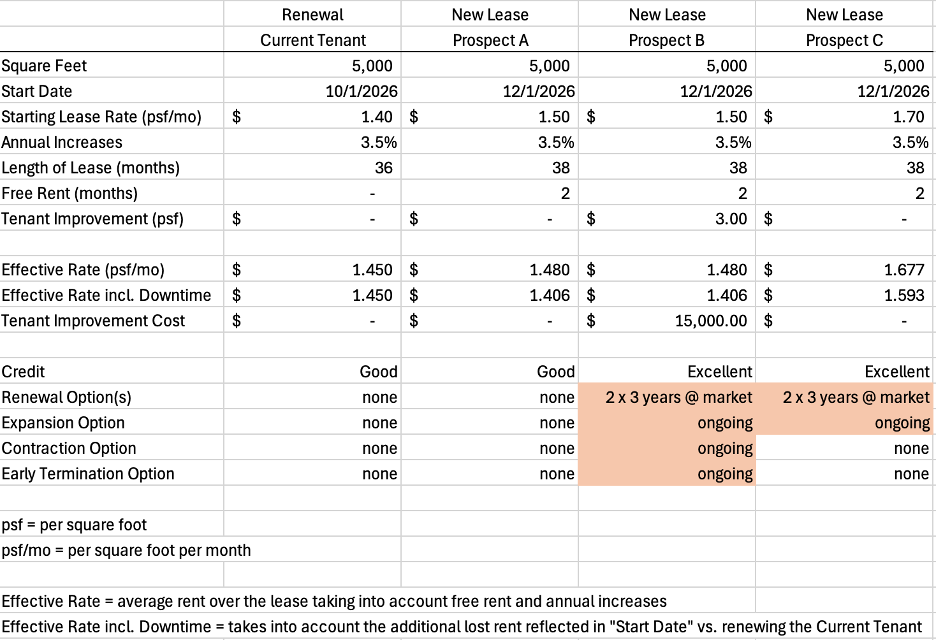
Table 1: Lease Comparison Example
So what does this table tell us? Prospect C is the best option. Let’s go through each one in detail to understand why.
Current Tenant vs. Prospect A
Current Tenant: will renew for three years as-is (no tenant improvements) for an effective rate of $1.450 psf/mo. As the renewal starts the day after the lease expires, the effective rate incl. downtime is also $1.450 psf/mo. This is our baseline.
Prospect A: will lease the space at a better start rate ($1.50 vs. $1.40) and effective rate ($1.480 vs. $1.450 - even with 2 months of free rent), but their lease will start two months later than the current tenant. This delayed start date reduces the “Effective Rate incl. Downtime” to $1.406 vs $1.450 for the current tenant.
Conclusion: unless the owner wants a higher start rate of $1.50 to present better optics for a stronger refinance or sale, the current tenant offers a better effective rate incl. downtime.
Current Tenant vs. Prospect B
Prospect B: same effective rate as Prospect A, but with $15,000 more in tenant improvement costs and all four of the rights landlords don’t like (renewal, expansion, contraction, and early termination).
Conclusion: unless the owner really wants the excellent credit, this is a worse deal than Prospect A. Current tenant is still the best deal.
Current Tenant vs. Prospect C
Prospect C: these are the best economics as compared to current tenant - start rate ($1.70 vs. $1.40), effective rate ($1.677 vs. $1.450), and effective rate incl. downtime ($1.593 vs. $1.450). They have excellent credit and don’t need any tenant improvements. The only downside is that they want renewal options and an expansion option.
Conclusion: the improved economics would likely be compelling enough for the owner to go with Prospect C over the current tenant, even with the renewal and expansion options. The only way the expansion option might be a deal breaker is if (i) the leasing market is extremely strong or (ii) the landlord has other plans for that suite.
Closing Thoughts
Not all leasing decisions will be obvious. They will be filled with trade-offs relative to financial and non-financial terms. Here’s the process I recommend to help you make decisions on which tenant to go with:
Start with the pure math on the financial terms to see the best deal.
Then layer in the tenant credit.
Finally, factor in the options the tenant is asking for. Are any of these deal breakers for you?
Then take the time to think about what is important to you.
Financially, do you care more about (i) cash flow or (ii) maximizing net operating income so that you can sell or refinance?
How important is tenant credit to you?
Are you willing to take on the risk and uncertainty associated with the tenant options? If you are selling or refinancing in the near term, make sure you talk with a sale broker and/or debt broker to understand how these options will be viewed by buyers and/or lenders.
Trade-offs will always exist. Take the time to think about them and understand what is most important to you.
Think.
Analyze.
Negotiate.
Repeat.
Be patient and focused to negotiate the deal that works for you.