The Power of Promote: A Real Deal, Fully Broken Down
Understanding equity waterfalls and the impact of fees on returns
Over the past five weeks, we have covered four case studies and compared what it is like to invest as a general partner (GP) and a limited partner (LP).
Today I am going to bring these two concepts together by building off of the home run deal from When the Market Bails You Out and integrating the fees and promote introduced in GP vs. LP: Who Does the Work, Who Takes the Reward?.
The case study was about an investor who bought an industrial building and lost operational focus. The investor was bailed out by rising rents and decreasing cap rates resulting in a home run deal.
The deal yielded a 2.30 equity multiple: $206,914 net sale proceeds (before tax and excluding cash flow) on a $90,000 equity investment over a four year hold period.
If only all deals would perform this well!
We are going to build off of this deal and see what would have happened if the investor (i.e. you) had raised 95% of the equity from limited partners (LPs) and only invested 5% of the equity yourself by forming a joint venture partnership.
Today we will cover:
The joint venture structure
The process of raising equity
The financial performance
The key takeaways
Let’s dig in.
The Joint Venture Structure
Let’s do a quick recap on the 100% leased industrial deal from the case study When the Market Bails You Out.
It was a $300,000 deal funded by $210,000 of debt and $90,000 of equity. The equity was 100% funded by you. The cap rate on costs was 7.5% and the interest rate on the interest only loan was 6.5%. This positive leverage (cap rate > interest rate) resulted in an initial cash-on-cash return of 9.9%. You operated it for 4 years and sold it at a 7.00% cap rate, making a 2.3 equity multiple as described in the introduction.
Let’s rewind the clock and see how this could have looked if you had raised money from LPs to create a joint venture structure. Here is how it would look:
Equity: 5% by you. 95% raised from LPs.
Fees:
Acquisition: 1.5% of purchase price. $296,000 x 1.5% = $4,440 one time fee.
Asset Management: 1.5% of equity. $98,000* x 1.5% =$1,470 per year.
Property Management: 4% of gross revenue. $1,200 per year.
Equity Waterfall:
Equal amounts (aka pari passu or pro rata) until an 8.0% internal rate of return (IRR) and then
80% to all investors, both GP and LPs, based on their 5% / 95% ownership and 20% to promote (100% to GP)
Let’s decipher what this means.
*We will get into why the equity rose from $90,000 to $98,000 in the Pro Tip below.
Equity
This is straightforward. Instead of funding 100% of the equity yourself, you raise 95% of it from LPs.
Fees
Again, fairly straightforward. You have decided to charge a collection of fees, both one-time (acquisition) and recurring (asset and property management).
Equity Waterfall
This is a bit more complicated, but you will grasp it.
Remember, promote is the ability for the GP to earn a higher percentage of the total profits than the percentage of their original equity investment if the deal does well.
In this case you structured the deal such that you earn promote if the deal does better than an 8% IRR. You get 20% of all the amounts over an 8% IRR. This additional amount is known as promote.
IRR is a common calculation used in real estate investing. It is effectively a deal's annualized return, taking into account the time value of money. IRR is the single discount rate that makes the present value of all the cash in and out equal zero — it rewards getting money back sooner.
Pro Tip: those of you comparing the original case study with the fee calculations above may notice something. The equity went from $90,000 to $98,000. Why? Three reasons: (i) the acquisition fee of $4,440, (ii) increased acquisition cost of hiring a lawyer to help you with the joint venture agreement, and (iii) the fact that the lender is giving you a fixed loan amount of $210,000 regardless of whether you have LP partners or not. See table 1 for summary.
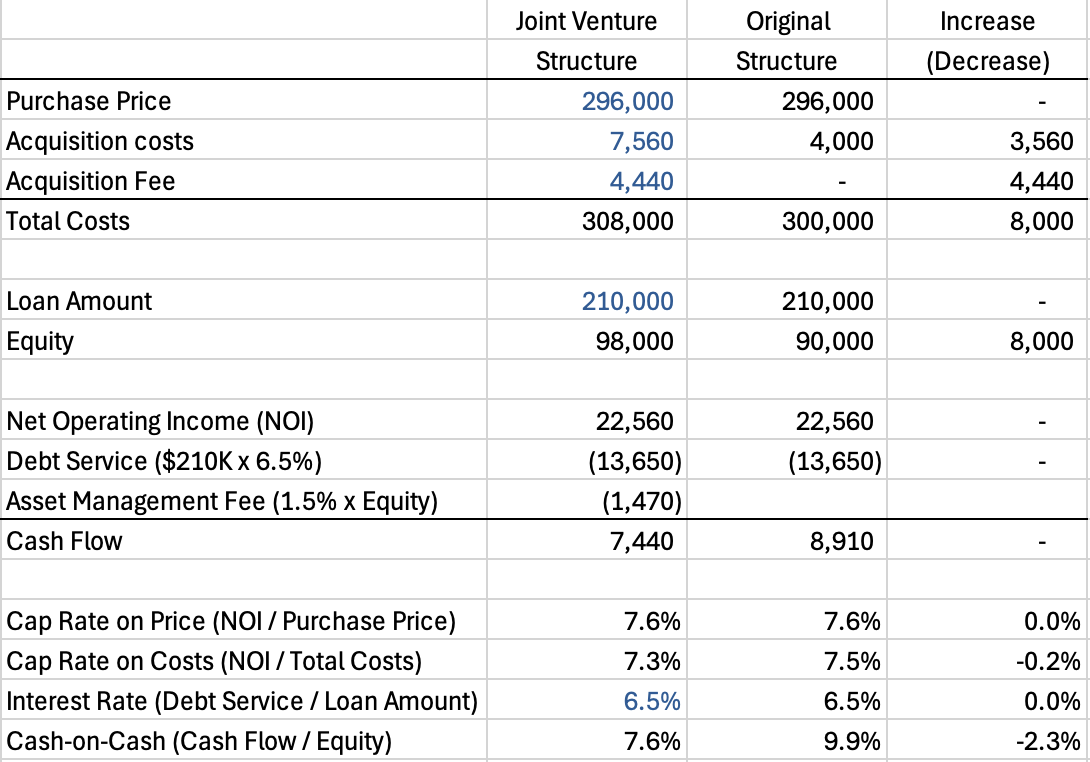
Table 1: Increased Costs of Joint Venture Structure
You should notice something else from the table. Two of the key return metrics went down: (i) cap rate on costs from 7.5% to 7.3% and (ii) cash-on-cash returns from 9.9% to 7.6%.
The cap rate on costs went down because the NOI remained constant while the costs increased from $300,000 to $308,000.
The cash-on-cash return went down for two reasons: (i) increased equity —$90,000 to $98,000 — due to the acquisition fee and increased structuring costs and (ii) the 1.5% of equity asset management fee you are charging. Any fee that is a percentage of equity charged on an annual basis directly reduces the cash-on-cash return.
Key Takeaways
Fees Reduce Returns: charging fees directly reduces the deal returns, especially cash-on-cash returns. The legal and structuring costs of a joint venture also increase costs.
Don’t Get Too Greedy: choose the fees and equity structure you feel are reasonable, recognizing that the LP investors will need to get excited about the returns after fees. Do the research to see what other GPs are doing.
The Process of Raising Equity
Books could be written on the process of raising equity. There are teams at large real estate companies that focus on it.
Here are what I believe are the most important considerations for individual investors acting as a GP:
Great Deals Sell Themselves: it starts with having a great deal. Find a deal you are excited about and your potential LPs should get excited too.
Be Realistic: don’t load the deal with too many fees. Look at the after fees returns and think about whether the LPs will get excited about these returns.
Start Small: you may want to anchor low on fees and promote structure for your first deal or two. Once you have a successful track record, you can justify charging more.
Look At $$$, Not Just %: the asset management fee above starts at $1,470 per year. This is just over $100 per month. You may find it is better to skip this fee and maintain a higher cash-on-cash return percentage. Instead, you could consider a disposition fee.
Whatever structure you choose, you will still need to follow a typical sales process to raise equity:
Create clear marketing materials that describe the deal and returns.
Reach out to many investors, likely starting with your friends and family.
Get enough investors to commit the 95% of equity.
Get everyone to sign the joint venture agreement and fund their money.
Do all of this fast enough to meet your due diligence and closing deadlines.
None of this will be fast or easy. You will need to work hard and persevere.
The Financial Performance
You are a hard worker. You persevere and raise the 95% of equity from the LPs. Now let’s look at the financial performance under this fee and promote structure.
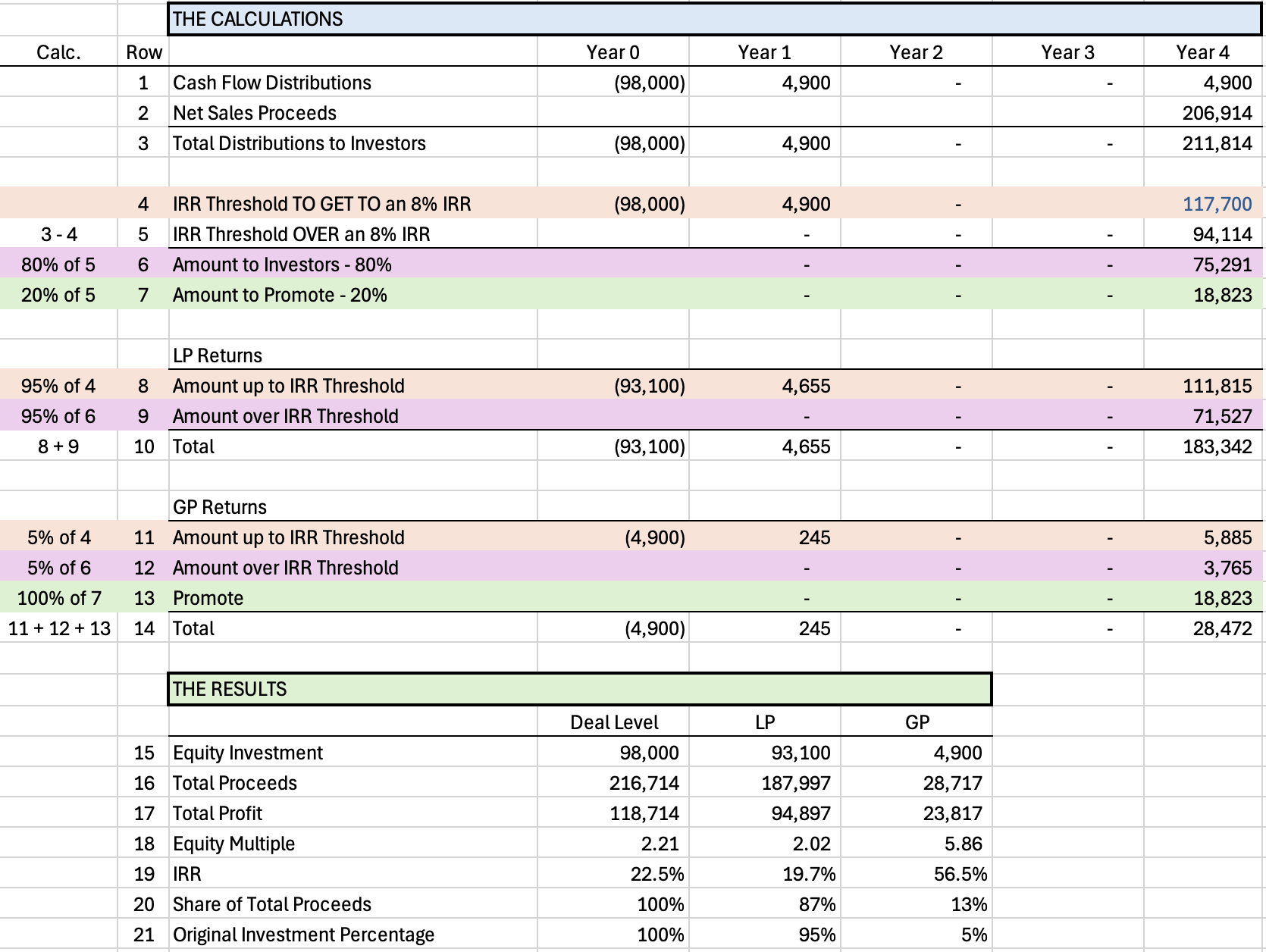
Table 2: Equity Waterfall With Promote Structure
The Calculations
Everyone gets an equal share of the distributions up to an 8.0% IRR. Above this 8.0% IRR, the distributions go 80% to all investors (LPs and GP) and 20% to the GP as promote. Here’s the breakdown.
Deal Returns (rows 1-3): before any promote calculations.
Promote Calculations (rows 4-7):
Row 4 shows the amount TO GET TO an 8.0% IRR <shown in orange>.
Row 5 shows the amount OVER the 8.0% IRR.
Row 6 shows 80% of row 5 going to all investors (LPs and GP).
Row 7 shows 20% of row 5 to promote (GP only).
LP Returns (rows 8-10)
Row 8 shows the LP getting 95% of the amount TO GET TO an 8.0% IRR <shown in orange>.
Row 9 shows the LP getting 95% of the amount OVER an 8.0% IRR <shown in pink>.
Row 10 adds up row 8 and 9 for the total LP returns.
GP Returns (rows 11-14)
Row 11 shows the GP getting 5% of the amount TO GET TO an 8.0% IRR <shown in orange>.
Row 12 shows the GP getting 5% of the amount OVER an 8.0% IRR <shown in pink>.
Row 13 shows the GP getting all of the promote from row 7 <shown in green>.
Row 14 adds up rows 11-13 for the total GP returns.
It’s a lot of math and not for the faint of heart. Understanding promote models (aka equity waterfalls) takes time and practice. You may want to re-read this section several times.
The Results
All of this results in the LPs and GP getting different returns as shown in rows 15-21.
Because the deal did so well (22.5% IRR - row 19), the promote was big ($18,823 - row 13) and the GP had a strong equity multiple (5.86 - row 18) and IRR (56.5% - row 19).
The LPs still did very well with a 2.02 equity multiple and a 19.7% IRR.
Everyone did well, but the GP’s equity multiple and IRR are much better than the LPs’. The GP invested 5% of the equity (row 21) and earned 13% of the total proceeds (row 20). That is the power of promote.
The Key Takeaways
So what do you make of all of this?
Here are my key takeaways:
The Joint Venture Structure Reduces LP Returns: charging fees reduces the deal returns, especially cash-on-cash returns. There is also the legal cost of structuring a joint venture agreement. The promote further reduces the investors’ returns, so only strong performing deals will be able to support this joint venture structure.
Everyone Wins If the Deal Does Well: there were no bad results in this example. Both the LPs and the GP did well, doubling their money in 4 years.
If the Deal Does Well, the GP Does REALLY Well: in terms of equity multiple and IRR, the GP did really well. They invested $4,900 (row 15) and pulled out $28,717 (row 16) in proceeds resulting in a 5.86 equity multiple before tax. This is an amazing way to turn limited investment funds into bigger dollars in a way you couldn’t do if investing by yourself.
IRR & Promotes Are Very Sensitive to Sale Proceeds: look at how much of the deal performance came from the sale: $206,914 (row 2) of $216,714 (row 16). Over 95%! Remember our sensitivity table from the case? Let’s look at an updated version, taking into account the GP/LP structure. Look at the IRRs below. If the rents were lower, the IRR barely reaches (or doesn’t reach) the promote threshold. Deals and promotes are highly sensitive to how well the deal does at time of sale.
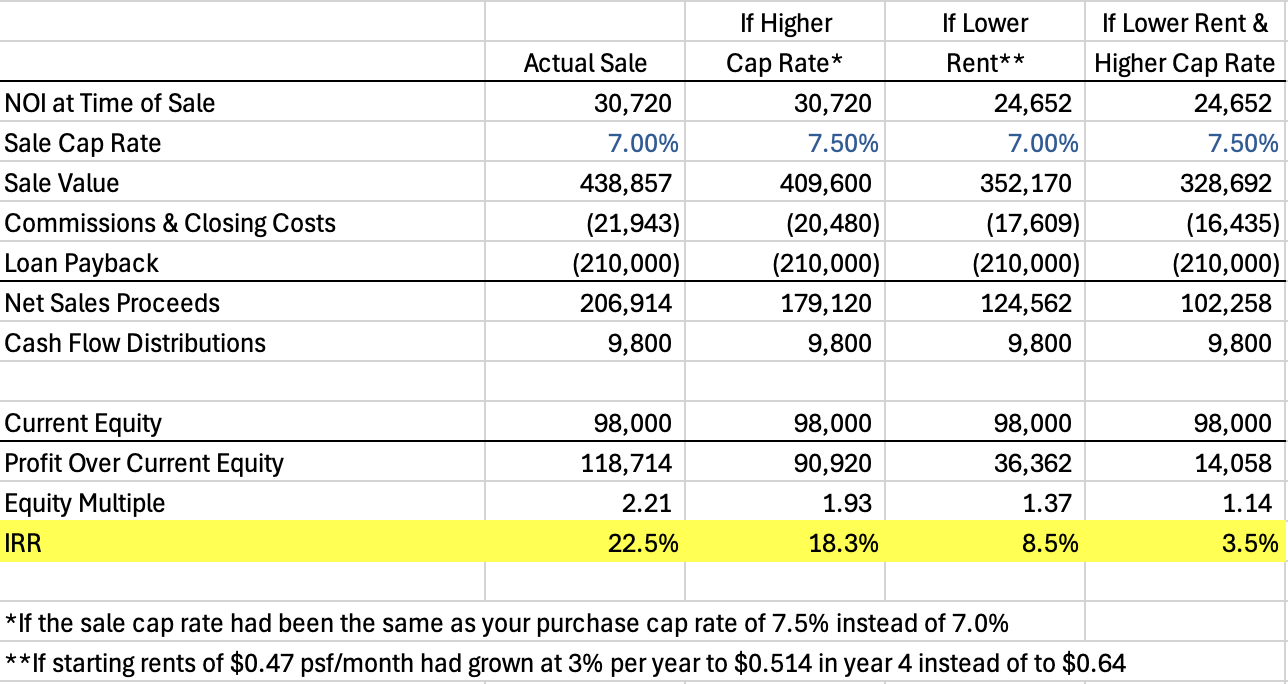
Table 3: IRR Sensitivity
Raising money from LPs is more expensive and a lot more work, but for the right deal it can be an excellent way to turbocharge your returns.
Try adding a zero to “The Results” from table 2: you invest $49,000 (row 15) and make total proceeds of $287,170 (row 16). Bigger deals = bigger dollars.
But remember to walk before you run. Do a deal or two on your own to develop your real estate investing skills.
By learning the fundamentals, you will drastically increase your chances of success when considering becoming a GP.
GP vs LP: Who Does the Work, Who Takes the Reward?
Why both investment options should have a place in your portfolio
Today we kick off a new series on the difference between investing as a general partner (GP) and a limited partner (LP).
You may have heard the terms GP and LP before, but I challenge you to take a moment and try to define what they really mean when you hear comments like:
“I have 5 LP investments that are crushing it. Easy money.”
“The fees and promotes that come with being a GP are too hard to pass up. Easy money.”
So which is better?
Today I will explain the key differences and trade-offs between being a GP and an LP. Here’s how we will approach it:
Defining what a GP and an LP is
Responsibilities & rights
Fees
Promote
Why I do both
By the end of this newsletter, you will have a clearer understanding of how to evaluate GP and LP investing relative to your goals.
Let’s dig in.
Defining What a GP and an LP Is
Here is a comparison of a GP and an LP:
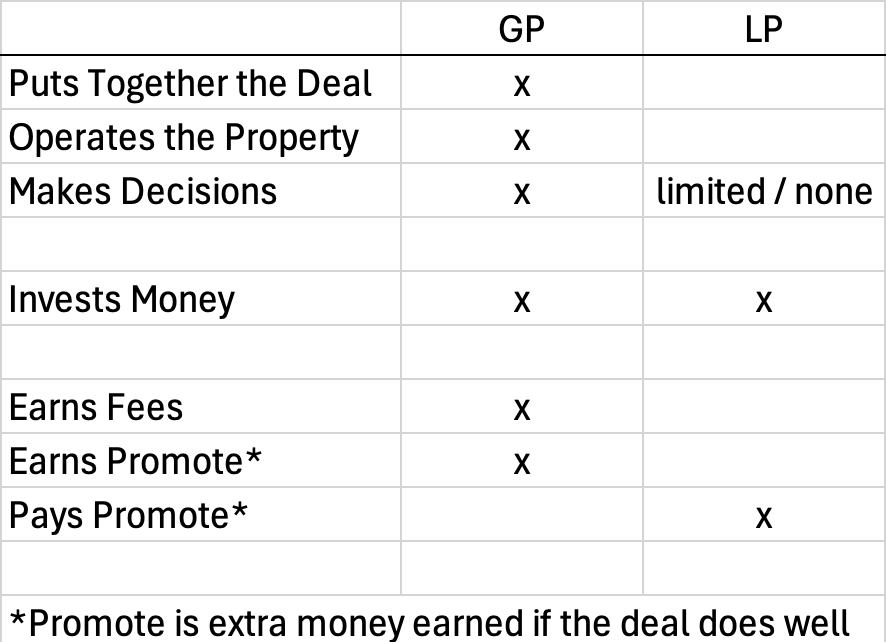
Table 1: GP vs. LP
Let’s break this down.
Putting the Deal Together
The GP runs the deal from start to finish, starting with finding a property to acquire. They lead all the steps outlined in The Acquisition Process series starting with Finding Your First Real Estate Deal.
It is not fast or easy. Time, money, and the GP’s reputation are at risk at every step of the way.
Operating the Property & Making Decisions
Once the deal is closed, the GP operates the property and executes the business plan.
Things rarely go as planned.
Things break. Tenants default on their leases. The economy gets better or worse.
The GP is the one who is always thinking and acting like the owner.
The GP has to work through it all, making most of the decisions from leasing to capital expenditures to building the right team to refinancing and to selling the property.
Pro Tip: sometimes the LP has limited approval rights. We will get into these in the next section.
Investing Money
Both the LP and the GP invest money in the property. For example, the GP might invest 5% of the equity and the LP(s) would invest the remaining 95%. Note that in many cases there are multiple LPs who collectively invest the 95%.
Earning Fees & Promote
As the GP does all the work, they are the only one who earns fees. They also have the potential to earn promote: extra money beyond their percentage share if the deal does well. The extra money for the GP comes out of the LP’s share. We will get more into the promote later in the newsletter.
All of this should start to paint the picture of how the roles and earning potentials of the GP and LP differ.
Responsibilities & Rights
The GP is the one doing (and getting paid for) all the work. They have full responsibility for the success or failure of the deal. Yes, there are many things outside of their control, but the GP is the one on the front line of executing the business plan.
That is not to say the LP doesn’t have any rights. Here is a list of approval rights that the LP might have:
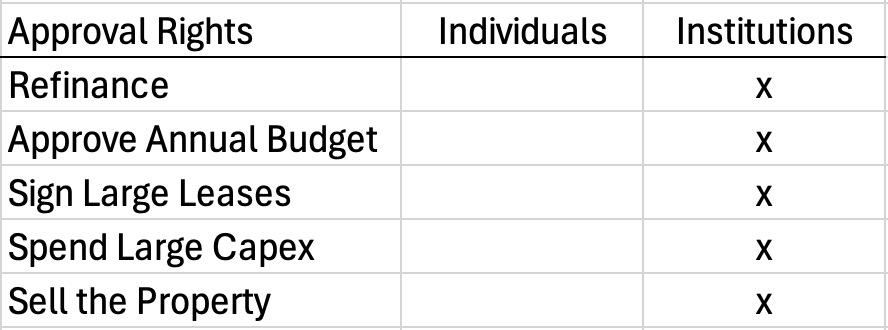
Table 2: LP Approval Rights
The table above adds in another layer to this discussion: the difference between individual investors and institutional investors.
Individual investors are people like me and you. We might invest $10,000 to $100,000+ in a deal with a GP. There could be 1-30+ of us investing together in a single deal operated by a single GP.
Institutional investors are private equity firms, pension funds, insurance companies, and university endowments. They write much bigger checks in each deal or fund (example: $10 million to $500+ million).
As the table above shows us, individual investors don’t really have any approval rights. The GP has broad discretion to operate the property as they see fit.
Very Important Note: one of the biggest negatives of being an LP investor without any decision making rights is you have no control over liquidity. None. Need your money out so you can buy a car or repair your home? Too bad. The GP is the one who controls when the property will be sold or refinanced.
Pro Tip: there are exceptions to this lack of control for individual LP investors. Specifically, if you are a very large (or the only) individual LP investor in a deal, you may be able to negotiate some approval rights.
Institutional investors have many rights. I only listed the big 5 in the table above.
Logistically, these approval rights require the GP to get the LP’s written approval to do certain things. GPs and LPs don’t always agree on everything. Even when they do, this adds a layer of logistical friction to the GP’s ability to operate the property.
Regardless of whether the GP has individual or institutional investors, there will be a joint venture (aka partnership) agreement that documents all of this. You can review and download an example in the Downloads & Deep Dives section of my website under Equity and Joint Venture Agreements.
Fees
In case I haven’t been clear enough, let me reiterate:
Being a GP is much more work than being an LP.
As an individual LP, you can be a complete vegetable while the GP does all the work. You could literally disappear into a mountain cabin without cell service once you have written your equity check.
The GP is the one sweating it out day-to-day, not only doing the work but also taking on the stress of the ups and downs of the property.
So why be the GP? Two reasons:
Earning Potential: you can earn more money than the LP in the form of fees and promote.
Mindset: if you are wired to want control, this will better suit your temperament.
Let’s start with fees. Here is a list of fees the GP might earn:
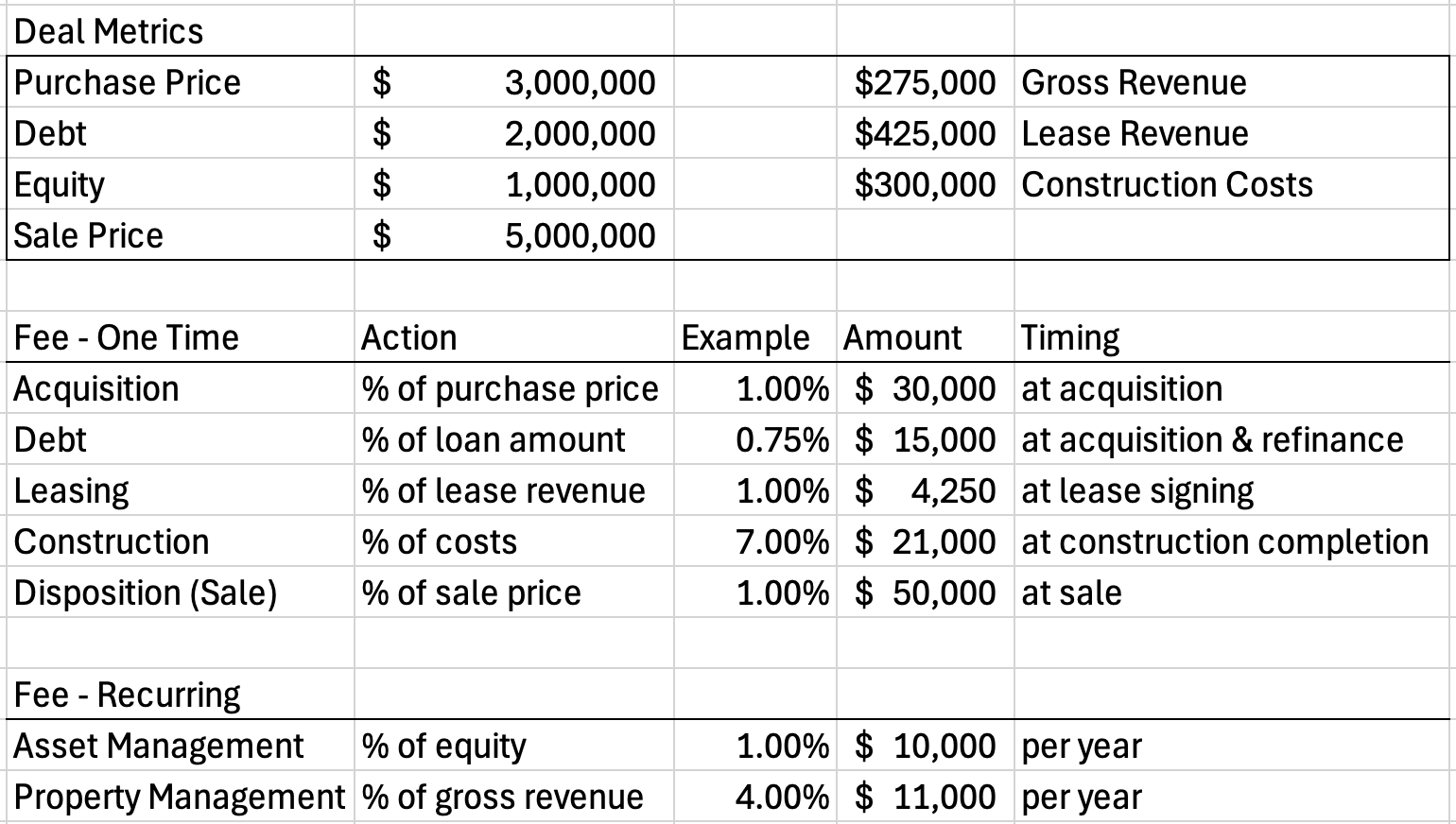
Table 3: Potential GP Fees
The top section includes one time fees tied to specific events. Example: $30,000 acquisition fee for acquiring the property (1% x $3,000,000 purchase price).
Other fees are paid on a recurring basis. Example: $10,000 per year asset management fee (paid monthly or quarterly) for operating the property and executing the business plan (1% x $1,000,000 equity).
Important Note: fees are paid by the property to the GP. Because they are paid by the property, all equity investors are effectively paying the fees because the property returns are diluted by the cost of these fees. Said another way, even the returns of the GP’s 5% investment are diluted by the fees.
But…the GP is the only one who can earn promote.
Pro Tip: the fees in the table above are just examples. Every GP will (try to) charge different types and amounts of fees.
Promote
Promote is the ability for the GP to earn a higher percentage of the total profits than the percentage of their original equity investment if the deal does well. Here’s an example:
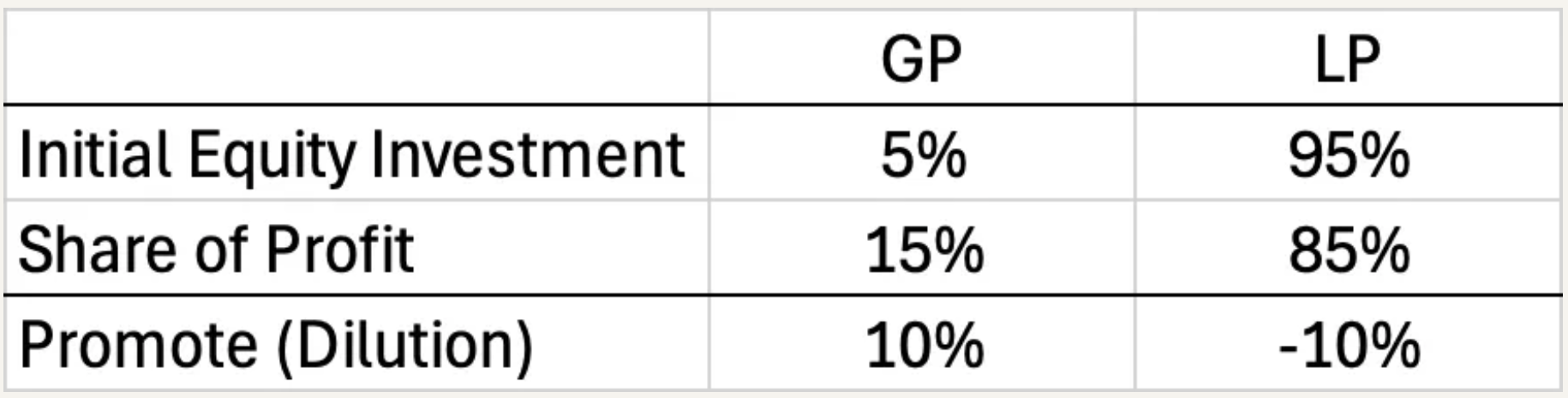
Table 4: Simplified Promote Example
Keep in mind that the example above is an oversimplification to teach the theory. Behind the scenes there will be math done in excel and language in the joint venture agreement that says the GP will earn a certain percentage of the returns over an internal rate of return (IRR) threshold. Example 20% over an 8% IRR.
Don’t worry about this for now. We will do an example next week.
For now just digest the concept that the GP has the potential, not the guarantee, to earn extra money if, and only if, the deal does well.
Pro Tip: there is the risk of misalignment of interest between the GP and LP relative to fees and promotes. Watch out for fee heavy deals where the GP may be motivated to hold the property long-term for the fees, especially if there is little promote.
Why I Do Both
By now you may be falling into two different camps:
GP: you like the earning potential of being a GP and are excited about being front line with the real estate.
LP: being a GP sounds like a lot of work that you don’t have the time or inclination for. The LP route sounds good to you.
Both camps are right.
I have done about half of my 60+ investments as a GP and half as an LP. Here’s why I believe both are good options for your investment portfolio.
The Argument for Investing As a GP
Being a GP Teaches You More: there is no better teacher than running your own deal as a GP. You will miss most of this learning as an LP.
Being a GP Increases Your Earning Potential: fees and promote can be meaningful over time and a path to turbocharge your limited equity capital.
Being a GP Gives You Control: you control not only the business plan and sale timing, but also when money is distributed from cash flow. Said another way, you are the one who controls liquidity.
The Argument for Investing As an LP
It’s Totally Passive: write your check and then you are done. This a great fit if you don’t have much time or interest in managing a property. Being a GP includes running the property AND working with the LPs, some of whom will constantly call you for updates and give you their opinion.
Being a GP Is Stressful: the pressure is on you. LPs rightly (and wrongly) point the finger at the GP when things go wrong.
Fees & Promotes Are Normal: are you a stock investor? If so, then be aware that your returns are reduced by the high salaries and stock paid to the CEO and senior executives. Being a real estate LP investor is the same thing. That is the way investing works.
Diversification Is Easier as an LP: even if you are a GP or work for a GP, you will probably have an asset class you specialize in (example: apartments). Investing as an LP can allow you to diversify into other asset classes (example: industrial or retail).
Pro Tip: How To Be a GP Without Taking On As Much Risk
There is a way to “hack” the system: work for a GP.
Find a real estate company where you can invest as a GP while still earning a salary and bonus. Not every company offers this, but many do. You get the best of all worlds:
Security of salary and bonus.
Learn from the expertise of the founders and senior executives.
Participation in the promote once you have been there long enough.
Don’t expect to be able to participate in the promote from day 1. Play the long game by joining a good company and working your way up.
Closing Thoughts
Again, there is no single right approach.
As I discussed in The Risk-Return Spectrum: Choosing Your Real Estate Investment Strategy, my real estate investing over the past 20+ years has had two main stages:
GP Investing Through Employer: I spent most of my career with a GP focused on industrial. By joining an established firm with leaders who understood industrial, I was able to get paid to learn. I executed 100+ business plans, earned a salary and bonus, and participated in the promote after I had been there for years.
LP Investing: In 2015, I started making LP investments with a multifamily GP focused on generating consistent cash flow distributions. The LP investing gave me diversification in terms of both asset class (multifamily) and investor returns (cash flow, not just equity multiples).
It is important to keep in mind that there are trade-offs in being a GP and an LP investor. Neither is better than the other.
Take the time to understand yourself: your time, your demeanor, your goals.
Then evaluate these criteria against the trade-offs.
There is a real estate investing path for everyone.
You will find yours.