Case Study 3: When the Market Bails You Out
Investing $90,000 in an industrial building
Our case study series continues today with an investment in an industrial building in Fort Worth, Texas.
This is our third case study. Here’s a quick review of our first two:
Duplex: you diligently followed the principles I presented in the previous newsletters. The market and the economy were steady over your investment period. Everything went smoothly.
Fourplex: you were in a 1031 tax deferred exchange, so cut some corners to acquire your next property. This led to some unplanned capex costs. Then the leasing market slowed down. The net result was that your equity value was flat for your four year hold period (i.e. you didn’t make any money beyond your annual cash flow).
With these two case studies, I am demonstrating that some things are within your control and some things are outside of your control.
Today I am going to discuss an investment where you screw up some of the things within your control, but manage to hit a home run based on things outside of your control.
Luck was on your side.
As with the last two weeks, we will follow a consistent format:
The Target Niche
The Acquisition
The Operating Years
The Sale or Refinance
Enjoy this one. Having the wind at your back is a lot of fun!
Let’s dig in.
The Target Niche
You live in Dallas and have seen the Dallas Fort Worth area continue to grow. You have a full-time job, so want to find an investment that is relatively passive.
You talk with other investors and create your niche:
Asset Class: Industrial
Geography: Fort Worth, Texas
Strategy: Very Light Rehab
Key Takeaways:
Industrial is one of the easiest and most passive asset classes to operate. The tenants take care of the maintenance inside their suites and often pay 100% of the operating expenses as additional rent. This is known as a triple net (aka NNN) lease. The leases are generally 1-5 years long, vs. 6-12 months for residential and multifamily.
You have the benefit of investing in a property that you can drive to.
You have a niche that suits your limited time availability.
The Acquisition
You get a referral for a broker from another investor you trust. You have a call with the local broker and describe your niche.
Over the course of 60 days, you look at 15 properties for sale. You are starting to learn the market by following the key steps to finding your first deal.
In month three you see a property for sale that is a little better than the rest.
This is the one to pursue.
You have the broker write up an offer for you and, after a few rounds of negotiation, you come to an agreement on price and other deal terms with the seller. The property is 40 years old and 100% leased to two tenants for multiple years. Here are the financial details:
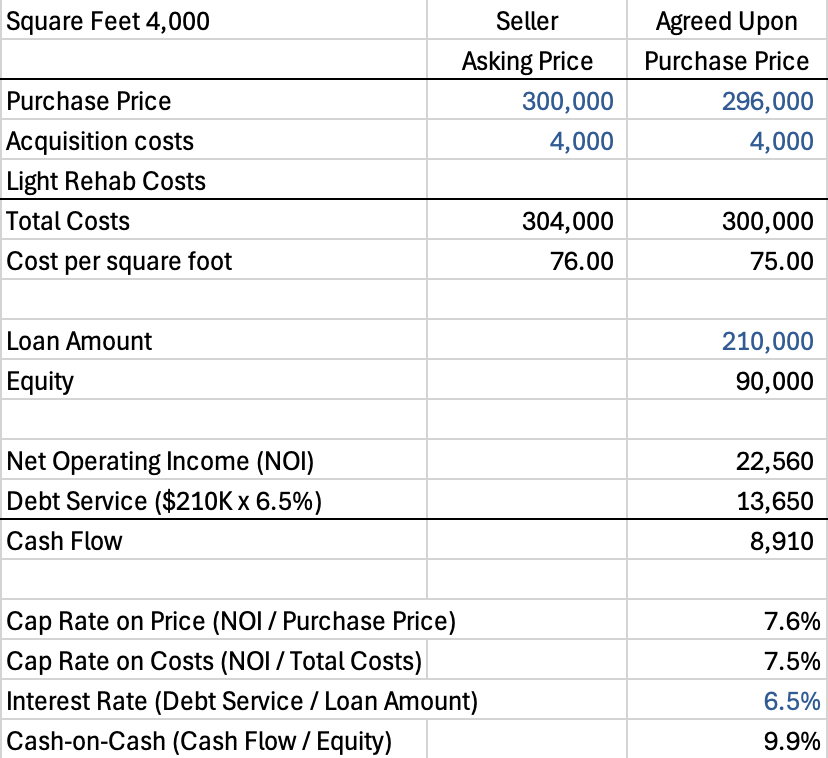
Table 1: Acquisition Financials
What does this tell us?
Equity & Debt
You were able to negotiate the purchase price down to $296,000 from $300,000.
You believe you can get a loan for $210,000 (70% of $300,000 total costs).
Your equity required at time of purchase will be $90,000.
Financial Return Projections
Your cap rate on cost is 7.5% and your interest rate is 6.5%.
You have positive leverage (7.5% > 6.5%) giving you a cash-on-cash return of 9.9% at time of purchase.
You don’t have any plans to materially increase the rent beyond 3% per year. You view this as a relatively passive investment that will give you steady cash flow.
You use a purchase and sale agreement template and hire local vendors to perform your due diligence. The local broker refers you to a debt broker who helps you get a loan in line with your projections.
The due diligence did not uncover any significant deferred maintenance items.
Key Takeaways:
Get to Know the Market: talk with a local broker and tour the market with them.
Be Patient: it is only by looking at many deals that you start to have a sense of the market and the deal that looks better than the rest.
Build a Team: having a (local) team that can help you is critical. You want a team that does each function regularly as they know the pitfalls.
The Operating Years
Initial Onboarding
The initial onboarding goes smoothly because you used the local property management and accounting team referred to you by your broker.
Year 1 - Smooth Sailing
All goes well in year 1.
Industrial turns out to be relatively easy to operate. The property manager handles the small number of tenant issues. Everything goes as planned.
You visit the property once a month, but soon cut this back to once a quarter as there is really nothing to do.
Year 2 - You Start Paying Less Attention to the Investment
Things went so smooth in year 1, that you start to lose focus on the property.
The money keeps coming in, so you focus your attention on other things. You successfully earn a promotion at your job, which means you take on a team of direct reports. This requires more hours and attention at work.
You are so busy that you are not paying much attention to the emails from your property manager asking how you want to handle the pending vacancy in unit 1 coming up at the end of year 2.
Year 3 - Unit 1 is Vacant
The end of year 2 comes around and the tenant in unit 1 vacates.
You have no real plan.
You drive out to the property on a Saturday and walk the unit. You can’t decide how you want to fix it up: paint? lighting? new carpet in the small office area? new roll-up doors?
You send an unorganized and confusing list of items to your property manager and ask them to get three bids from contractors to do the work.
Your lack of clarity with the construction scope results in contractor bids that are all over the place.
You are distracted and unorganized all year and don’t make any decisions on how to fix up the space.
To make matters worse, the tenant in unit 2 is vacating at the end of the year.
Year 4 - The Market Bails You Out
The only good thing you did at the end of year 3 was re-engage with the local broker.
He has great news for you.
While you were spinning your wheels trying to decide how to fix up the units, market rents have grown significantly. They were $0.47 per square foot (psf) per month when you bought the property. By the end of year 3, they are $0.64 psf/month.
The broker is able to lease both units at the new market rent on an “as-is” basis — you did not need to fix up the interior of the units nor give any free rent because the market was so strong. Your only leasing cost was a $5,700 commission paid to the broker: 6% of the total base rent for the two 3-year leases.
Four Year Financial Summary
Here’s a table that summarizes it all:
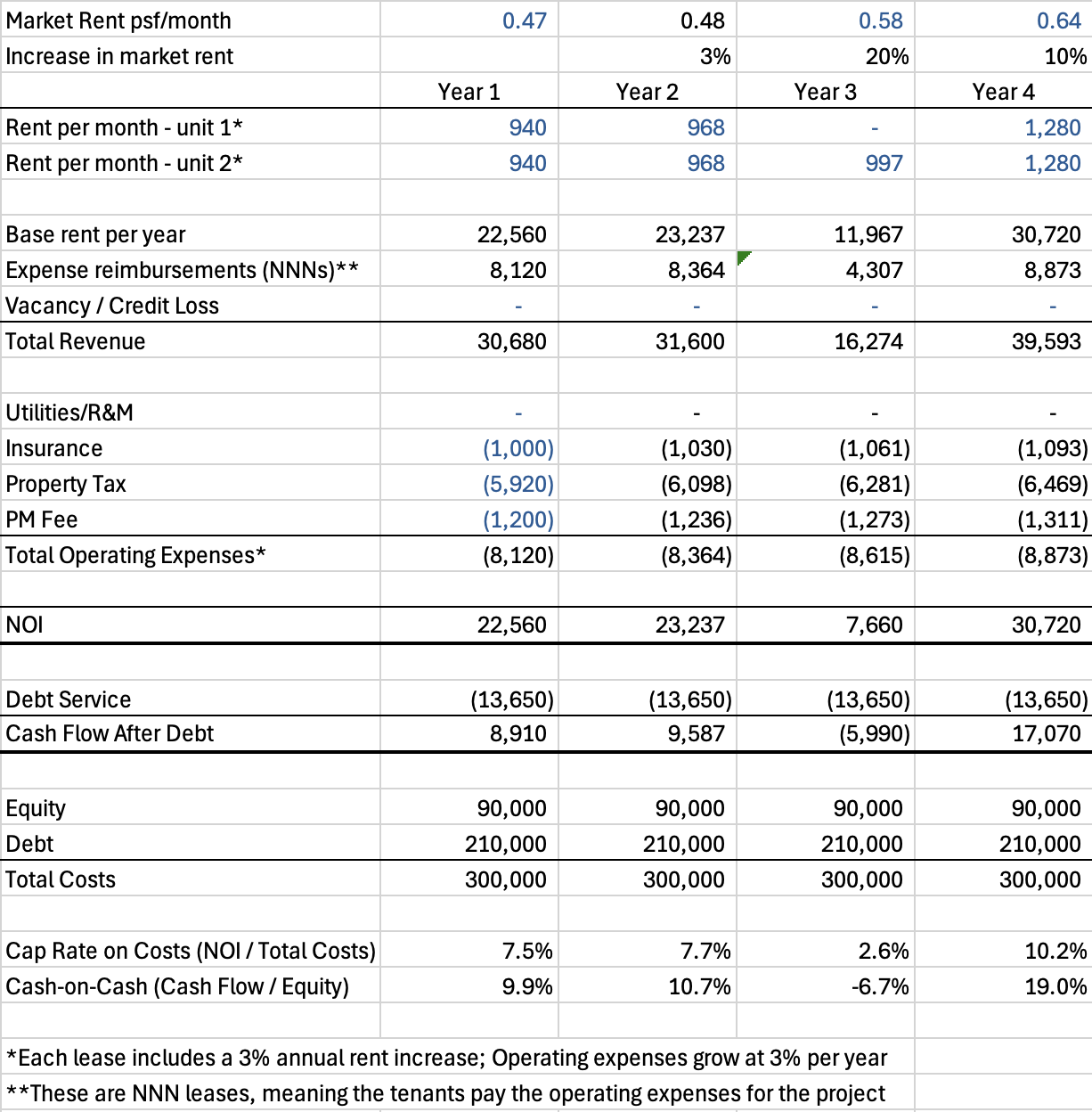
Table 2: Operational Summary
Key Takeaways:
You Lost Focus: commercial properties (industrial, retail, and office) tend to have leases that are 1-5+ years long. This can mean there are extended periods of time where there is nothing to do. This is both positive and negative. The positive is that it can be quite passive. The negative is that you can lose focus and not address upcoming items that need your attention (ex. tenant lease expirations). This is what happened to you.
The Cash Flow Suffered: your lack of focus resulted in a full year of vacancy and $1,683 of negative cash flow in year 3. Not only did you lose the base rent for unit 1, but you also lost their share of the expense reimbursements revenue (aka the NNN revenue).
You Were Unorganized: one of the most critical aspects of managing commercial properties is preparing units for the next tenant when they are vacant. This could be as simple as a deep clean or as extensive as major construction work. Pro Tip: involve your local broker BEFORE the unit is vacant. You want their guidance on how to fix up the space. They are the experts.
You Were Sloppy With the Contractors: giving a contractor unorganized information to give you a pricing bid for construction work wastes everyone’s time and does not give you an accurate price estimate.
The Leasing Market Saved You: despite your many blunders, the leasing market was on fire — with market rents increasing over 35% since you acquired the property (from $0.47 psf/month to $0.64 psf/month). You had no control over this and would not have been aware of the increase if you hadn’t re-engaged with your local broker. You got lucky.
The Sale or Refinance
With the increase in market rents, more investors want to buy industrial properties in Fort Worth.
Your broker believes you can sell it for an 7.00% cap rate on the $30,720 of annual NOI for just over $438,000. See below for the calculations:
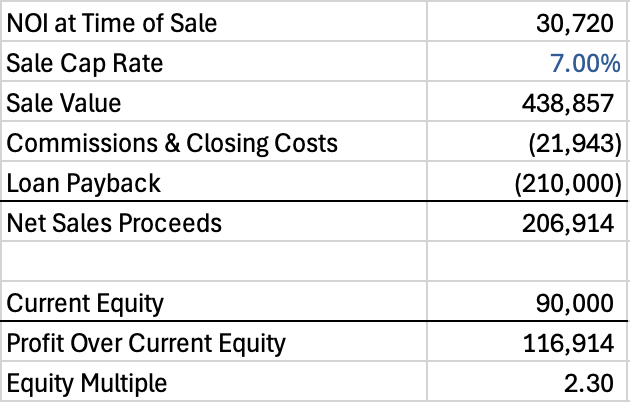
Table 3: Sale Projections
Over the next 90 days, you work with the broker to market and successfully sell the property for just under $438,000, in line with the broker’s projection.
As investor demand was so strong, it was a quick and smooth sale.
This nets you $206,914 vs. your equity invested of $90,000 giving you a before tax profit of $116,914 and a 2.3 equity multiple. Note that this equity multiple counts sales proceeds only. A full return picture would also include any cash flow distributions from the property.
Boom!! Crushed it!
Key Takeaways
Higher NOI = Higher Value: the rents increased significantly, growing from $0.47 psf/month to $0.64 psf/month. This increased your NOI significantly.
Cap Rates Move: cap rates are always changing. You bought the property for a 7.5% cap rate on total costs and sold it for a 7.0% cap rate.
Higher NOI + Lower Cap Rate = Turbo Charged Sale Value: see below for a summary of how your value would have been different if (i) rents had not grown and/or (ii) the sale cap rate had not decreased. What a difference!
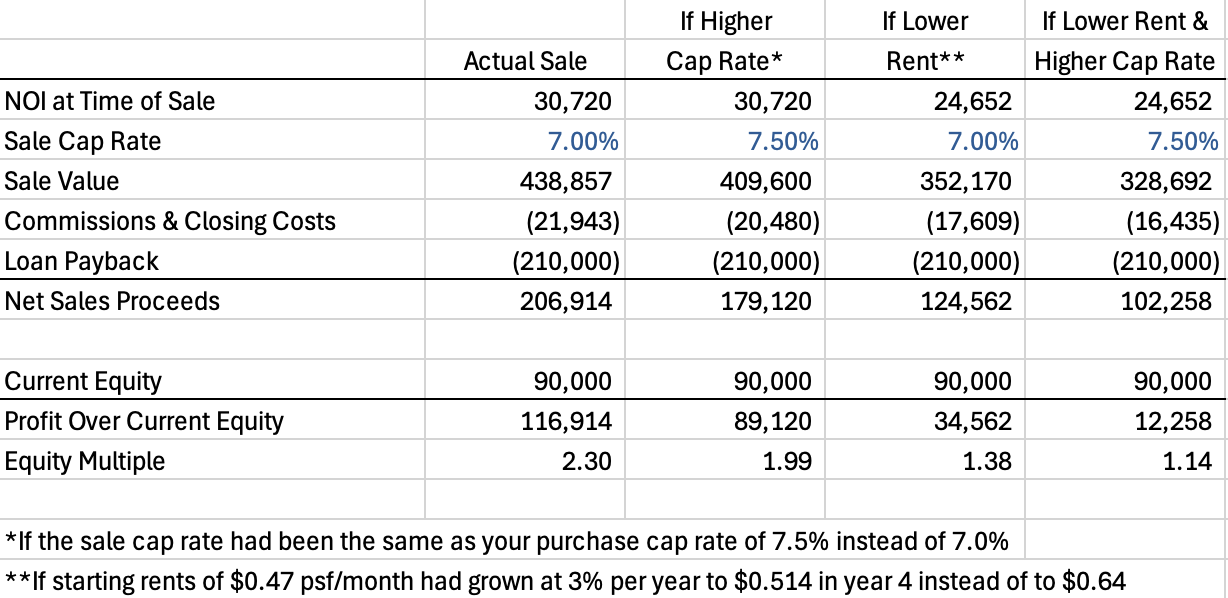
Table 4: Effect of Changes in Market Rent and Cap Rate on Sale Value
Take the time to really look at the “Profit Over Current Equity” and “Equity Multiple” in each column.
It is the combination of increased NOI (through increased market rent) and lower cap rate that really drives up the sale value.
A Note on the Refinance Option
In this case you chose to sell the property. You could have instead pursued a cash-out refinance. Assuming you could get 70% of the market value in refinance proceeds, you would have pulled out over $300,000: 70% x $438,000 = $306,600 before refinancing fees and costs.
This is $96,000 more than your existing $210,000 loan. Said another way, you would get back all your $90,000 original equity and still own the property. Just remember, there are also downsides to a cash-out refinance.
Closing Thoughts
This is an example of a deal where the outcome was much more impacted by things outside of your control than within your control.
You Were Unorganized: you were slow to react to the upcoming vacancies. You didn’t have a clear plan to clean up the units. You wasted the contractors time and got unreliable bids. You didn’t involve the broker early enough.
You Finally Re-Engaged With the Broker: you took your time, but you were smart enough to eventually engage with the leasing expert — the local broker. Better late than never.
The Market Saved You: the combination of increased market rents and the lower cap rate resulted in a big increase in value and a very successful sale.
So how do you do this again?
That’s tough to pull off.
Many investors believe they can time the market and/or improve a property so much that the next investor will pay a low cap rate for the property.
Some are able to achieve this, but very few can achieve it consistently.
The investors that achieve this tend to be vocal and their deals actively talked about. The deals where the market moved against the investor tend to be the ones you hear less about.
The key is to make investments that are not dependent on major rent growth or cap rate compression.
You want a deal that works based on current market conditions.
Don’t count on luck, but enjoy it when it happens.