Case Study 4: Fix & Flip — The Easy Path to a Quick Profit?
Investing $130,000 in a fix & flip
Our case study series continues today with a fix & flip investment in a 2-bedroom home in Tempe, Arizona.
This is our fourth case study. Here’s a quick review of our first three:
Duplex: you diligently followed the principles I presented in the previous newsletters. The market and the economy were steady over your investment period. Everything went smoothly.
Fourplex: you were in a 1031 tax deferred exchange, so cut some corners to acquire your next property. This led to some unplanned capex costs. Then the leasing market slowed down. The net result was that your equity value was flat for your four year hold period (i.e. you didn’t make any money beyond your annual cash flow).
Industrial: you invested $90,000 in an industrial building. Things were easy due to the longer leases. You lost focus and were unorganized when the property needed your attention most. But the leasing market saved you and it ended up being a great deal, despite your stumbling efforts.
These three case studies showed a variety of outcomes impacted by factors both within and outside of your control.
Today I am going to wrap up the case study series with a fix & flip. Fix & flips are as they sound: you buy a vacant property with the intent of fixing it up and then immediately selling it.
As it is vacant, there is no income nor leases. These are speculative deals sold to future homeowners.
As with the last three weeks, we will follow a consistent format:
The Target Niche
The Acquisition
The Rehab Period
The Sale or Refinance
Let’s dig in.
The Target Niche
You live in Phoenix, AZ and sell software for a living. You have listened to two of your colleagues talk about their side hustle: fix & flips of homes in Tempe, AZ.
Here is the formula:
Buy a vacant home. It should be old and a little beat up, but in a good neighborhood. Ideally, the other houses are nicer and more expensive.
Fix up the home with a rehab that focuses on making it look consistent with the nicer properties in the neighborhood. This could include paint (interior and exterior), flooring, kitchens, bathrooms, and landscaping. See The Many Ways You Can Add Value to Your Real Estate Investment for further details.
Sell the home at a similar sales price to the nicer buildings in the neighborhood for a quick profit in 12 months or less.
You recently had one of your best software sales of your career so have money to invest. You are ready to give it a try.
You define your niche:
Asset Class: Single family home
Geography: Tempe, AZ
Strategy: Fix & Flip
Key Takeaways:
Don’t Reinvent the Wheel: learn from those who have “been there, done that”. Knowing (and trusting) someone who is already doing what you want to do.
Pick a Niche: without a niche, you will be looking at anything and everything.
The Acquisition
You spend more time learning the strategy from your colleagues and driving around Tempe. They turn you on to a local broker they have worked with and show you how to regularly check Zillow and other property listing sites.
You take your time waiting for the right deal. You are starting to learn the market by following the key steps.
Over the course of 90 days, you look at 40 properties for sale. You find your deal and come to an agreement on price ($293,500). Other nicer properties in the same area are selling for $450,000.
Here are the financial details:
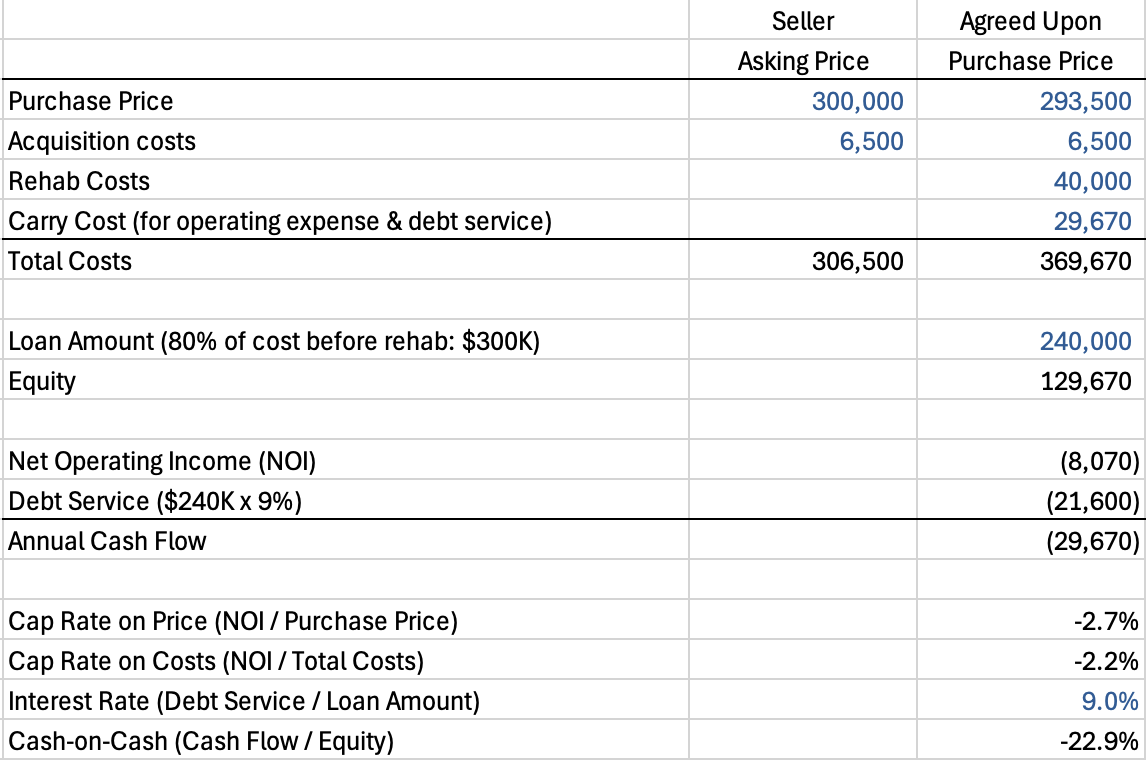
Table 1: Acquisition Financials
What does this tell us?
Equity & Debt
You were able to negotiate the purchase price down to $293,500 from $300,000.
You believe you can get a loan for $240,000 (80% of $300,000 cost before rehab). $300,000 is more than your purchase price but you believe the property will appraise at $300,000 and the lender will size the loan based on appraised value. Note that the lender will not be funding any percentage of the rehab costs or debt service. This will need to come out of equity (i.e. you).
Your interest rate is 9.0%, much higher than the first three case studies. Lenders are taking on more risk with a fix & flip because there is no revenue. It is not uncommon for them to charge a loan origination fee of 1-2% of the loan amount at time of acquisition and a loan payoff fee of 1-2% at time of sale. This is why the acquisition costs are more than the industrial case study of a similar purchase price.
Your equity required at time of purchase will be $60,000: $300,000 cost before rehab minus $240,000 loan = $60,000. Your total equity required will grow to almost $130,000 with your $40,000 rehab cost and $30,000 operating costs (negative NOI and debt costs).
Financial Return Projections
Your cap rate on cost is negative. There is no revenue, so the NOI is negative. Cap rates are not a relevant metric in fix & flips.
Your total costs after rehab and carry costs will be just under $370,000. This leaves a good amount of room for profit if you can sell it for $450,000 after rehab, in line with the nicer properties in the neighborhood.
As I described in the first three case studies, you use a purchase and sale agreement template and hire local vendors to perform your due diligence. The local broker refers you to a debt broker who helps you get a loan in line with your projections.
One of the most critical aspects of a fix & flip is that you want to get a good handle on your rehab costs before you buy the property.
Why is this so important?
Because a fix & flip only works if you keep your total costs below what you think you can sell it for after rehab. Under pricing your rehab costs will directly reduce your profit.
Make sure you use the due diligence period to get in contractors to accurately price out the rehab costs.
Key Takeaways:
Get to Know the Market: talk with a local broker and tour the market with them.
Be Patient: it is only by looking at many deals that you start to have a sense of the market and the deal that looks better than the rest.
Use Due Diligence to Price Out Your Rehab: Nailing down your rehab costs is critical. Cost overruns will directly eat into your profit. Follow the principles in Understanding the Critical Role of Contractors.
The Rehab Period
Time is your enemy with fix & flips. As there is no revenue to offset your operating and debt costs, you are burning money (and increasing your costs) every month.
Fortunately, you decided to work with the contractor your experienced colleagues had recommended. You involved them in the acquisition process and they were able to start the rehab work 1 month after closing.
The rehab goes smoothly.
The contractor has “been there, done that”. They knew what to look for during the acquisition so don’t come across any surprises.
You were candid with them, telling them this was a fix & flip. With this knowledge, they recommend (and you approve) a build quality that is appropriate for the strategy: reasonable quality that will look good. If you were going to live in the house, you might select higher quality, but this is fine for a fix & flip.
The rehab work is complete at the end of month 5.
Key Takeaways:
You Worked With a Good Contractor: this was key. The right contractor is essential for fix & flips.
You Made Reasonable Choices on Quality: you didn’t over improve the property. You recognized that this was not your home, but an investment.
Your Rehab Costs Were Accurate: they came in line with your acquisition budget.
The Sale
So far, so good. Everything is going according to plan.
As the construction is coming to completion, you reconnect with the local broker to talk about a sale. The broker likes what she sees and believes she can sell the property for $450,000.
Let’s go!!! You are pumped.
Here are the projections:
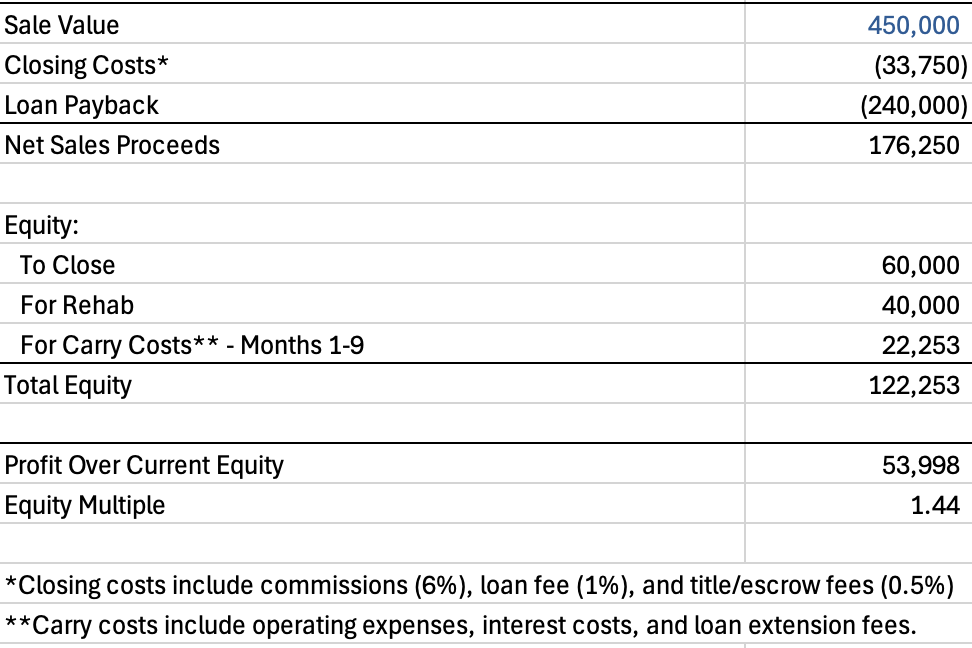
Table 2: Sale Projections
You are going to make a quick profit!
Your broker moves quickly. Note that the home sale process moves faster than investment properties. The marketing material is easier to produce as there are no cash flow projections. Home buyers normally close in 30 days, not the 60-90 days with investment properties.
You sell the property for $450,000 at the end of month 9, giving you a before tax profit of $53,998 — a 1.44 equity multiple on your $122,253 equity investment in just 9 months.
You are feeling like a successful real estate investor!
Is it always this easy?
No.
Let’s explore some other ways this could have gone. See below for a table of four different outcomes that could have happened.
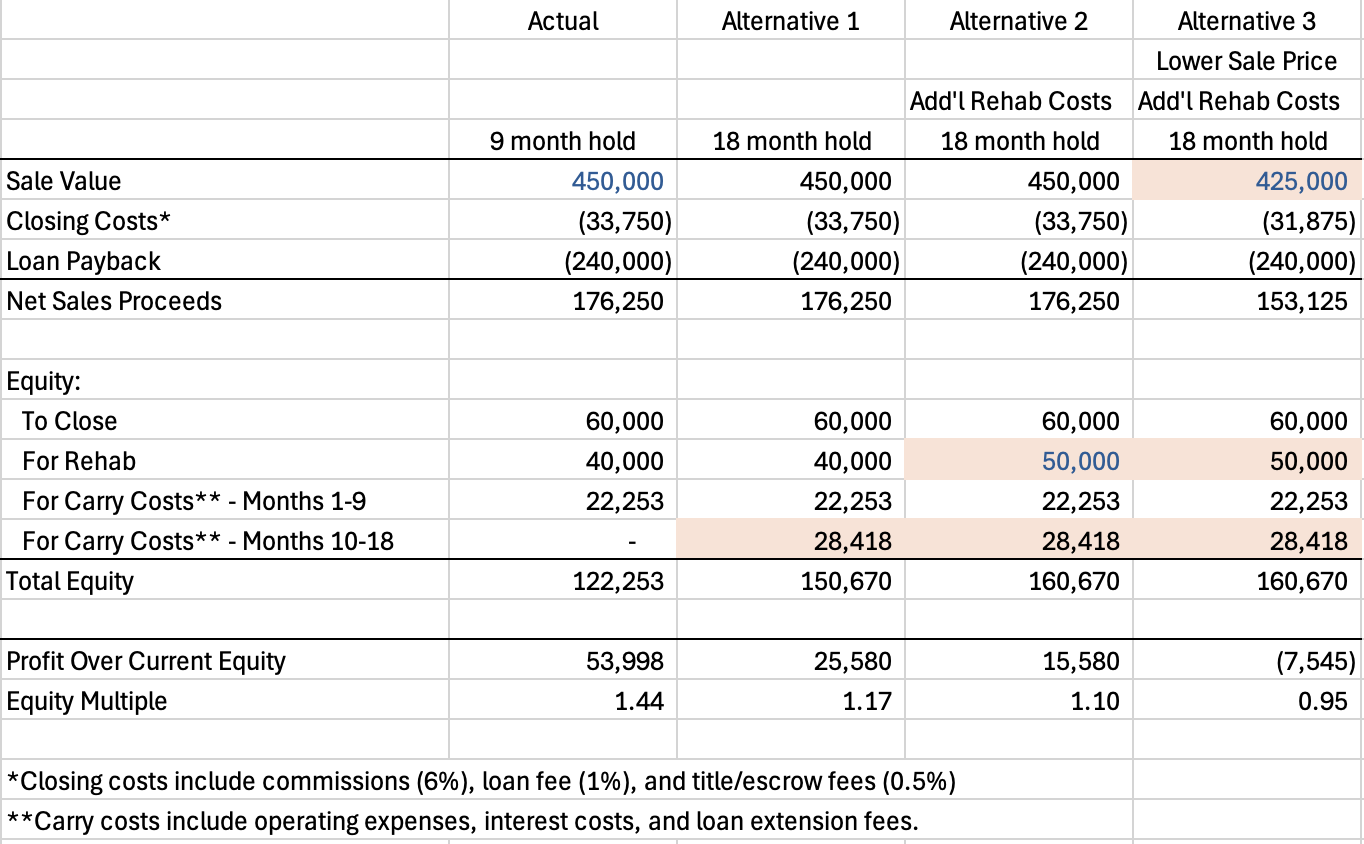
Table 3: Alternative Performance Outcomes
The table above shows how the outcome could have been significantly different. Let’s go through each one.
Alternative 1: 18 Month Hold Period
The rehab could have taken longer and the property could have taken longer to sell. Remember that there is no revenue. Each month you are paying operating expenses and interest costs. Another 9 months of holding the property will cost you $28,418, directly reducing your profit.
Lenders that loan on fix & flip properties typically give you a short-term loan. In this case, they gave you a one year loan with the ability to extend for 6 months at a fee of 2% of the loan amount: $4,800. In addition to operating expenses growing at 3%, this loan extension fee is why the second 9 months cost so much more than the first 9 months.
Alternative 2: 18 Month Hold Period & Additional Rehab Costs
Same scenario at alternative 1, but your rehab costs grow from $40,000 to $50,000. Again, this directly reduces your profit.
Alternative 3: 18 Month Hold Period, Additional Rehab Costs, & Lower Sale Price
Triple whammy. The sale price is not what you anticipated. You sell the property for $425,000, not $450,000. In this case, you don’t even break even.
Closing Thoughts
There are no shortage of stories of people who have made money on the fix & flip strategy. It is easy to think that they always go smoothly.
Unfortunately, the stories of those that have lost money are less prevalent. People tend to brag of their success while remaining quiet on their failures.
Here’s what to keep in mind:
Fix & Flips Are Different: in the other three case studies, we focused on properties that were leased to tenants. We based values on cap rates on the stabilized NOI. Fix & flips are vacant properties that are sold to homeowners. The valuation process is entirely different. The first three are investments. The fix & flip is someone’s home, making it much more of an emotional purchase.
Buy the Ugly Duckling With Potential: you want to buy a property in a good neighborhood that doesn’t look as nice as the other properties, but could with some cosmetic work.
Do the Research: accurately projecting your sale price is critical. Talk with multiple brokers. Tour properties for sale that are already listed at your target sale price. Watch what they actually sell for.
Time is Your Enemy: you want to complete your rehab and sell quickly. Each month you will be writing a check for operating expenses and interest costs. This directly reduces your profit.
Work With the Right Contractor: you need to estimate your construction costs right and move quickly. The right contractor will help you do this.
Pay Attention to Your Loan Terms: there are lenders that focus on fix & flip owners, but they are not cheap. Interest rates and fees will be higher and the loan duration (length) will be shorter. Read the loan documentscarefully.
Profits Are Before Tax: profits from a fix & flip investment will be treated as ordinary income. You don’t get the tax advantages of other investment properties. Make sure you look at your potential profits on a before and after tax basis.
The fix & flip strategy is not for the faint of heart.
Things can easily go wrong.
Be prepared to spend nights staring at the ceiling wondering why you got into this.
But…things can also go extremely well. It is one of the fastest ways to make money by being a real estate investor.
Go in eyes wide open, understanding both the risk and opportunity.
You may find it is a strategy that works for you.
Lessons From All Four Case Studies
We have covered four case studies with different outcomes. Here’s what they teach us about real estate investing.
Discipline Pays Off: following the steps in the process I have outlined in all the newsletters maximizes your chances of success.
Sloppiness (Usually) Leads to Failure: if you don’t maintain focus in executing your business plan, you will increase your chances of the deal going badly.
Luck Can Play a Material Role: you can’t control the economy, your tenants’ business success, or what your competitors do. Sometimes this will work for you. Sometimes it will work against you.
If being a real estate investor was easy, everyone would do it and investor returns would keep going down.
Recognize that it is an investment class that combines strategy, discipline, and operating performance.
This is what makes it so fascinating and rewarding.