How to Sell Your Property Without Leaving Money on the Table
The 7 steps of a sale — from picking a broker to picking a buyer — and why the highest offer isn’t always the best
Last week I introduced the concept of selling your property.
This is often the culmination of years of hard work, perseverance, and (hopefully) some luck.
You studied the investment fundamentals.
You took the time to pick your niche and build your team.
You reviewed many properties until you found the one with economics a little better than the rest.
You completed the acquisition and set yourself up for successful operations with your team.
You successfully executed your business plan and increased the net operating income.
Well done!
Now you are ready to reap the rewards by selling your property.
This week we are going to dive deep into the sale (aka disposition) process and unpack the key steps that will yield the best results including:
Understanding market and economic conditions.
Working with a broker.
Preparing your property for sale.
The marketing and bidding process.
Selecting a buyer.
Navigating the purchase and sale agreement, the due diligence process, and closing.
What to do with the sale proceeds.
Let’s dig in.
Understanding Market and Economic Conditions
One of the realities of owning real estate (and any other investment) is that there are two main things that affect value: (i) things you can control and (ii) things you cannot control.
Things you can control include the systems, processes, and actions you take to manage your property such as painting the building, selecting a broker, and how you treat your tenants.
Things you can’t control include everything else. Humbling, isn’t it?! Examples of things you can’t control include how the economy is doing, the policies politicians put into place, and whether your tenant can pay rent.
Understand and accept the difference between these two things and take advantage of the economic tailwinds when they are blowing in your direction.
If the economy is strong and buyers are paying high value for real estate like yours, this may motivate you to sell. On the other hand, if market conditions are poor, you may not want to sell until they recover.
A good broker will help you navigate this.
Working With a Broker
A good investment broker will be your main ally in the sale process. “Investment” brokers specialize in selling properties, as opposed to leasing them. However, there are many brokers that do both. The most important thing is to find one that regularly sells properties of your type (aka asset class) in your property’s market.
A good broker will:
Educate you on the market conditions.
Give you an estimate of what your property will sell for. This is known as a “broker opinion of value”. Values will mainly be based on cap rates as discussed in Cap Rates: The Simple Math of Real Estate Investing.
Advise you on how to prepare your property for sale.
Prepare marketing materials and run the sales and marketing process.
Help you select a buyer and navigate the closing process.
In exchange for all this critical work, you will pay them a sales commission when (and only when) the property sells. This commission will be between 1% and 6% depending on the value of the property. The smaller the property, the higher the commission. Here are two examples:
$1,000,000 property value at 6% commission rate = $60,000 commission.
$3,000,000 property value at 4% commission rate = $120,000 commission.
Commissions vary from market to market. Start by asking the broker what they think is fair and work from there. Once you come to an agreement, you will sign a broker listing agreement. This is just like a broker listing agreement for leasing I discussed previously, but modified for a sale. The broker will have a template to use.
Pro tip: talk with multiple brokers about selling your property before you select one. Getting multiple opinions of the market and value is extremely helpful. And remember, just because you talk with a broker doesn’t mean that you are committing to do anything. It is just a conversation at this point.
Preparing Your Property For Sale
Once you decide to sell and you select a broker, I highly recommend you follow their advice on how to prepare your property for sale. Here’s an example:
My company owned a 100% leased, 30-year-old industrial building in an excellent market. The only problem was that the building looked old. We followed the broker’s recommendation to (i) paint the building and (ii) re-coat and re-stripe the asphalt.
Wow! It looked almost brand new and made such a better first impression on buyers.
The result: our sale price increase far exceeded the money we spent on these two cosmetic upgrades.
The Marketing and Bidding Process
The first step the broker will take is to prepare the marketing materials which include a 1-4 page brochure and a 5-20 page offering memorandum (OM).
The brochure is the teaser that they will email out to their database of brokers and investors, as well as post to sale websites like CoStar and LoopNet. Interested buyers will then express interest and request an OM.
Most brokers will have potential buyers sign a confidentiality agreement before releasing the OM. This allows them to (i) register the potential buyer in their database for follow-up and (ii) legally require the potential buyer to keep non-public information confidential.
In a strong seller’s market where values are high, the broker may not list a sales price. They will run a bidding process with a group of buyers to maximize the price.
In a weaker seller’s market, the broker may list a sales price and react to offers as they come in.
It all depends on (i) the market conditions and (ii) the strategy you and your broker agree upon.
I have experienced successful sales as a seller using both strategies at different times. However, it is MUCH more thrilling as a seller to see a broker run a bidding process that drives up the sales price. Good brokers are masterful at this.
Selecting a Buyer
Selecting a buyer? This is just about picking the one with the highest price, right?
Yes and no.
Remember that an offer (aka a non-binding letter of intent) will include the price and other deal terms such as (i) the due diligence period, (ii) the closing date, (iii) whether there are extension options, and (iv) the deposit amounts.
Additionally, each buyer will have their own reputation based on previous purchases (if any) that the broker will share with you.
Here’s an example of three offers:
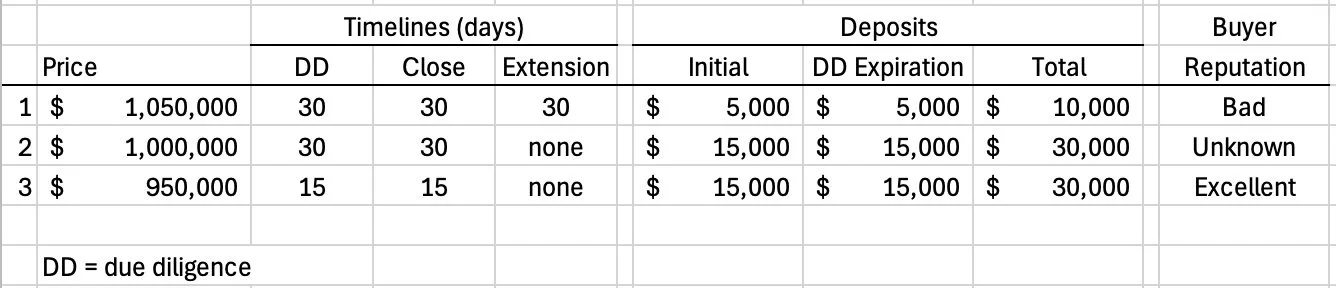
Table 1: Buyer Offer Sheet
You are faced with some trade-offs. The strongest price is from a buyer with a bad reputation (for not closing deals), the longest timeline, and the lowest deposit. The long timeline (30 + 30 + 30), the low deposit ($10,000 vs. $30,000), and the bad reputation are red flags. Be careful. You could spend 30-90 days with this buyer and end up with a dead deal.
The lowest price is from the buyer with the best reputation and timeline.
Who should you pick?
There is no right answer. Talk it through with your broker and make the best decision for you.
I have gone both routes in my investing career. My preference? If the price is close, I go with the buyer with the strong reputation. It is rough to spend 30-60 days with a buyer only to have the deal collapse at the last minute.
Pro tip: Watch out for “re-trades”. A re-trade is when a buyer tries to renegotiate the price down, typically because of an issue they find in due diligence. Sometimes this is warranted: the roof needs replacing immediately and you never disclosed this. Sometimes it is not: the buyer later decided their rent assumptions were wrong. Buyers typically develop bad reputations because they try to re-trade on each deal. If re-trades come up, lean on your broker to help you navigate a workable solution.
Navigating the Purchase & Sale Agreement, the Due Diligence Process, and Closing
Once you select a buyer, the process is very similar to the acquisition process I previously wrote about. I suggest you revisit:
But…there are two differences worth highlighting:
Due Diligence
As you prepare the due diligence for the buyer, make sure you look for potential red flags from a buyer’s perspective. Do this before or during the marketing process so that you have time to clean up any issues.
For example, I was once selling a property that had 8 years remaining on the roof warranty. As we prepared the due diligence, we couldn’t find the warranty document. We had to request this from the roof installer. They provided a copy, but it took a couple of weeks. No harm, no foul. But this would have been a stressful scramble if the buyer had found the problem in the last days of their due diligence process.
The lesson: review your files in advance of giving them to the buyer to address any gaps or red flags.
Lender Communication
As soon as you are considering selling the property, talk with your lender to confirm that you can sell it and what the loan payoff amount will be.
I was once selling a property and didn’t take this important step. The loan was set up such that if the loan was paid off at any day after the 1st of the month, the borrower (i.e. me) had to pay a full 30 days of interest. We closed on the 3rd, so had to pay for 27 extra days of interest.
Had I checked this in advance, I could have structured the sale to close on the 1st.
Learn from my mistake. Talk with your lender in advance of committing to sale terms and dates.
What To Do With the Sale Proceeds
A successful sale is the culmination of a successful investment. It is the “points on the board” of your hard work. Your profit is secured.
But…you will still need to pay taxes unless you complete a 1031 tax-deferred exchange as discussed in 5 Tax Advantages That Make Real Estate Investing So Powerful. I suggest you re-read the 1031 exchange section of that newsletter before you consider selling your property.
Here are two examples from my investing history:
Sell & 1031 Exchange
We successfully executed the business plan of a retail property. I didn’t need the cash and wanted to use the proceeds to invest in another property. I completed a 1031 exchange into another cash-flowing property.
Sell & Pay Long-Term Capital Gains
We successfully executed the business plan for an industrial property. I wanted to use the cash and was willing to pay the tax now.
Just remember that by completing a 1031 exchange, you are deferring (not eliminating) your tax to be paid in an uncertain date in the future. The economic conditions in the future are unknown. This is a future risk you are taking.
Closing Thoughts
Whether you decide to 1031 exchange or not, selling a property can be an excellent way to turn your hard work into cash.
The most important thing is to work with an investment broker who regularly sells properties similar to your property in your property’s market. They will know what the property is worth and who the likely buyers are.
Responding to a random offer you receive or trying to sell the property without a broker is like gambling: it may work out, but the odds are against you.
Be a professional.
Leverage the power of a good broker.
You got this.
You Improved the Property. Now How Do You Get Paid?
The three ways to turn a value-add into cash — and how to pick the one that fits your goals
We have covered a lot on executing your business plan over the last nine weeks.
I defined what it means to add value and discussed the many ways to do this.
I discussed the critical role of contractors and how to navigate construction contracts.
I then spent five newsletters breaking down leasing from a leasing overview to nailing your rent projections to understanding effective rent to reading leasing contracts to analyzing whether or not to renew a tenant.
Executing your business plan is a process. Early on I presented a formula for success:
Understand Your Goals + Focus + Talk with Experts + Budgeting + Develop a Game Plan = Setting the Property Up for Success
You then need to execute.
Today I will talk through what to do once you have successfully executed your business plan. Your hard work, patience, and perseverance have paid off. Maybe there was even a little luck along the way.
But here's the question most investors face next: how do you actually get your money out?
There are three main ways to do this:
Enjoy the cash flow.
Sell the property.
Cash out refinance.
Each way has its pros and cons. The decision of what to do depends on the goals you are trying to achieve, which may change over time.
Let’s dig in.
Your Real Estate Investment Example
Let’s create an example to use in explaining and evaluating the three ways to monetize your investment. The math will tie to my previous post: Cap Rates: The Simple Math of Real Estate Investing
Here’s the example:
A little over two years ago, you bought a property that was 100% leased to one tenant with two years left on the lease. The net operating income (NOI) at time of purchase was $10,000. [Reminder: NOI = revenue less operating expenses but before interest costs and capital expenditures.]
Your total cost to buy the property was $170,000 — a $165,000 purchase price plus $5,000 in closing costs. After securing a $110,000 loan with a 5.5% interest rate, your equity was $60,000.
$170,000 - $110,000 = $60,000
The property was old and in need of some cosmetic repairs. As it was fully leased when you bought it, you waited patiently until the lease expired to complete your light rehab.
You spent $30,000 to do a light rehab (paint, carpet) and paid a commission to a broker to find a new tenant. Because the loan amount is fixed, the $30,000 cost increased your equity (aka cash investment): $60,000 original equity + $30,000 light rehab and commissions = $90,000 total equity.
After the light rehab, you were able to increase the NOI to $15,000.
Here’s a summary table to help you keep track of everything.
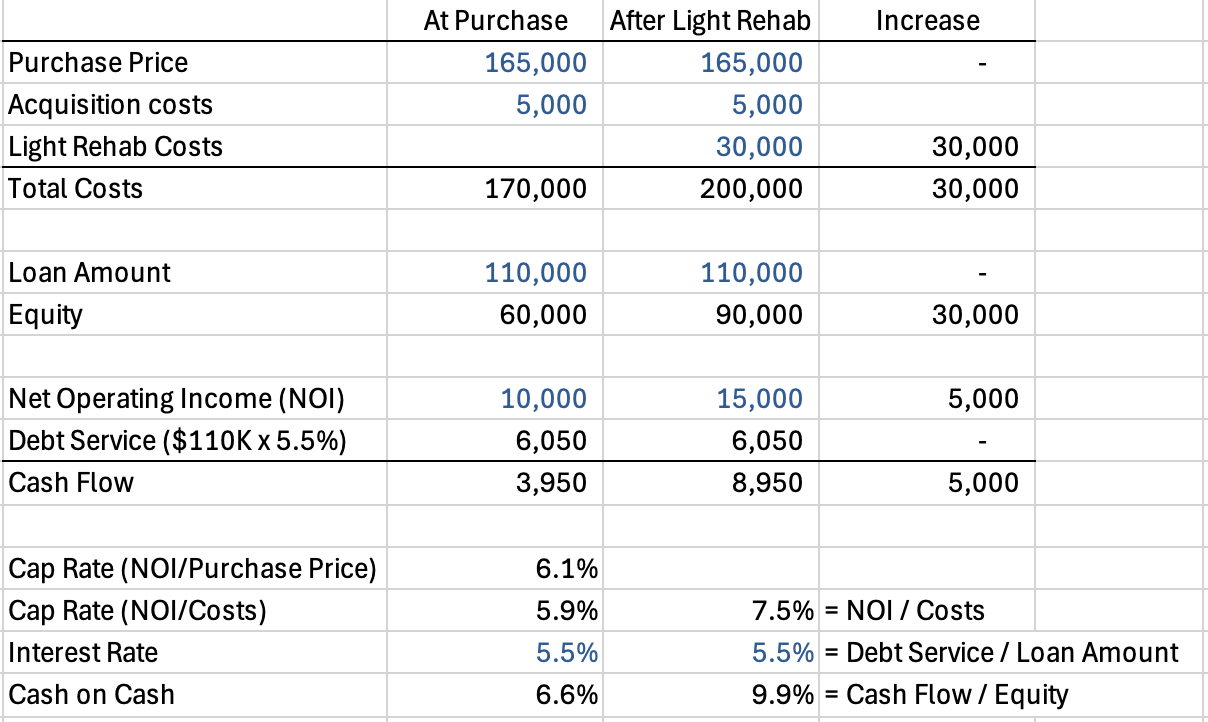
Table 1: Financial Impact of a Successful Business Plan Execution
Note that there are two ways to look at your cap rate.
Using purchase price (what you pay to buy the property): NOI / Purchase Price — $10,000 / $165,000 = 6.1%
Using total costs (your actual return on your cost basis): NOI / Total Costs — $10,000 / $170,000 = 5.9%
Neither is more accurate than the other. Each explains a way to look at your cap rate.
So what do these calculations tell us? Two main things:
#1) Cash Flow Increase
By spending a one-time cost of $30,000 for the light rehab and commissions, you went from $3,950 per year of cash flow to $8,950 per year. $30,000 to get $5,000 more per year? Well worth it.
#2) NOI Increase = Value Increase
You have increased the NOI. NOI is a key metric buyers and lenders use to value a property. To oversimplify a bit, the value of the property has increased.
Why is this oversimplifying?
Because cap rates can go up and down depending on overall market sentiment, independent of your individual property.
For this discussion, let’s assume they stayed fixed.
Monetizing Value
Now let’s get into the fun part. How do you turn your hard work into cash? Said another way, how do you “monetize” the increase in value?
Option 1: Enjoy the Cash Flow
The first way is the most straightforward and passive: do nothing and enjoy the increased cash flow.
The $8,950 cash flow per year after light rehab on your $90,000 of equity is a 9.9% annual cash-on-cash return. Much of it is shielded from tax by depreciation. See 5 Tax Advantages That Make Real Estate Investing So Powerful.
If you are a cash flow investor like I am, this may be the best fit for you.
Option 2: Sell the Property
Properties are typically sold based on a capitalization rate (cap rate). In this case you bought the property for a 6.1% cap rate: $10,000 NOI divided by $165,000 purchase price = 6.1%.
Let’s assume you can sell the property for the same 6.1% cap rate. $15,000 post light rehab NOI divided by 6.1% = $245,902.
This gives you a profit before commissions, closing costs, and income tax of $45,902. $245,902 - $200,000 total costs. Not a bad return in two years for your equity investment of $90,000.
If you are focused on increasing your total net worth as much as possible, this could be the path for you. You could consider a 1031 exchange to defer the taxes as I discussed in 5 Tax Advantages That Make Real Estate Investing So Powerful.
Option 3: Cash Out Refinance
Refinancing the property could be a way to have the best of both worlds.
The increase in NOI will likely allow you to put a bigger loan on the property. Your original loan of $110,000 was about 65% of total costs ($110,000 / $170,000 = 65%).
Using the same 65% on the new market value we calculated above ($245,902) would give you a new loan of just under $160,000. $245,902 x 65% = $159,836. This new loan amount is almost $50,000 more than your original loan.
Doing this is known as a “cash out refinance”. There is no tax on the $50,000. You could use it to invest in a new property.
But…you will have to pay back $50,000 more in debt when you eventually sell the property. This is additional risk you are taking on.
Important Caveat: Not all lenders will immediately give you a cash out refinance. Every situation is different so talk with multiple lenders.
Remember that your interest costs will go up and your cash flow will go down. If we assume the same 5.5% interest rate, your annual cash flow drops from $8,950 to $6,209.
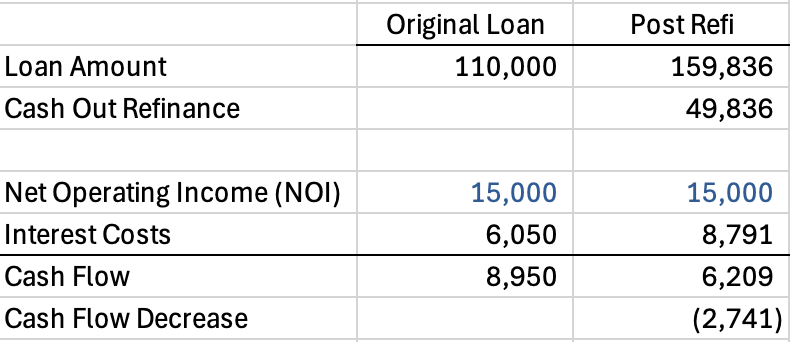
Table 2: Cash Out Refinance
You also have higher fixed expenses with the new interest costs. This gives you less cushion if you lose the tenant and/or the economy sours.
A cash out refinance is a good option for investors who want the best of both worlds (and are comfortable with higher fixed expenses): ongoing cash flow and additional money to invest in the next deal.
Sale vs Cash Out Refinance
In this example, the cash out refinance proceeds ($49,836) are more than the sales proceeds before closing costs and commissions ($45,902).
This is not always the case.
Interest rates and cap rates regularly move around depending on market conditions and market sentiment. If you are on the fence of which option is best for you, educate yourself by talking with brokers on market cap rates and lenders (or debt brokers) on loan options.
Pros and Cons
So let’s put it all together to see what the best fit for you is.
Enjoy the Cash Flow
Action: none; enjoy the additional cash flow.
Pros: passive; no further execution risk.
Cons: minimal current cash compared to a sale or cash out refinance.
Good for: investors focused on cash flow.
Sell The Property
Action: sell the property.
Pros: ability to unlock value and 1031 exchange into a new property to repeat the process of a new strategy on a new property.
Cons: execution risk on the sale; sale commission costs; tax exposure if no 1031 exchange.
Good for: investors focused on creating maximum wealth by buying, adding value, and then selling multiple properties over time. Buy > Add Value > Sell > Repeat
Cash Out Refinance
Action: refinance the property with a larger loan.
Pros: ability to unlock value without paying taxes and continue to benefit from (a reduced) cash flow; the proceeds from the cash out refinance could be used to buy a new property.
Cons: execution risk on the refinance; transaction costs of refinance; risk of having more debt and interest expense.
Good for: investors wanting to balance ongoing cash flow and ability to grow their real estate portfolio by buying new properties.
One additional very important note. This is a single tenant property. If you sell the property, you have eliminated any risk associated with the tenant vacating or defaulting. If you hold the property, whether for cash flow or through a refinance, the risk associated with the tenant stays with you. And a cash out refinance increases the risk because you have more debt you will need to pay back.
What Worked for Me
As with my investing strategy, my monetization strategy has changed over time.
Stage I (Years 1-10+): Buy > Add Value > Sell > Repeat
I was all about maximizing the power of the limited funds I had. The goal was to create value, sell a property, and invest it in a new one. This was an effective method to build wealth. I still have a number of investments that fit this strategy.
Stage II (Years 10+): Enjoy the Cash Flow & Cash Out Refinances
Once I had built wealth, or at least could see a path to that future with my existing investments, I started to be more focused on cash flow. I was able to build up a combination of assets under two strategies:
Cash Flow: I have one property that I own debt free. The strategy is focused on consistent cash flow.
Cash Out Refinance: Buy > Add Value > Cash Out Refinance > Repeat. The LP investments I have follow this strategy. I use the cash out refinances to buy more cash-flowing assets.
These stages have worked well together. I wouldn’t have been able to focus on cash flow investing without the capital I built up through selling properties.
Finding the Monetization Option That Fits You
Let’s think about what might work for you.
Situation A: Limited Capital, Long Time Horizon
This is likely your situation if you are early in your career. You are rich in time, energy, and health, but poor in money. You have a long time horizon for the power of compounding to go to work.
The buy > add value > sell > repeat is a path that could allow you to turn your limited funds into something more meaningful.
Situation B: Some Capital, Shorter Time Horizon
Maybe you are exploring real estate investing for the first time later in life. Your time horizon to retirement, or at least leaving a W-2 job, is shorter. You have worked hard and saved a decent amount of capital to invest.
In this case a combination of enjoying the cash flow and cash out refinances may be a better fit for you.
What is Right for You?
I have seen investors follow each of these paths successfully. It all depends on your available capital, time horizon, and goals.
Remember the fundamentals from the series on investment fundamentals: pick a nicheand choose your investment strategy.
Take the time to really think:
What are you trying to achieve?
What is your investment horizon?
How much time and money do you have today to work at this?
How much risk are you willing to take on while still having the ability to sleep well at night?
You can do this.